For businesses, the final stretch of the year is about more than closing the books.
It is also a time to recognise the people who helped make the year happen.
NetFlorist’s internal sales data shows that corporate gifting rises sharply from mid-October through December, as companies turn their attention to employees and clients ahead of the festive season.
During the 2025 year-end period, corporate gifting revenue increased by 45% compared with average sales for the rest of the year.
The data covers the period from 1 September 2025 to 31 August 2026.
The numbers tell an interesting story
Businesses are not necessarily spending the same amount on every recipient.
During the year-end period, companies spent an average of R850 on client gifts, compared with R250 on employee gifts.
Premium gifts for key clients and senior stakeholders exceeded R1,000.
Personalisation is also firmly part of the corporate gifting landscape.
Around 85% of NetFlorist’s corporate orders included a recipient’s name and/or company branding.
The result is a gifting market where scale, personalisation and timing all play a role.
Why the year-end rush matters
According to Ryan Bacher, co-founder and managing director of NetFlorist, the increase highlights just how concentrated corporate gifting becomes during the final weeks of the business calendar.
“From mid-October, corporate gifting shifts very quickly from occasional orders to planned year-end programmes.”
Businesses can find themselves buying for very different groups at the same time.
That might mean gifts for hundreds or even thousands of employees, alongside smaller groups of valued clients.
The scale can change dramatically. So can the type of gift.
Clients and employees receive different kinds of gifts
The difference between the average client and employee spend reflects the different scale and purpose of the gifting.
Client gifting generally involves smaller volumes and higher-value choices.
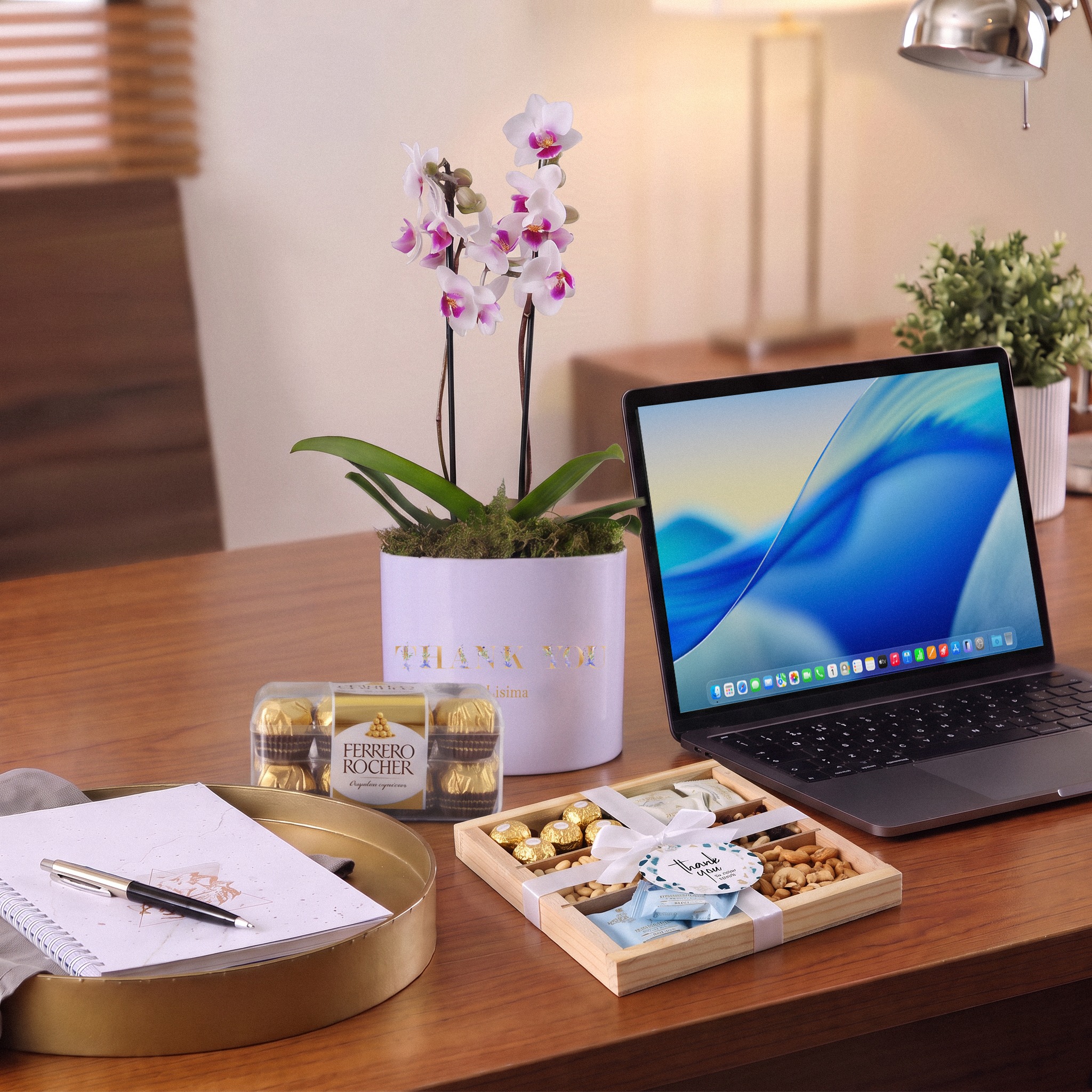
These include premium hampers, gourmet treats and personalised combinations.
Employee gifting tends to happen at much greater scale.
Popular choices include chocolates, mugs, water bottles, lunch bags and smaller gourmet or bath and body hampers.
Bacher says the difference in spending should not be interpreted as a difference in importance.
Employee programmes are generally much larger. Businesses therefore have to balance the cost per gift with the need to recognise a much bigger group.
One order demonstrates just how large these programmes can become.
NetFlorist’s largest corporate order to date comprised 4,500 branded snack tins for employees at a company in the automotive sector.
Planning can make all the difference
Large employee gifting programmes require more than simply choosing a product.
NetFlorist’s data shows that employee gifting programmes are typically booked four to six weeks in advance.
Individual corporate orders, by comparison, are typically placed one to two weeks in advance.
The additional time allows businesses to coordinate recipient lists, personalisation and delivery details.
That becomes particularly important when gifts have to reach employees across multiple locations.
As Bacher puts it, a business may place one order for thousands of employees, but each person experiences that gift individually.
The challenge is therefore managing the scale without making the recipient feel like another name on a distribution list.
Flowers remain the biggest corporate gifting category
NetFlorist’s 2026 corporate sales data to date also reveals what businesses are buying.
Flowers account for 41.4% of total corporate gifting spend, making them the company’s largest corporate gifting category.
They are followed by:
- Snacks — 18.4%
- Personalised gifts — 16.7%
- Chocolate & nougat — 7.2%
- Plants — 4.9%
- Alcohol — 4.3%
- Other — 3.8%
- Baby — 2.8%
- Stationery — 0.3%
- Apparel — 0.1%
Flowers, snacks and personalised gifts collectively account for 76.5% of NetFlorist’s corporate gifting spend.
The figures are based on NetFlorist internal sales data from 1 January to 1 September 2026.
Personalisation is changing the corporate gift
The product itself is only part of the story.
NetFlorist’s data shows that approximately 85% of its year-end corporate orders include some form of customisation, whether that means a recipient’s name or company branding.
That points to a clear role for personalisation in the corporate gifting process.
However, there is a balance to find.
Bacher says companies are increasingly looking for ways to maintain their brand identity without allowing the gift to feel like an advertisement.
“No one wants their year-end gift to feel like an advertisement.”
For larger employee programmes, branding remains popular, particularly on practical products that can create a sense of shared identity across a workforce.
The new challenge: gifting beyond the office
The rise of hybrid and geographically dispersed teams has added another layer to corporate gifting.
Where hundreds of gifts might once have been delivered to one office, businesses can now have employee gifting programmes involving individual deliveries to recipients across South Africa.
That makes planning increasingly important as the year-end rush approaches.
For Bacher, the starting point should not necessarily be the product or the logo.
Businesses should first consider what they want the recipient to take away from the gesture.
Once that is clear, the gift, message and delivery can work together to communicate it.
Year-end gifting is already in motion
The data paints a picture of a corporate gifting season that becomes increasingly active from mid-October through December.
Businesses are buying for clients and employees, but they are doing so in different ways.
Clients tend to receive higher-value gifts, while employee programmes operate at significantly larger volumes.
Personalisation is widespread. Flowers lead corporate spending. And large employee programmes require weeks of planning.
As South African businesses move towards the final stretch of the corporate calendar, the message from the data is straightforward: year-end gifting is not simply a last-minute gesture. It is a carefully planned part of how businesses recognise employees and clients.
For companies managing hundreds or thousands of recipients, getting ahead of the rush can make it easier to coordinate the gift, the personalisation and the delivery — ensuring that the gesture reaches the person it was intended for.
About NetFlorist
NetFlorist is a South African online florist and gifting retailer founded in 1999 by Ryan Bacher, Lawrence Brick and Jonathan Hackner. The company is headquartered in Waterfall, Gauteng, with three additional fulfilment warehouses in City Deep, Cape Town and Durban.
The company enables nationwide delivery of flowers, plants, gift hampers and personalised gifts across South Africa, including Johannesburg, Pretoria, East London and Port Elizabeth. Same-day delivery is available in major metros, while international delivery is available to the UK, Australia and the USA.
NetFlorist also offers corporate gifting solutions, including custom branded gifts and merchandise for businesses.