

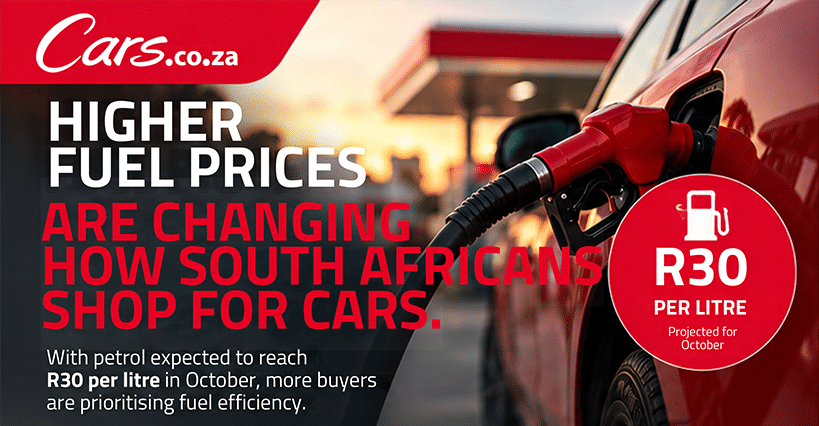
As October fuel-price adjustments are projected to push inland 95-unleaded petrol close to the R30-per-litre threshold, motorists are taking a closer look at what their vehicles cost to run.
New consumer data from Cars.co.za suggests that the pressure at the fuel pump is not simply causing people to delay buying vehicles.
Instead, it is changing what they look for when they shop.
According to the Cars.co.za Industry Report 2026, fuel efficiency has become one of the most important factors influencing vehicle decisions, with buyers increasingly considering the total cost of owning and running a vehicle.
Fuel Efficiency Is Now A Major Buying Priority
The numbers tell a clear story.
Among active car buyers surveyed on the Cars.co.za platform, 70.8% identified purchase price as a primary decision driver, while 52.5% identified fuel efficiency.
That puts fuel efficiency second on the list.
It also places the running cost of a vehicle ahead of traditional considerations such as brand loyalty and resale value.
The shift reflects a broader change in how consumers are assessing their next vehicle.
Instead of looking only at the price on the windscreen, buyers are increasingly considering what that vehicle could cost them every month once fuel and other running expenses are included.
Smaller Engines Gain Attention
One response to rising fuel costs is a move towards smaller, more fuel-efficient vehicles.
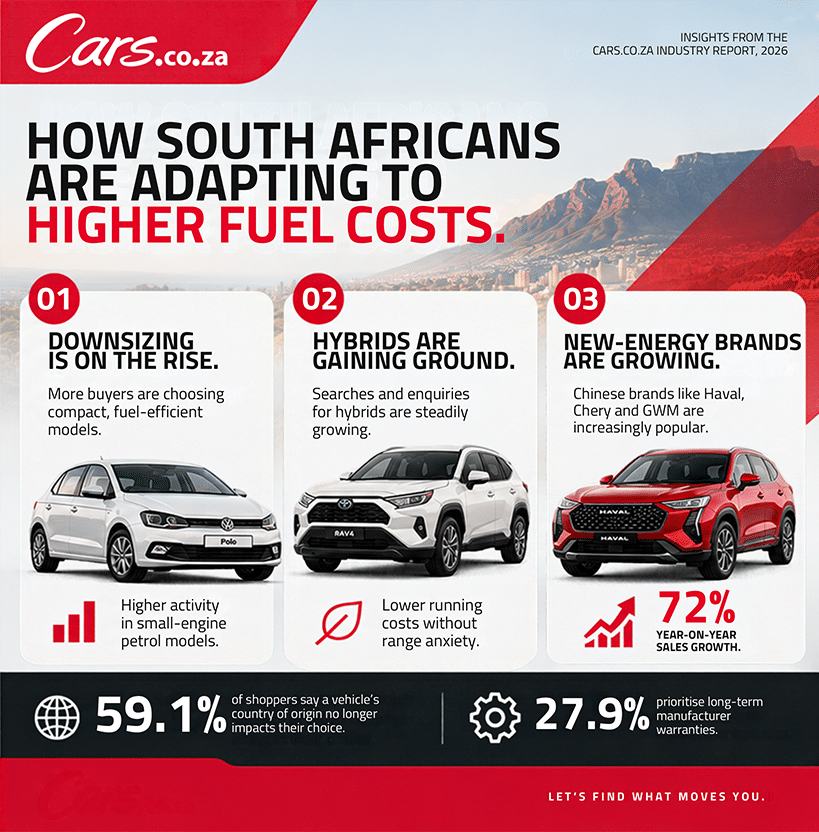
Cars.co.za data shows growing activity around compact, small-capacity petrol models, with vehicles such as the Volkswagen Polo and Volkswagen Polo Vivo continuing to generate strong overall lead volumes on the platform.
The trend points towards consumers placing greater emphasis on fuel consumption rather than simply choosing vehicles with larger engine capacities.
For motorists watching their household budgets, every kilometre matters.
Hybrids Offer A Middle Ground
While electric vehicles continue to attract interest, the transition to fully electric motoring still faces hurdles.
According to Cars.co.za, these include higher initial purchase prices and challenges around public charging infrastructure.
That has created space for hybrid vehicles.
Petrol-electric hybrids are seeing steady quarter-on-quarter growth in search and enquiry activity on the platform.
For consumers considering alternatives to conventional petrol vehicles, hybrids offer another route towards reducing fuel consumption without the range concerns associated with fully electric vehicles.
Cars.co.za describes this as a pragmatic middle ground for motorists looking for lower fuel-per-kilometre running costs.
Chinese Brands Change The Value Conversation
Another major development is the growing presence of Chinese automotive brands.
According to Cars.co.za platform data, Chinese automotive sales have surged 72% year-on-year, while inventory from Chinese manufacturers continues to expand on the platform.
Brands including Haval, Chery and GWM are offering feature-rich, fuel-efficient crossover models at price points that compete directly with traditional entry-level vehicles.
Consumer attitudes towards the origins of these vehicles are also shifting.
59.1% of surveyed shoppers said a vehicle’s country of origin no longer affects their choice.
That could create greater room for affordable hybrid and small-displacement alternatives from newer market entrants.
South Africans Are Doing The Maths
For Alan Quinn, Chief Innovation and Product Officer at Cars.co.za, the change is increasingly about looking beyond the initial purchase price.
“What we are seeing on Cars.co.za is a clear transition toward a ‘total cost of ownership’ mindset.”
Quinn says motorists are considering factors such as cost per kilometre, fuel economy and remaining service plans alongside the vehicle’s ticket price.
As fuel prices rise, the calculation becomes even more important.
A vehicle that costs less to operate can have a different impact on a household budget over time, making fuel consumption an increasingly important part of the buying conversation.
This Is Not Only An EV Story
Quinn also points out that the shift towards more efficient motoring should not be viewed solely through the lens of electric vehicles.
While fully electric vehicles are growing, he says immediate alternatives for many South African motorists include self-charging hybrids, modern 1.0-litre turbocharged petrol engines and value propositions from newer automotive market entrants.
The common thread is practicality.
Consumers are using vehicle-shopping platforms to investigate ways of managing the impact of future fuel-price increases.
 What Could Shape The Next 12 Months?
The pressure on household budgets is likely to remain an important influence on vehicle decisions.
Cars.co.za identifies several factors that could shape buyer behaviour over the next year.
Financing And Flexible Mobility
With 53% of South African consumers actively cutting back on discretionary spending, financing structures and overall monthly vehicle costs are becoming increasingly important.
Balloon-payment considerations, flexible finance structures and operating costs could all play a role in how buyers assess affordability.
More Hybrids And EVs
The range of non-traditional powertrains is also expanding.
More accessible hybrid powertrains and entry-level electric vehicles are expected to enter the market, while longer manufacturer warranties could help strengthen consumer confidence.
According to the Cars.co.za data, 27.9% of shoppers prioritise long-term manufacturer warranties.
Digital Research Meets The Test Drive
Consumers are also doing more research before making their final decisions.
35.2% of consumers rely on video and written reviews, according to the supplied Cars.co.za data.
At the same time, 35.3% place ultimate reliance on test drives.
That combination highlights the role of both digital research and real-world experience in the modern car-buying journey.
Fuel economy figures may appear on paper, but consumers still want to understand how a vehicle performs in real-world conditions before making a decision.
The Pump Price Is Changing The Conversation
South Africa’s vehicle market is being shaped by more than the price of a new car.
As fuel costs put greater pressure on household budgets, consumers are increasingly looking at the complete ownership equation.
For some, that means a smaller petrol engine.
For others, it could mean a hybrid, an entry-level EV or a newer value-focused brand.
The Cars.co.za data suggests the question is no longer simply “How much does the car cost?”
It is increasingly becoming:
“How much will this car cost me to live with?”