
What if a school could be more than classrooms, corridors and playgrounds? What if it could function like a small city, giving children space to explore, connect, collaborate and discover the world around them?
That question took centre stage at PULSE 2026 in Indore, India, where award-winning South African architecture practice Hubo Studio delivered the conference’s opening in-person keynote and led an interactive workshop exploring the future of educational design.
The international gathering brought together educators, architects, researchers, innovators and policymakers from countries including Japan, Finland, India, Australia and Malaysia. Organised by the Global Learning Space Network (GLSN), the conference explored the theme Where Culture Meets Learning.
For Hubo Studio, the event marked an important milestone in its growing international presence. It also placed South African educational architecture at the centre of a global conversation about how thoughtfully designed spaces can shape children’s lives.
A global conversation about the future of education
PULSE 2026 brought together leading voices in education, research and learning environment design.
The programme featured Hannu Haarala, Chair of the Finnish Learning Environments Association (LEAF), and Markku Lang, its Vice Chair. Australian architect and learning environments researcher Dr Fiona Young also joined the programme, alongside Dr Reiko Shimokura of Japan’s Meijo University.
Delegates also experienced Becoming Human, a digital presentation by Kevin Bartlett, Director of Education at Education Design International.
Another notable development was the unveiling of a collaboration between GLSN and Finland’s LEAF. The event also marked the launch of Nordic learning environments research, reinforcing international efforts to connect educational thinking with architectural innovation.
Against this international backdrop, Hubo Studio brought a distinctly South African perspective to the opening in-person keynote.
Its central message challenged a familiar assumption: schools should not simply house learning. They should actively help shape it.
Schools as mini-cities: Rethinking the learning environment
Hubo Studio founder and lead architect Asher Marcus joined educational strategist Dr Embeth van der Wal to present School as a Mini City.
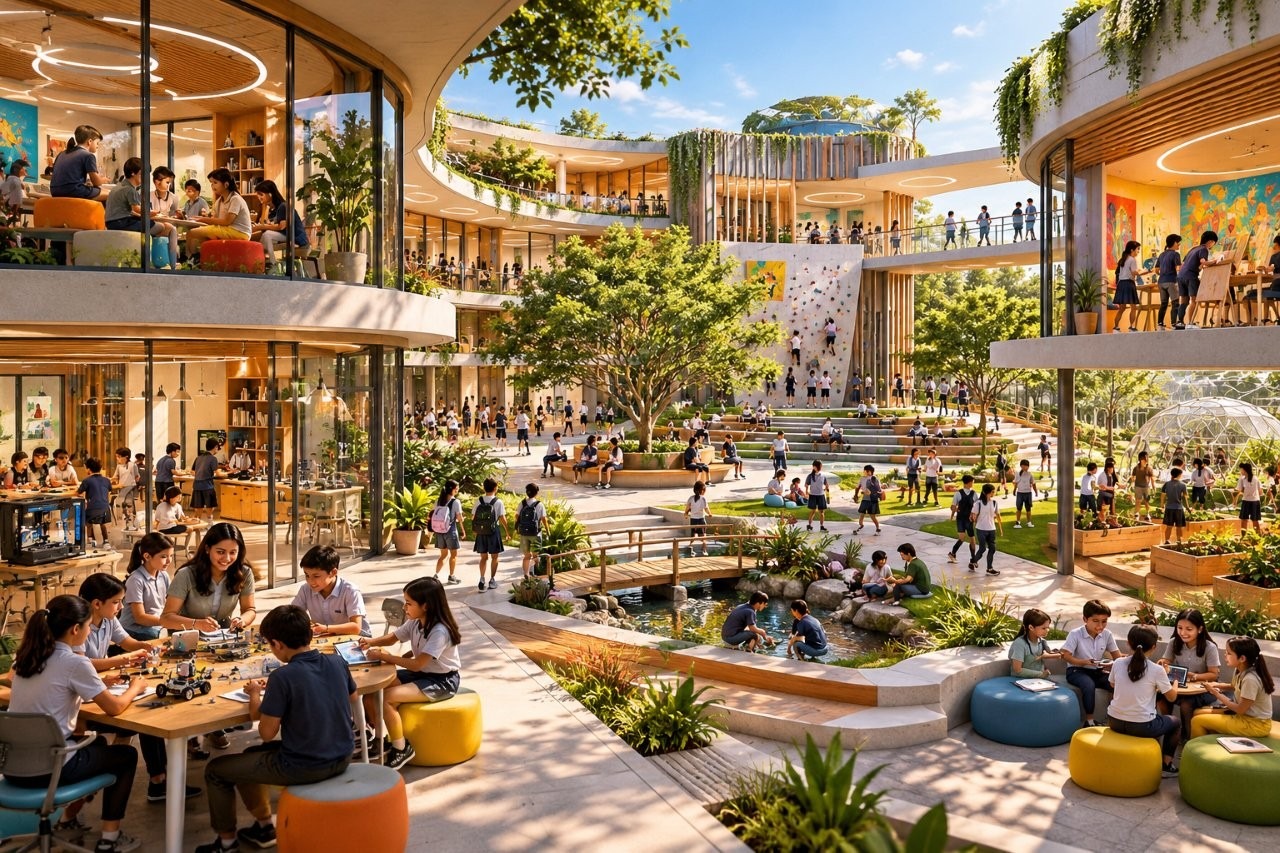
The keynote invited delegates to imagine schools as vibrant ecosystems rather than collections of conventional classrooms and corridors. In this vision, architecture becomes an active part of a child’s educational experience.
Drawing on Reggio Emilia-inspired educational principles, Marcus explored how spaces can encourage curiosity, collaboration, wellbeing and a sense of belonging.
The concept draws inspiration from the complexity of a city. Public squares, neighbourhoods, landscapes and shared spaces can create opportunities for discovery, independence and spontaneous interaction.
Rather than treating architecture as a backdrop to education, this approach places the learning environment at the heart of how children experience the world.
“If we imagine schools as mini-cities, we see them changing, becoming templates for innovation, growth and the wellbeing of a child. Schools have the potential to become the greatest spaces a child can experience in the world,” said Marcus.
The idea is both architectural and educational. A thoughtfully designed school can offer children opportunities to connect with others, explore their interests and develop a stronger sense of independence.
For Hubo Studio, the ambition extends beyond designing buildings. It is about creating environments that actively contribute to children’s development.
When imagination meets artificial intelligence
Following the keynote, Hubo Studio took its ideas from the stage into an interactive workshop called Capture the Feeling.
The session brought international educators and delegates together to explore how the next generation of learning environments might look and feel.
Instead of starting with floor plans, buildings or traditional design briefs, participants began with a more human question: how should a school make us feel?
Through visual exploration, storytelling and collaboration, participants considered how emotions, values and aspirations could inform architectural concepts.
Artificial intelligence played a role as a creative partner. It helped participants visualise possibilities, question assumptions and communicate ideas across cultural and professional boundaries.
The approach placed human experience before physical form. Rather than asking participants to fit their ideas into an existing building concept, it encouraged them to imagine the experience they wanted a learning environment to create.
The workshop generated strong participation, energy and creativity. It also demonstrated Hubo Studio’s commitment to co-creation, bringing educators directly into conversations about the spaces in which learning takes place.
By creating a shared language between education and architecture, Capture the Feeling showed how technology and human imagination can work together to explore new possibilities for learning environments.
“You made a difference to so many lives”
The response to Hubo Studio’s contribution was recognised by Akshay Bajaj, co-founder of PULSE and the Global Learning Space Network.
Praising both the keynote and the workshop, Bajaj highlighted the energy, interaction and engagement the studio brought to the conference.
“You went beyond our expectations. I knew you would be the rock stars of our stage from day one, but the way you conducted the workshop was just wow. Everyone was amazed by the energy and the way you handled the interactions with people. It was super fun and awesome,” said Bajaj.
He added:
“You made a difference to so many lives here in India, and they will all remember you forever.”
The feedback reflected the impact of an approach that goes beyond conventional architectural presentations. Instead of simply presenting ideas, Hubo Studio created an opportunity for educators to participate in imagining the future of educational design.
For Dr Embeth van der Wal, the experience was equally significant.
Having recently completed her doctorate in education at just 30 years old, Van der Wal represents a new generation of educational thinkers questioning conventional approaches to teaching, learning and the environments that support them.
Her work at Hubo Studio connects educational research with architectural design, helping translate insights into how children learn into spaces that support their development.
Reflecting on the experience, she said:
“This one was a life changer. The people, the conversations, the openness to new ideas and the collective ambition to rethink education were extraordinary. We came away inspired, energised and thinking bigger than ever.”
An award-winning South African practice with international reach
Hubo Studio’s appearance at PULSE 2026 builds on a period of international recognition for the Johannesburg-based practice.
Its Redhill Early Learning Centre received the World Architecture Festival’s Best Use of Natural Light award in 2025. The project also received recognition as Educational Build of the Year at the SCAPE Awards.
In 2026, Redhill secured two Architizer A+Awards: Jury Winner in the Kindergarten category and Popular Choice Winner for Educational Interiors.
These achievements have helped strengthen the studio’s international profile. Hubo Studio is increasingly involved in educational projects and collaborations across South Africa, the United Kingdom and the United States.
Its work brings together educational strategy, architectural innovation and collaborative design. Underpinning this approach is the belief that physical environments can profoundly influence how children learn, connect and grow.
The studio continues to challenge conventional ideas about schools, advocating for learning environments that nurture curiosity, creativity, independence and human development.
At PULSE 2026, its ideas found a platform for international exchange, demonstrating how questions about learning spaces can resonate across different cultures, educational systems and communities.
“Across different cultures, countries and educational systems, we share one powerful ambition: to create a better world for our children through education,” said Marcus.
He concluded:
“The future of education isn’t something we wait for. It’s something we imagine, design and build together.”
About Hubo Studio
Hubo Studio is an award-winning Johannesburg-based architecture and educational design practice working internationally to reimagine the relationship between learning and the built environment.
Founded by architect Asher Marcus, the studio combines architecture, educational strategy and participatory design to create environments that inspire curiosity, creativity, connection and human development.
Its work spans early learning centres, schools, campus masterplans and educational transformation projects in South Africa and internationally.
Guided by the philosophy of making education spatial, Hubo Studio believes that learning environments should actively participate in education, shaping not only how children learn but also how they experience the world.
About PULSE and the Global Learning Space Network
PULSE is an international gathering organised by the Global Learning Space Network (GLSN). It brings together educators, architects, researchers, policymakers and innovators to explore the relationship between educational practice and learning environment design.
The third edition, held from 5 to 7 October 2026 at the Sheraton Grand Palace in Indore, India, explored the theme Where Culture Meets Learning.
The programme included international keynote presentations, research discussions, collaborative workshops and cross-cultural exchanges focused on reimagining educational environments for future generations.
For more information, visit Hubo Studio.