

Being young in South Africa today requires courage.
It means chasing opportunities in a challenging economy, navigating rising living costs, adapting to a rapidly changing job market and trying to build a future amid uncertainty.
For many young people, financial success can feel out of reach.
Some are still studying. Others are sending out countless CVs. Many are starting their first jobs, launching side hustles or searching for ways to create additional income streams.
Yet despite these challenges, a growing number of young South Africans are proving that financial resilience is not about how much money you have. It is about how you respond to the circumstances around you.
And according to financial experts, that mindset could become one of the most valuable assets a young person can develop.
Building Stability in an Uncertain World
Youth Month offers an opportunity to reflect on the realities facing South Africa’s younger generation.
One of the most pressing challenges remains unemployment.
According to the latest figures referenced by FNB, 45.8% of young South Africans actively looking for work are unemployed.
For many, this means financial security does not automatically arrive with a first paycheck.
Instead, it is built over time through consistent habits, informed decisions and a willingness to adapt.
“That means financial stability doesn’t just arrive with the first paycheck. Instead, it’s built deliberately through everyday money habits, smart decisions and multiple income streams,” says Clair Brenner, CEO of FNB nav».
While the statistics paint a challenging picture, they do not tell the whole story.
Across the country, young people are finding innovative ways to create opportunities for themselves.
Some are tutoring. Others are freelancing, coding, creating digital content, selling products online, offering services within their communities or transforming hobbies into businesses.
Technology is opening doors that simply did not exist a decade ago.
The Rise of a More Financially Aware Generation
One of the most encouraging trends emerging among South African youth is a growing interest in financial literacy.
Young consumers are increasingly paying closer attention to how they earn, spend and save money.
Brenner says this shift is becoming increasingly visible.
“One thing we’ve seen at FNB is that there is a palpable demand among the youth for tools to intuitively support money management. Young consumers are increasingly focused on understanding their spending, building savings habits and making more considered financial decisions, even when income is constrained.”
This reflects a broader change in mindset.
Rather than viewing money management as something to worry about later in life, many young people are choosing to learn these skills earlier.
Five Habits That Build Financial Resilience
Financial resilience does not happen overnight.
It develops through consistent actions repeated over time.
According to Lethukuthula Ngcobo, FNB’s Product Manager for Integrated Advice, financial literacy begins with understanding available options and making informed decisions that support long-term goals.
Understand Your Cash Flow
The first step is knowing exactly where your money goes.
Small daily expenses often seem insignificant on their own but can have a significant impact over time.
Tools such as FNB’s nav» Money Smart Budget can help users track spending patterns, monitor cash flow and identify opportunities to improve financial habits.
When people understand their money better, they are better equipped to make informed decisions.
Save Before You Think You’re Ready
One of the biggest misconceptions about saving is that it requires a large income.
In reality, consistency matters far more than size.
Even small amounts saved regularly can create positive habits and provide a financial cushion when unexpected expenses arise.
The goal is not perfection.
The goal is progress.
Be Careful With Debt
Credit can be useful when managed responsibly.
However, understanding the costs and repayment obligations attached to borrowing remains critical.
Before taking on debt, young consumers should ensure they fully understand the terms and whether repayments fit comfortably within their budget.
Financial resilience is strengthened when debt is managed wisely rather than becoming a burden.
Invest in Your Skills
Perhaps the most valuable investment a young person can make is in themselves.
New qualifications, certifications, courses and practical experiences can increase future earning potential and create additional opportunities.
As industries continue to evolve, continuous learning remains one of the most effective ways to stay competitive.
Build a Support System
Money should not be a lonely conversation.
Support networks can play a powerful role in helping people stay accountable and focused on their goals.
Whether through stokvels, savings groups, mentors or trusted friends and family members, having people who encourage positive financial behaviour can make a meaningful difference.
Small Actions, Big Results
Ngcobo believes consistency remains one of the most powerful financial tools available.
“Consistency matters. Small actions repeated over time can have a meaningful impact on your financial future.”
It is a message that resonates strongly in today’s economic environment.
Financial resilience is rarely built through sudden windfalls or lucky breaks.
More often, it is created through small, intentional decisions repeated day after day.
Each time someone saves a little more, learns a new skill, reduces unnecessary spending or improves their financial knowledge, they are strengthening their future options.
Turning Financial Literacy Into a Lifelong Advantage
Financial literacy and financial resilience work hand in hand.
One provides the knowledge.
The other delivers the outcome.
Tools such as My Advisor on the FNB App are designed to help users better understand their money habits, gain personalised insights and make informed decisions aligned with their financial goals.
But ultimately, technology is only part of the solution.
The real power lies in the choices people make every day.
As South Africa celebrates Youth Month, there is growing evidence that many young people are embracing those choices with determination and creativity.
They are proving that resilience is more than surviving difficult circumstances.
It is learning, adapting, growing and creating opportunities where none existed before.
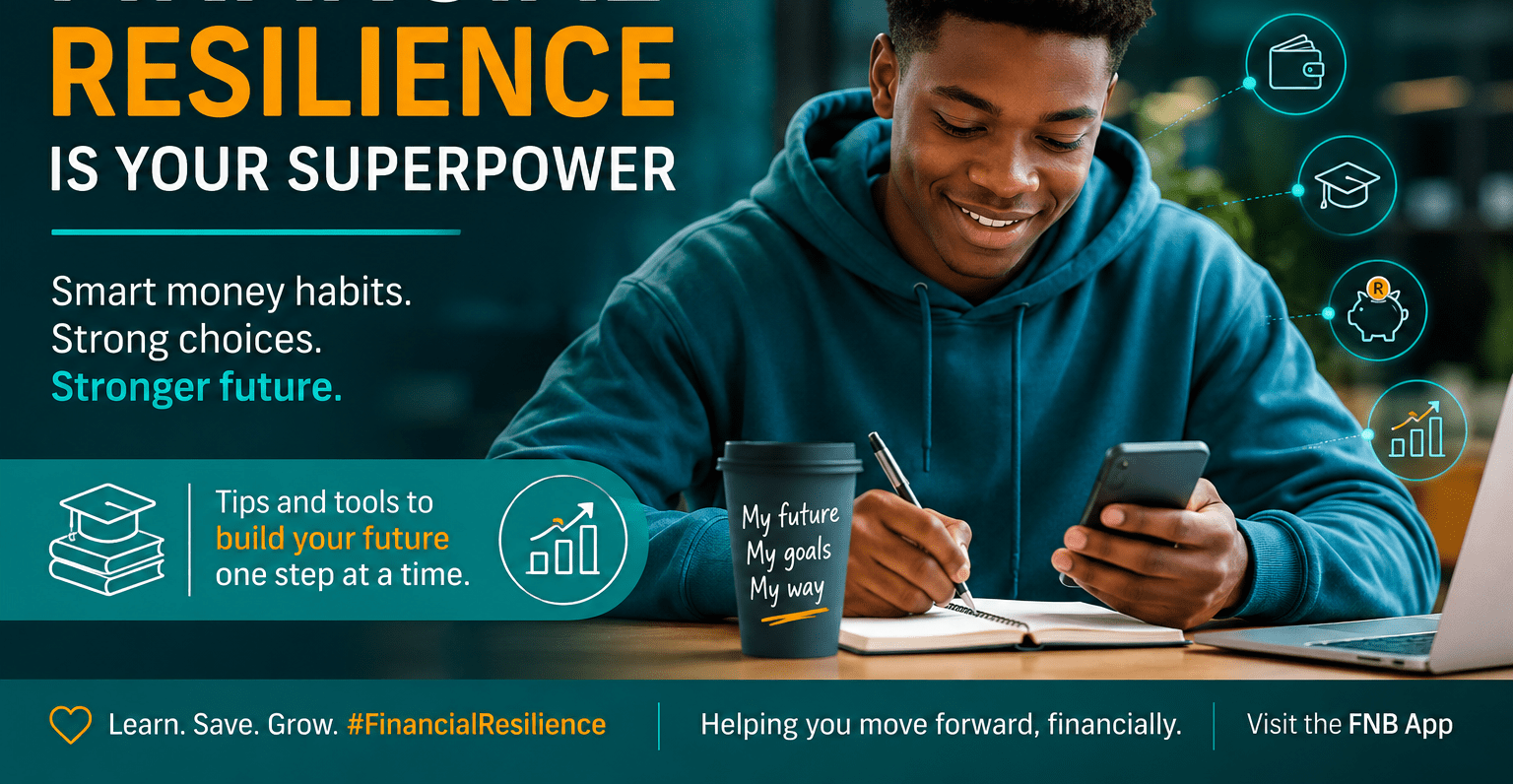
And perhaps that is why financial resilience has become one of the most important superpowers a young South African can possess.
Not because it guarantees success overnight.
But because it helps turn uncertainty into possibility—one decision, one habit and one step at a time.