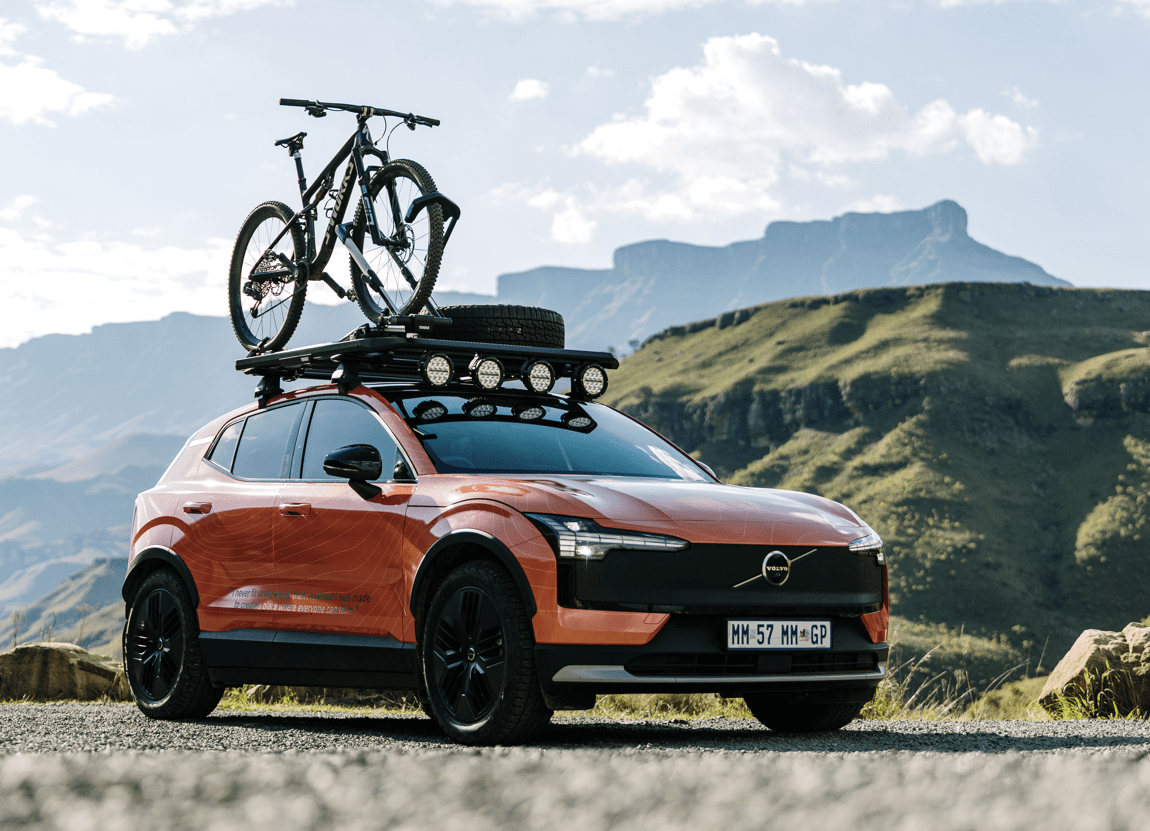
 For decades Sani Pass has been South Africa’s cinematic test of machine and mettle — steep, loose, windy and unforgiving. On 30 October 2025, Volvo Car South Africa added a new chapter: the all-electric EX30 Cross Country became the first battery-electric vehicle (BEV) to successfully ascend Sani Pass, proving that electric mobility can not only survive but excel on extreme terrain.
A modern milestone on an old trail
The climb is symbolic. In 1969 a Volvo first tackled Sani Pass, and 56 years later the EX30 Cross Country repeated that rite of passage — this time without a drop of fossil fuel at the wheels. The achievement is both technical and cultural: it signals that EVs have left the city garages and are ready for bona-fide adventure.
Small, fierce and properly equipped
Don’t be fooled by its compact footprint. The EX30 Cross Country in its Twin-Motor Performance guise delivers up to 315 kW (≈422 hp) and 543 Nm, with a claimed 0–100 km/h in roughly 3.6–3.7 seconds — numbers that help explain how the little Volvo handled the steep gradients and switchbacks of the Drakensberg with composure. Volvo’s Cross Country treatment adds higher ride height and protective cladding, but the story here is powertrain capability married to chassis control. Volvo Cars
A fully solar-to-solar journey — the charger at altitude
What sets this ascent apart is the energy story: Volvo partnered with CHARGE to install what organisers describe as South Africa’s highest solar-powered EV charger, positioned just below Sani Pass at 1,566 metres at the Premier Resort Sani Pass. That unit enabled a solar-to-solar demonstration — the EX30 recharged using locally generated solar power and then completed the climb, highlighting how clean-energy infrastructure can unlock sustainable exploration in remote places. CHARGE says the station will be upgraded with battery backup in Q2 2026 to allow overnight charging and more flexible operation.
What Volvo and its MD said
“This ascent of Sani Pass by the EX30 Cross Country is a defining moment for electric mobility in South Africa,” said Grant Locke, Managing Director of Volvo Car South Africa, framing the climb as proof that EVs can tackle the most challenging terrain while remaining sustainable. For Volvo in South Africa — which has been positioning the EX30 Cross Country as a rugged, locally relevant electric option — the stunt underlines product capability and the brand’s ambition to link electrification with lifestyle.
CHARGE’s founder Joubert Roux described the collaborative nature of the project and confirmed plans to add battery storage to the site next year, a move that will permit overnight charging and strengthen the remote charger’s utility. The upgrade is a practical step toward enabling longer, cleaner journeys into rural and mountainous tourism destinations.
Why the climb matters beyond PR
This isn’t just a marketing moment. The exercise addresses three real questions for EV adoption in South Africa:
-
Capability: Can a BEV handle extreme off-piste conditions? The EX30’s twin motors, torque and regen management answered yes. Volvo Cars
-
Energy autonomy: Can remote tourist assets be served by renewables? The solar charger shows local generation can be practical with the right investment.
-
Infrastructure scaling: A demonstration charger at 1,566 m is symbolic — the next step is a network of renewable-powered chargers with storage to support overnight and multi-day trips. CHARGE’s public infrastructure projects and development partnerships (including recent DBSA-backed expansion plans) point to exactly that kind of scaling.
The technical nuance: regen, traction and range management
Climbs like Sani require careful thermal and energy management: uphill bursts draw power, while downhill sections allow regenerative braking to recover energy — but loose gravel and rock demand traction control and conservative regen settings. Engineers and drivers will have tuned the EX30’s torque delivery, thermal protection and tyre choice to balance grip and efficiency; the result was an ascent that respected both vehicle limits and mountain safety. Media road tests of the EX30 Cross Country earlier this year emphasised that the model’s off-piste geometry and AWD system are purposefully tuned for just these kinds of tests.
What this means for South African drivers and tourism
For adventurous South Africans, the message is clear: EV ownership need not be an urban compromise. As destination chargers powered by renewables appear in national parks, mountain resorts and coastal towns, EVs can become tools for sustainable tourism, not just commuter transport. For resorts and local economies, offering clean-energy charging is both an amenity and a longer-term differentiator that can attract eco-minded travellers.
A measured note on safety and scale
Sani Pass remains a challenging route — vehicle clearance, driver skill and weather matter. Volvo’s climb was controlled and supported; it should not be read as a blanket greenlight for every EV owner to tackle the Pass unprepared. What it does do is accelerate the conversation: with proper equipment, local charging investment and responsible planning, EVs can broaden their footprint into South Africa’s most storied landscapes