
As South Africa marks Women’s Month, new research is painting a powerful picture of modern womanhood—one defined by resilience, ambition and confidence, but also shaped by persistent financial pressures.
The inaugural 1Life Insurance Women’s Life Confidence Index, released on 5 August 2026, reveals that while the majority of South African women believe they have the power to shape their own futures, many continue to face significant financial barriers that limit their ability to build lasting security.
The nationwide study, which surveyed 957 women across South Africa, evolved from 1Life Insurance’s Women’s Month Survey first introduced in 2025. The new Index offers a broader look at the realities influencing women’s financial confidence, resilience and future aspirations.
Confidence Is Growing, but Financial Freedom Remains Out of Reach
One of the strongest findings from the research is the contrast between women’s personal confidence and their financial reality.
The survey found that:
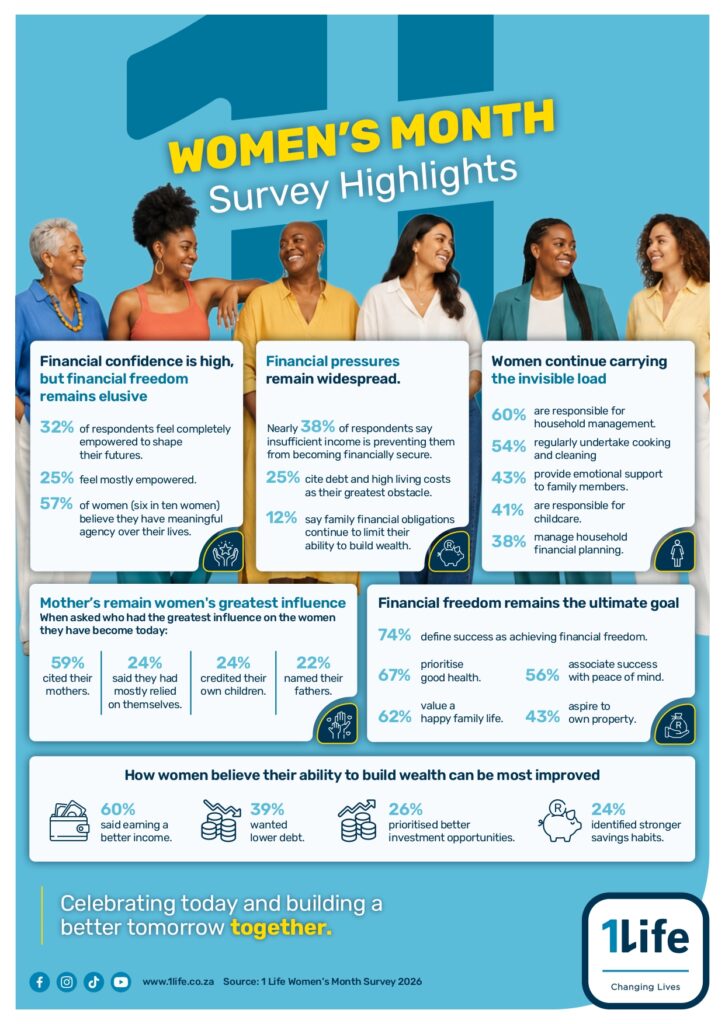
- 32% of women feel completely empowered to make important decisions about their future.
- An additional 25% feel mostly empowered.
Together, this means 57% of South African women believe they have meaningful control over the direction of their lives.
Despite this optimism, financial challenges continue to dominate everyday life.
According to the research:
- 38% identify insufficient income as the biggest obstacle to achieving financial security.
- 25% cite debt and the rising cost of living as their greatest challenge.
- 12% say family financial responsibilities limit their ability to build wealth.
The findings reinforce trends first identified in the 2025 Women’s Month Survey, showing that while confidence has improved, financial realities continue to slow long-term progress.
Women Carry More Than Financial Responsibilities
The report also highlights the significant unpaid responsibilities many women continue to shoulder alongside paid employment.
Among respondents:
- 60% manage household responsibilities.
- 54% regularly handle cooking and cleaning.
- 43% provide emotional support to family members.
- 41% are responsible for childcare.
- 38% oversee household financial planning.
These responsibilities become even more significant considering that more than a quarter of those surveyed are single parents or primary caregivers.
The Women Who Inspire Women
When respondents were asked who had influenced the women they have become today, mothers emerged as the most important source of inspiration.
The survey found:
- 59% credit their mothers as their greatest influence.
- 24% say they have relied primarily on themselves.
- 24% identify their own children as major influences.
- 22% credit their fathers.
The results underline the enduring importance of family relationships and strong female role models across generations.
Financial Freedom Tops Women’s Definition of Success
Although financial pressures remain widespread, South African women’s aspirations remain firmly focused on creating stable and secure futures.
The study found that:
- 74% define success as achieving financial freedom.
- 67% prioritise good health.
- 62% value a happy family life.
- 56% associate success with peace of mind.
- 43% aspire to own property.
When asked what would help them build wealth more effectively, respondents identified:
- 60% — earning a better income.
- 39% — reducing debt.
- 26% — better investment opportunities.
- 24% — stronger savings habits.
According to Hayley Parry, Money Coach and Facilitator of 1Life Insurance’s Truth About Money, the findings show that women already understand what financial success looks like.
“These findings tell us that women already know what they want for themselves and their families. They want financial freedom, peace of mind and the confidence that the people they love will be protected. Through Truth About Money, we’ve seen how practical financial education, combined with the right financial protection, can help women move from simply coping to building lasting financial resilience and generational wealth.”
Protection Matters, but Important Gaps Remain
The Index also examined how women are protecting themselves and their families financially.
Among respondents:
- 69% have funeral cover.
- 62% have life cover.
However, significantly fewer women reported having disability cover, dread disease cover or income protection insurance.
Although around half believe their families would be mostly or fully financially prepared if something happened to them, 16% admit they are not financially prepared, while others remain uncertain about their level of protection.
 A New Benchmark for Women’s Financial Wellbeing
Building on the success of the original Women’s Month Survey, 1Life Insurance has officially transformed the research into the annual Women’s Life Confidence Index.
Going forward, the Index will monitor women’s progress across five key pillars:
- Financial Confidence – managing money, planning and protecting the future.
- Lived Empowerment – women’s sense of agency over their lives.
- Support Networks – emotional, practical and financial support systems.
- Legacy and Generational Wealth – aspirations to create long-term financial security.
- Future Optimism – confidence in personal, family and financial prospects over the next five years.
By measuring these indicators annually, 1Life Insurance aims to create one of South Africa’s leading benchmarks for understanding women’s financial wellbeing, resilience and confidence.
The research platform will also support broader public conversations around financial education while reinforcing the company’s commitment to helping South Africans protect what matters most.
A Picture of Progress—and the Work Still Ahead
The inaugural Women’s Life Confidence Index presents an encouraging picture of women who are increasingly confident in themselves, their choices and their ambitions.
At the same time, it highlights the financial realities that continue to prevent many from fully realising those ambitions.
As South Africa celebrates Women’s Month, the findings serve as both a celebration of women’s resilience and a reminder that meaningful financial empowerment requires more than determination alone—it also depends on access to opportunity, education and the right financial support.