
Johannesburg did not just host a fashion show last night — it witnessed a transformation.
On the opening night of South African Fashion Week Spring/Summer 2026, Gert-Johan Coetzee delivered a showcase that refused to exist within the limits of a runway. Staged at The Cirk, Behind the Crimson Door unfolded as a fully immersive, multi-sensory experience — where couture was not displayed, but activated.
From the first note of music to the final sweep of crimson fabric, this was fashion in motion — urgent, emotional, and unapologetically alive.
When Fabric Takes Flight
The opening moment set the tone with cinematic precision. A live musical performance commanded the room, and then — as if defying gravity itself — an aerial performer ascended into the air, her gown trailing behind her in sculptural waves.
It wasn’t just dramatic. It was symbolic.
The fabric didn’t follow her — it responded to her. Every movement turned cloth into choreography, establishing the central thesis of the night: fashion does not exist in stillness.
A Front Row of Power, A Room Full of Energy
The atmosphere was charged. South Africa’s cultural elite filled the space — including Pearl Thusi, Nadia Nakai, Lira and Kim Jayde — each bearing witness to a moment that felt destined to echo beyond the season.
But even with star power in the room, the true spectacle remained firmly on the stage — and above it.
Couture in Motion: The Power of Fringe, Flow, and Form
At the core of Coetzee’s collection was a bold and deliberate obsession with movement.
Fringe emerged not as embellishment, but as language.
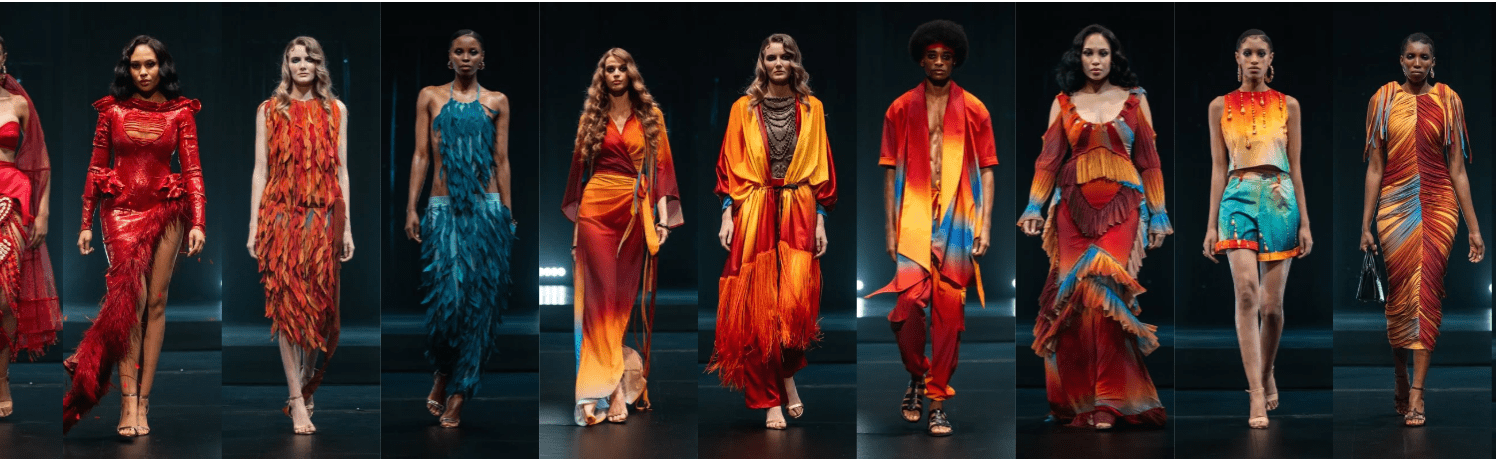
A standout turquoise, backless, floor-length gown became one of the defining visuals of the night — its cascading fringe extending the body into space, creating a rhythmic echo with every step. It didn’t just move; it multiplied motion, blurring the line between garment and atmosphere.
Across the collection, this philosophy repeated itself:
- Silhouettes expanded and contracted with intention
- Textures reacted to light, air, and velocity
- Fabrics were engineered to perform, not just drape
Each piece was less about being seen — and more about being experienced.
The Art of Colour: Ombré as Emotion
Colour played a cinematic role in shaping the narrative.
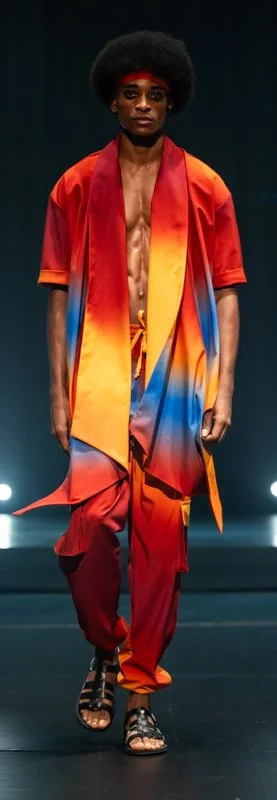
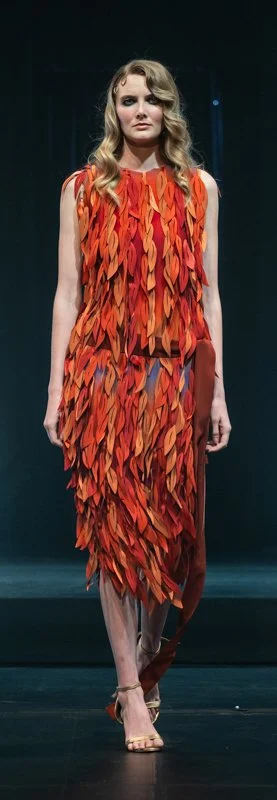
Ombré gradients swept across both menswear and womenswear — transitioning through vivid yellows, electric turquoise, deep maroons, and commanding reds. These tonal shifts did more than decorate the body; they sculpted it, guiding the eye in fluid motion.
The effect was hypnotic.
Each look felt like a moving canvas — a visual transition between states of being: innocence to boldness, hesitation to power, fear to release.
Breaking the Runway: Fashion Becomes Theatre
Midway through the evening, the show dissolved entirely into performance.
Directed by Joanna Pawelczyk, the production shifted into a full theatrical sequence — a bold departure from traditional runway structure. Dancers, aerialists, and live music merged into a burlesque-inspired spectacle that was intimate, expressive, and deeply immersive.
Sequins flickered under strobe lighting.
Feathers pulsed with movement.
Silhouettes exaggerated emotion.
In this moment, Coetzee made his most daring statement:
fashion is not separate from performance — it is performance.
The Story Behind the Door
Beneath the spectacle lay a deeply human narrative.
Behind the Crimson Door follows Charlotte — a young woman leaving her rural beginnings in search of a bigger life. Her journey moves through fear, temptation, illusion, and ultimately, self-discovery.
It is a story that mirrors Coetzee’s own path — from a small-town upbringing to global recognition.
Doors, both literal and symbolic, appeared throughout the production — representing the pivotal moments where choice defines destiny. Stay or leave. Fear or courage. Safety or growth.
The garments evolved alongside this narrative:
- Beginning with restraint and subtlety
- Expanding into bold, structured couture
- Culminating in unapologetic, statement-making pieces
Clothing became emotional architecture — shaping and reflecting the inner world of the wearer.
The Final Act: Crimson, Command, and Main Character Energy
As the show reached its climax, the palette deepened into rich reds — a visual crescendo of intensity and confidence.
Here, Coetzee delivered some of his most striking pieces:
- Leather full-length boobtube gowns that radiated authority
- A sculpted red corset-and-skirt ensemble that embodied pure “main character” energy
- A shimmering sequined fringe gown that drew audible gasps and applause
It was a finale rooted in power — not just aesthetic, but emotional.
A Collaboration That Changes the Game
The partnership with CIRK elevated the entire production into something rare.
More than a venue, CIRK became a creative collaborator — bringing aerial artistry, spatial depth, and theatrical discipline into the fashion space.
With the full production set to run publicly from late April through mid-June, this showcase was only the beginning — a preview of a larger cultural moment in the making.
Beyond the Runway, Beyond Expectation
What Gert-Johan Coetzee achieved last night was not just innovation — it was redefinition.
He challenged:
- The stillness of traditional runway formats
- The separation between fashion and performance
- The idea that clothing exists only for visual consumption
Instead, he offered something far more powerful:
fashion as movement, as emotion, as story.
In a global industry constantly searching for the next evolution, Johannesburg may have just found its answer — behind a crimson door.
And once you step through it, there is no going back.