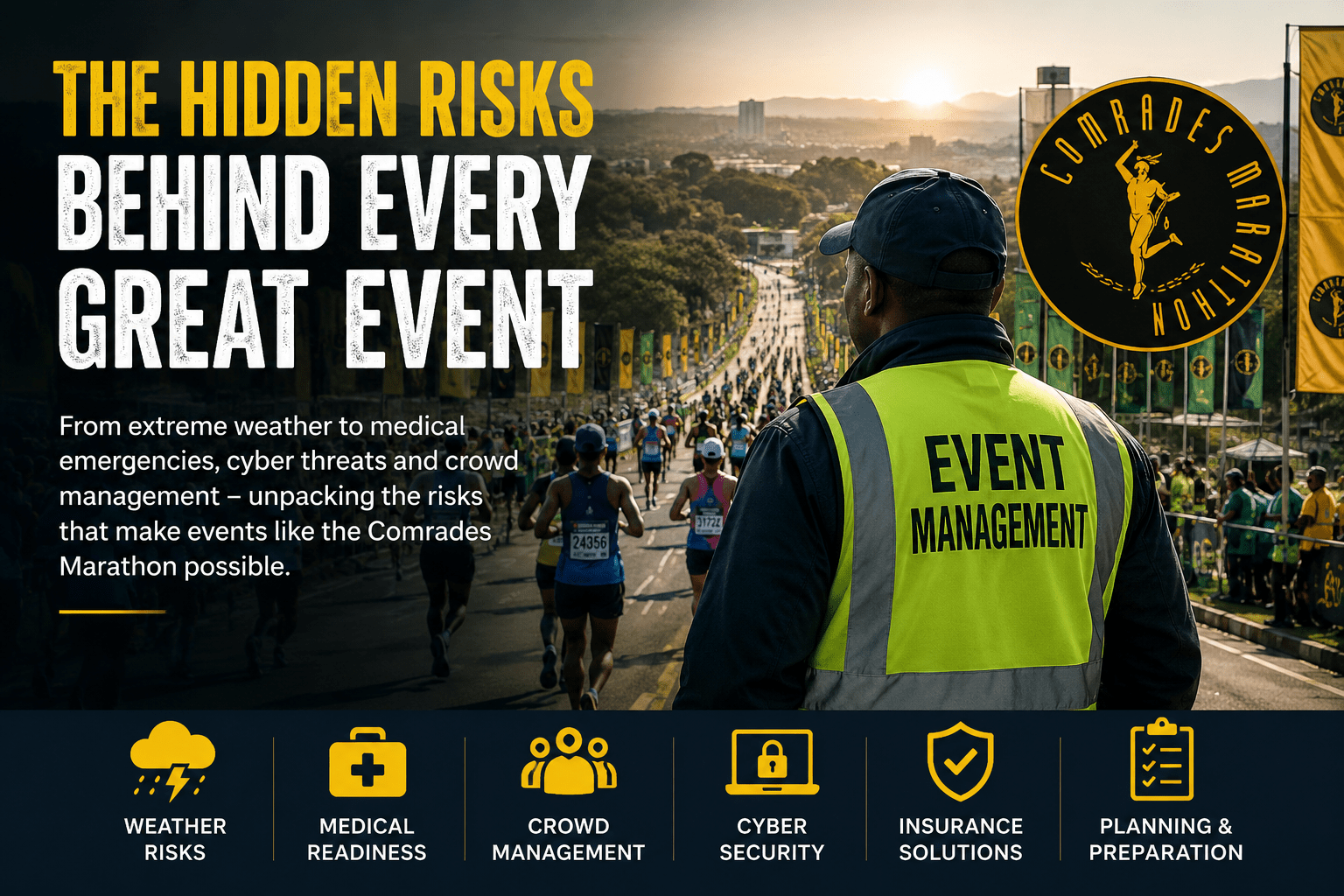
For millions of South Africans, the Comrades Marathon is a celebration of endurance, determination and the unbreakable human spirit.
It is a day when thousands of runners push their bodies to the limit, spectators line the route in support, and the nation collectively marvels at one of the world’s most iconic ultramarathons.
But while the drama of race day unfolds in plain sight, another marathon takes place long before the starting gun sounds.
It is a marathon of planning, preparation, coordination and risk management — one that is largely invisible to the public but absolutely essential to the success of any major event.
According to Mamoeti Nosi, Product Head: Events at iTOO Special Risks, the greatest threats to large-scale events are often not the obvious ones. Instead, they are the hidden risks quietly developing behind the scenes, capable of disrupting months of preparation if not identified and managed effectively.
“The biggest risks at major events are rarely the ones people talk about,” says Nosi.
“They are the ones that unfold quietly, behind the scenes, in the shadows of logistics, weather patterns, medical readiness and digital infrastructure. They are the risks that, if not managed with precision, can derail an event long before the first runner crosses the start line.”
When Mother Nature Holds the Final Vote
Few factors demonstrate this reality more clearly than the weather.
Unlike logistics, infrastructure or staffing, weather remains the one variable that no organiser can control. The only option is preparation.
South Africans have witnessed firsthand how severe weather conditions can force organisers into difficult decisions. Events such as the Cape Town Cycle Tour have previously been cancelled because extreme winds created unsafe conditions for participants and spectators.
For an event as lengthy and exposed as the Comrades Marathon, weather planning becomes a critical component of risk management.
Every structure along the route must be secured, emergency procedures must be established, and contingency plans must be developed long before meteorologists provide a final forecast.
“For a race as long and exposed as Comrades, every structure must be secured to withstand sudden changes, and every contingency must be mapped out long before the forecast becomes clear,” explains Nosi.
The most difficult scenario remains the possibility of a race cancellation.
While no organiser wants to see months of planning come to an abrupt halt, safety must remain the overriding priority. The Comrades Marathon Association works closely with the South African Weather Service to monitor conditions, issue warnings and activate contingency measures when necessary.
Adding to the challenge is the unique climate along the race route. Early morning temperatures can be bitterly cold, yet runners may later face intense heat as conditions change throughout the day.
To help mitigate these risks, event organisers often secure specialised insurance solutions, including Contingency, Cancellation and Non-Appearance cover, alongside Event Liability insurance.
Medical Readiness: Planning for Every Possibility
Endurance events naturally carry medical risks.
While runners focus on crossing the finish line, organisers must prepare for every potential emergency, from minor injuries to life-threatening incidents.
Heat exhaustion, dehydration, muscle injuries, falls and severe cardiac events all form part of the risk landscape associated with large-scale endurance races.
For an event covering such a vast distance, medical preparedness cannot be centralised. Instead, resources must be distributed strategically along the route to ensure rapid response times when every second matters.
“The scale of the Comrades Marathon means medical readiness must be distributed along the entire route, with strategically positioned stations, emergency vehicles and trained personnel ensuring rapid response,” says Nosi.
This level of preparedness is made possible through extensive collaboration among medical professionals, emergency responders and event planners working months in advance.
Managing the Human Factor
The atmosphere created by spectators is one of the defining characteristics of any major sporting event.
Yet the very crowds that create excitement and energy can also introduce significant safety risks.
With thousands of spectators gathering at various points along the route, crowd management becomes a highly specialised discipline.
Access points must remain open, emergency services require unobstructed movement, and sanitation and hydration facilities must be capable of supporting large volumes of people.
A seemingly minor issue can quickly escalate when multiplied across thousands of attendees.
“While spectators bring atmosphere and energy, they also introduce risks that must be carefully controlled,” says Nosi.
Poor crowd management can lead to crushes, bottlenecks and other dangerous situations that place both participants and spectators at risk.
This is one reason why Event Liability insurance remains a critical safeguard for organisers, helping protect against third-party claims involving bodily injury or property damage should unforeseen incidents occur.
The Digital Threat Few Spectators Ever See
While weather and medical emergencies are visible risks, one of the fastest-growing threats to major events exists almost entirely behind computer screens.
Modern sporting events rely heavily on digital infrastructure.
Runner registration systems, participant databases, timing technology and communication platforms are now central to event operations.
Unfortunately, they have also become attractive targets for cybercriminals.
A successful cyberattack could expose sensitive personal information, interrupt race timing systems or disrupt operational processes, creating both financial and reputational damage.
Nosi warns that cyber resilience has become a non-negotiable component of event management.
From vulnerability assessments and secure data handling practices to recovery planning and cybersecurity monitoring, digital protection now forms a critical layer of event integrity.
The Power of Collaboration
Managing risks of this scale cannot be achieved by a single organisation acting alone.
High-profile events such as the Comrades Marathon depend on collaboration between multiple stakeholders through structures such as the Venue Operations Cluster (VOC).
The VOC brings together emergency services, law enforcement agencies, municipalities and social partners, creating a coordinated framework designed to identify risks early and respond effectively when challenges emerge.
This collaborative approach helps strengthen resilience and reduces the potential impact of unexpected disruptions.
More Than a Safety Net
For many people, insurance is viewed as something that only becomes important when things go wrong.
But in the world of major event management, its role extends far beyond financial protection.
According to Nosi, insurance serves as a strategic partner that contributes expertise, insight and risk management support long before an event takes place.
Across weather preparedness, medical readiness, crowd control, third-party safety, logistics and cybersecurity, the common thread remains the same: successful events are built on anticipation, planning and resilience.
The crowds may only see the finish line.
But behind every successful major event lies a complex network of professionals working tirelessly to ensure that when the spotlight shines, everything runs exactly as it should.
And in many ways, that invisible effort is a marathon all its own.