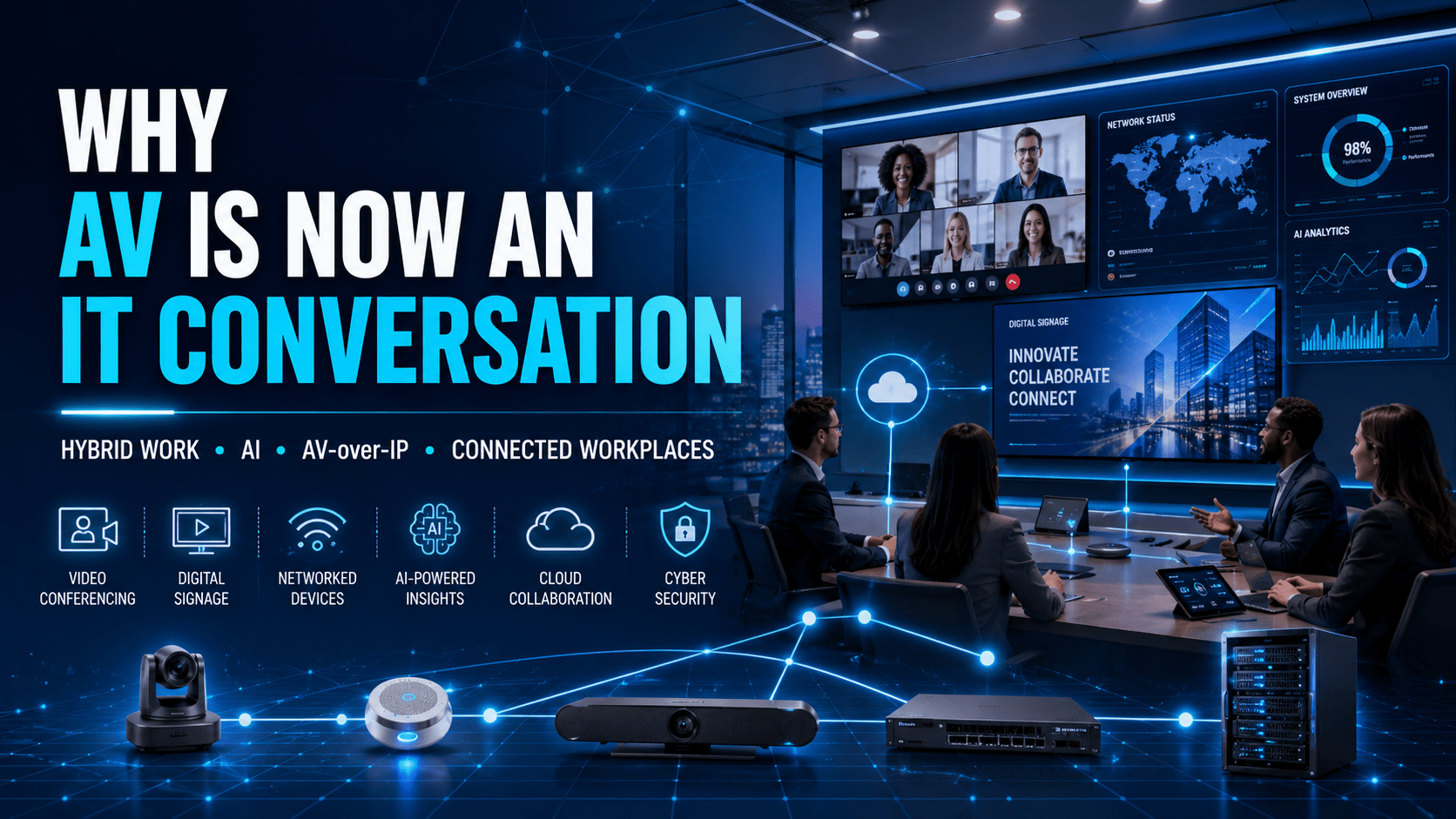
The days when audiovisual technology lived quietly in a conference room corner are over.
For years, AV systems operated largely outside core business technology infrastructure. Meeting room screens, projectors and sound systems were often managed separately from enterprise networks and IT operations. Today, however, the rise of hybrid work, AI-powered devices, cloud collaboration and AV-over-IP technology has transformed the landscape entirely.
Modern AV systems are now deeply connected, intelligent and increasingly dependent on the same networks that power the rest of the business.
According to industry leaders speaking ahead of Mediatech Africa 2026, this convergence is changing the way organisations deploy, manage and secure technology.
AV Has Entered the Network Era
The shift has been dramatic.
When Mediatech Africa last took place before the pandemic, hybrid work was still emerging and AI had not yet become part of everyday business discussions. Since then, organisations have invested heavily in collaboration technology to support remote and in-person teams.
Today’s conferencing systems, wireless presentation platforms, room booking solutions, digital signage networks and collaborative workspaces all rely on connected infrastructure.
According to Stuart Pringle, Managing Director of Omega Digital Services, connectivity has become the foundation of modern AV.
“Virtually all the devices we’re deploying now are networkable,” he explains.
“They may not all be streaming media directly over the IP network, but because they can now be remotely monitored and are amplified by AI, almost every device within an AV solution is connected to the network.”
This evolution means AV is no longer simply about screens and speakers. It has become part of the broader technology ecosystem.
The Ownership Challenge
As AV and IT continue to merge, organisations face a new question: who is responsible?
Historically, facilities teams managed physical meeting spaces while IT departments handled networks, devices and software.
Today, the modern meeting room sits squarely between the two.
Displays, cameras, microphones, environmental controls, booking systems, cloud platforms and network infrastructure all work together to create seamless collaboration experiences.
According to Jesse Bosch, Head of Commercial at Prosirius, this overlap is creating challenges for organisations worldwide.
“If you have 10 people in a boardroom and it takes you 10 minutes to get the audio or screen working, you’ve essentially wasted 10 minutes of 10 individuals’ time,” he says.
“That downtime is expensive.”
Bosch notes that many organisations are still trying to determine who owns the AV environment and who is accountable when issues arise.
The complexity continues to grow as businesses expand across multiple campuses, offices and countries.
Teams increasingly want a single platform that allows them to monitor, manage and proactively support AV infrastructure in the same way they would any critical IT asset.
Why IT Can No Longer Ignore AV
The reality is that AV systems can have a significant impact on corporate networks.
Kyle Joynt, Chief Technology Officer at Prosirius, warns that AV-over-IP solutions can consume large amounts of network bandwidth.
“An AV-over-IP solution uses multicast traffic, which can be very bandwidth-heavy and noisy on the network,” he explains.
“It’s capable of bringing down a corporate network very quickly.”
Because of this, collaboration between AV specialists, network engineers and IT professionals has become essential.
Successful deployments now require careful planning, design and management to ensure performance, reliability and scalability.
Cybersecurity Becomes a New Priority
As AV systems become more connected and AI-enabled, cybersecurity concerns are also growing.
What was once considered a standalone technology now forms part of an organisation’s digital ecosystem.
Every connected display, camera, microphone and collaboration platform represents a potential entry point that must be properly secured.
This topic will take centre stage at Mediatech Africa 2026, where Institute of Information Technology Professionals South Africa (IITPSA) representative Dr Maiendra Moodley will explore how connected technologies are expanding the enterprise attack surface and why governance failures can sometimes pose greater risks than technical vulnerabilities.
Technology Must Follow Business Needs
While technology continues to advance rapidly, industry experts caution against implementing solutions simply because they are available.
Sean Bethell, Head of Engineering at AVT, believes organisations should begin by understanding user requirements before selecting technology.
“IT and AV integrators should first understand the core needs of all key stakeholders, from end users through to the CFO and CEO,” he says.
According to Bethell, the best results come when organisations start with business objectives and user experiences, then build the technology environment needed to support those goals.
Too often, companies purchase technology first and only later attempt to determine how it fits their needs.
The Future Is Connected
The convergence of AV and IT is no longer a future trend. It is today’s reality.
Meeting rooms have become intelligent collaboration hubs. Digital signage has evolved into connected communication platforms. Broadcast, streaming and content creation workflows increasingly operate in cloud-based environments.
As organisations embrace hybrid work, AI-driven collaboration and connected experiences, AV will continue moving deeper into the IT domain.
For technology leaders, the message is clear: AV is no longer just about what people see and hear. It has become a critical part of how businesses communicate, collaborate and operate.
And as the lines between AV, networking and IT continue to blur, organisations that embrace collaboration between these disciplines will be best positioned to succeed in the connected workplace of tomorrow.
Mediatech Africa 2026 takes place from 30 June to 2 July at the Kyalami Grand Prix Circuit and International Convention Centre in Johannesburg, showcasing the latest innovations across AV integration, unified communications, broadcast, streaming, production technology, professional audio, lighting, staging and display solutions.