A home is usually described as an investment because of what it could be worth one day.
But there is another way to look at it.
What if your home could also help you spend less every month?
For South African homeowners facing rising electricity costs, municipal charges and household budgets under pressure, making the right improvements could turn the property you live in into a tool for reducing recurring expenses.
The idea is simple: spend strategically today to save repeatedly tomorrow.
And, according to financial services provider DirectAxis, that is where carefully planned home improvements can make a difference.
Your house could be costing you more than you realise
The monthly household bill is not just one expense.
It is electricity.
Water.
Municipal charges.
And the cost of running appliances and systems that may have been installed years ago.
For 2026/27, Eskom’s approved tariff adjustment means electricity prices for customers supplied directly by Eskom increased by 8.76% from 1 April 2026. Municipal bulk electricity tariffs increased by an average 9.01% from 1 July 2026.
That makes efficiency increasingly valuable.
As Gavyn Letley, Product Head at DirectAxis, explains, electricity, water and municipal charges are recurring costs that can continue long after a homeowner has paid off a bond.
“Every rand you don’t spend is a rand you keep,” he says.
That changes the way a homeowner might think about renovations.
The question is no longer only:
“Will this make my house look better?”
It can also be:
“Will this make my house cheaper to run?”
Start with the biggest energy users
One of the most obvious places to look is the geyser.
Eskom says an electric water heater can account for roughly 40% to 70% of the energy use of an average small customer, depending on the household and usage.
That makes the humble geyser a potentially important target for efficiency improvements.
The DirectAxis guidance suggests relatively simple measures such as insulating the geyser and hot-water pipes and installing a timer.
For households that use large amounts of hot water, a heat pump or solar water heater could offer greater savings, although the upfront investment is considerably higher.
Eskom has also previously advised homeowners to insulate geysers and exposed hot-water pipes, noting that pipe insulation can reduce geyser electricity consumption.
The lesson?
Before spending tens of thousands of rand on a major energy project, look at the expensive things you are already using every day.
Sometimes the cheapest upgrade is the smartest
Not every money-saving improvement requires a massive budget.
LED lighting is one example.
The upfront cost is relatively low. Installation is straightforward. And unlike a major renovation, the benefit can begin as soon as the lights are being used.
Then there are older appliances.
Refrigerators.
Freezers.
Washing machines.
Tumble dryers.
Many of these appliances operate frequently, sometimes every day. Older models can consume substantially more electricity than modern energy-efficient alternatives.
Replacing an appliance should still be approached carefully.
A cheaper electricity bill does not automatically make a new appliance a good investment if the purchase price takes too long to recover.
That is why payback period matters.
The solar equation
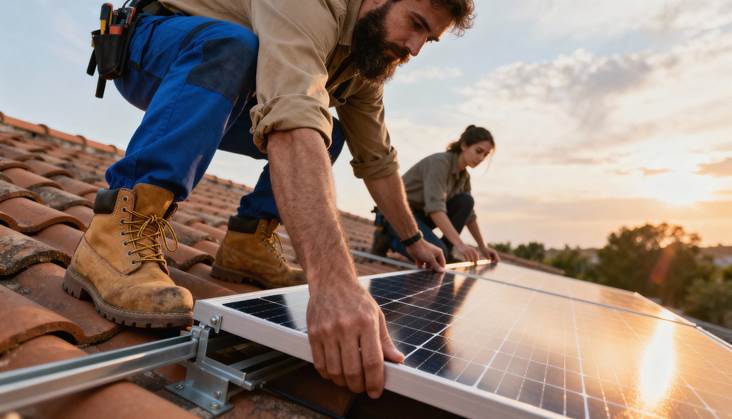
Solar PV is one of the more significant investments a homeowner can make.
A properly sized solar PV system can reduce reliance on electricity purchased from the grid. When combined with other energy-efficiency measures, the potential savings can become more meaningful.
But solar is not simply a case of installing panels and immediately counting the money saved.
The system has a cost.
There may be financing costs.
There may be installation and administration costs.
And the actual savings depend on household consumption, electricity tariffs, system size, usage patterns and other factors.
DirectAxis therefore recommends working out how long a larger project will take to pay for itself before committing.
That means looking beyond the headline price.
Cost versus savings.
Interest versus savings.
Repayments versus the household budget.
The numbers need to work.
Water can be an investment too
The same principle applies to water.
A leaking pipe may look like a maintenance problem.
It is also a money problem.
Rainwater-harvesting tanks, greywater systems, water-efficient taps, efficient showerheads and dual-flush toilets can all help reduce consumption.
And as municipal water costs rise, the value of using less becomes increasingly important.
Rainwater harvesting and greywater systems can also provide an additional layer of resilience during water restrictions or periods of drought.
The objective is not simply to use alternative water sources.
It is to waste less of the water you already pay for.
Three ways to make your home work harder
Letley breaks the approach down into three simple ideas.
Use less.
Improve efficiency so that your home requires less electricity and water to perform the same everyday tasks.
Waste less.
Manage energy and water more carefully, from fixing leaks to improving insulation and replacing inefficient appliances.
Generate more of your own.
Consider renewable technologies such as solar PV or, where appropriate, other options such as a borehole.
It is a remarkably simple framework.
And it can stop home improvement from becoming a shopping spree.
Instead, every project gets one important question:
What does this investment actually save me?
What could these upgrades cost?
The figures supplied by DirectAxis provide an indication of the upfront costs and potential payback periods.
| Improvement | Typical upfront cost | Potential payback |
|---|---|---|
| LED lighting | R500 – R5,000 | 6 – 24 months |
| Geyser blanket and pipe insulation | R700 – R2,000 | 1 – 3 years |
| Heat pump | R18,000 – R35,000 | 3 – 6 years |
| Solar water heater | R20,000 – R45,000 | 3 – 6 years |
| Energy-efficient refrigerator/freezer | R8,000 – R25,000 | 4 – 8 years |
| Ceiling insulation | R10,000 – R40,000 | 4 – 8 years |
| Solar PV with battery | R80,000 – R250,000 | 6 – 12 years |
| Greywater recycling system | R8,000 – R40,000 | 4 – 10 years |
| Rainwater harvesting tanks | R8,000 – R40,000 | 5 – 12 years |
| Water-efficient taps, showerheads and dual-flush toilets | R1,000 – R10,000 | 1 – 5 years |
These figures are indicative estimates supplied in the DirectAxis release. Actual costs, savings and payback periods will vary according to the property, installation, usage, tariffs and other circumstances.
That last point is important.
A payback period is not a guarantee.
Your household may use more or less electricity than another household. Installation prices vary. Tariffs change. Equipment has different lifespans.
So the table should be treated as a starting point for investigation, not a promise of returns.
The smartest renovation may be the one you don’t notice
There is something interesting about efficiency upgrades.
The best ones may not dramatically change how your home looks.
You may not notice the geyser insulation every time you walk through the house.
Nobody is going to admire your efficient showerhead from the pavement.
A ceiling insulation upgrade is hardly a glamorous renovation.
But if these improvements reduce recurring costs, their impact happens quietly — month after month.
That is where the investment argument becomes powerful.
A kitchen renovation might improve the look of your home.
An energy or water-efficiency upgrade can potentially improve both the way your home performs and the cost of running it.
Don’t borrow money before doing the maths
For smaller improvements, DirectAxis says many homeowners may be able to fund projects from their monthly household budget.
Larger projects, such as solar PV, may require financing.
This is where discipline becomes crucial.
Before borrowing, calculate the expected savings.
Then calculate the full cost of financing.
Include interest.
Include administration costs.
Consider the realistic payback period.
And make sure the monthly repayment does not put unnecessary pressure on the household budget.
A project that saves R1,000 a month but creates a repayment that strains the household’s finances is not automatically a financial win.
The numbers have to work from both sides.
A home that pays you back
Homeownership has traditionally been framed around appreciation.
Buy a property.
Maintain it.
Improve it.
Hopefully, its value increases.
But there is another form of return that can happen much sooner.
Every month that an efficient geyser, appliance, lighting system or water-saving installation reduces your household expenses, some of your money stays in your pocket.
That does not make every home improvement a good investment.
It does, however, give homeowners another lens through which to evaluate their spending.
As Letley puts it, every household’s circumstances are different, but the underlying principle remains the same: reduce recurring expenses while improving the value and efficiency of the property.
And perhaps that is the smarter way to renovate.
Don’t ask only what your home can become worth.
Ask what it can stop costing you.