

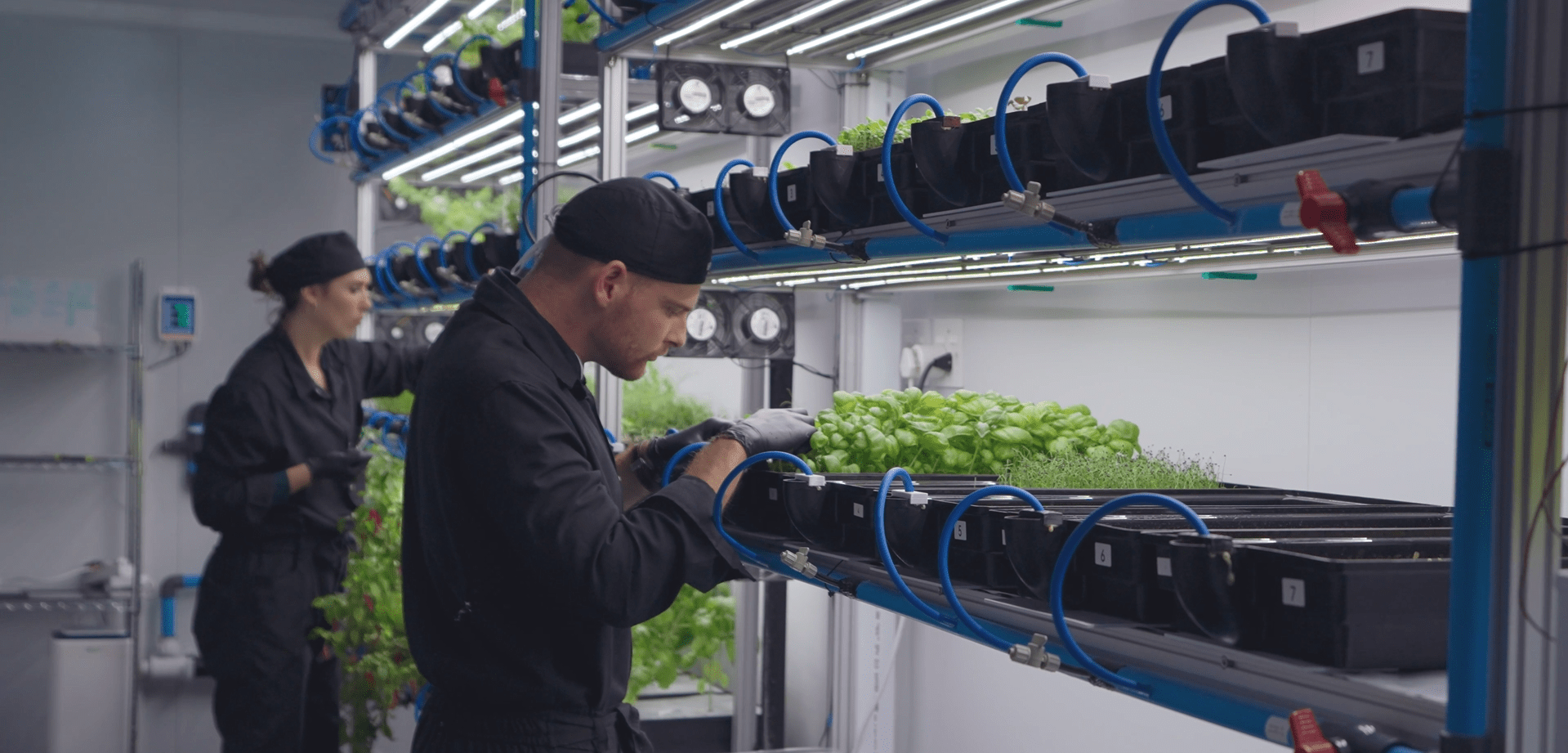
What if the next big idea in South African agriculture does not need a massive field?
What if it needs a shipping container?
In Somerset West, Western Cape, Arable Grow is turning that question into a working business model.
The agri-tech start-up is combining locally developed technology, hydroponics and renewable energy to grow fresh, nutrient-dense produce inside climate-controlled shipping containers.
It is a radically different approach to farming.
And it comes at a time when South Africa is facing mounting pressure from climate change, water scarcity and rapid urbanisation.
As cities grow and agricultural resources come under increasing pressure, Arable Grow believes food production needs to move closer to the people who consume it.
Farming without the traditional field
Conventional agriculture relies heavily on seasonal conditions, large areas of land and transport networks that can move produce from farms to consumers.
Arable Grow takes a different route.
Its modular container farms can be established close to consumers. They can also produce crops throughout the year in controlled environments.
The result is a farming model designed around consistency, proximity and resource efficiency.
One of its biggest advantages is water use.
According to Arable Grow, its container farms use approximately 95% less water than conventional farming.
The system also eliminates the need for pesticides and significantly reduces transport distances and food waste.
Produce can be harvested and delivered to retailers within hours.
That shorter journey helps preserve freshness, flavour and nutritional value while reducing the environmental impact associated with traditional supply chains.
Technology built for Africa
For founder and CEO Hein Duvenhage, Arable Grow was never simply about growing vegetables in an unusual location.
The bigger ambition was to use technology to tackle challenges facing African communities.
“The big idea was to build a business that makes a difference and use innovation and technology to develop a solution designed specifically for Africa,” says Duvenhage.
“We’re trying to solve a high nutritional density problem in urban environments while building a farming model that is more sustainable, more efficient and better suited to the future.”
That focus on local conditions is reflected in the technology behind the farms.
Much of Arable Grow’s technology has been developed in-house rather than imported.
This allows the business to adapt its systems to South African realities.
Solar integration supports the operation, while water-retention systems help conserve resources. The farms are also designed to remain resilient against load shedding, helping maintain reliable production.
It is a model built not only for controlled growing conditions, but for the realities of operating a business in South Africa.
Nothing goes to waste
The sustainability strategy does not stop when the crops leave the growing system.
Arable Grow grows crops according to demand, helping minimise unnecessary production and waste.
But surplus produce does not simply become a loss.
The company dehydrates surplus crops and transforms them into nutrient-rich superfood powder, extending their shelf life while creating additional value from produce that might otherwise go to waste.
The company is also investing in education.
Through its partnership with Beaumont Primary School in Somerset West, Arable Grow introduces learners to urban farming and encourages younger generations to think differently about agriculture.
That means the company’s model is reaching beyond technology and retail.
It is also introducing the next generation to new possibilities in food production.
The challenge beyond the technology
Developing an innovative farming system is one thing.
Getting that innovation onto supermarket shelves is another.
For start-ups, market access can be one of the biggest hurdles. So can achieving rigorous food safety standards, strengthening operations and convincing retailers to back an entirely new model.
For Arable Grow, SPAR became an important part of that journey.
SPAR was the company’s first retail partner, recognising the potential of a locally developed innovation that aligned with its focus on entrepreneurship and stronger local supply chains.
Through the SPAR Supplier Development Programme, Arable Grow received practical guidance to achieve Good Agricultural Practice (GAP) certification, strengthen its operational capabilities and enter the formal retail market.
For Duvenhage, that support went beyond certification.
“Our product offering is unique, and because it’s something new, people don’t always understand it immediately,” he says.
“The partnership with SPAR has given us exactly the kind of backing a start-up needs. Beyond helping us through certification, SPAR’s endorsement has given us credibility and opened doors that would otherwise have taken years to unlock.”
Why supplier development matters
The relationship also highlights the role that established retailers can play in helping emerging South African businesses move from innovation to commercialisation.
For SPAR, supplier development is about more than adding new businesses to its supplier network.
It is about supporting entrepreneurs who are developing solutions with the potential to strengthen local industries, create jobs and deliver long-term value to communities.
“At SPAR, we believe the future of South Africa’s food system depends on supporting local innovation and creating opportunities for entrepreneurs to grow alongside us,” says Yolisha Govender, Group Supplier Development Specialist at SPAR.
“Our Supplier Development Programme is designed to equip emerging businesses with the tools, knowledge and market access they need to build sustainable enterprises.”
Govender says businesses such as Arable Grow demonstrate how South African innovation can help address major challenges, including food security, sustainability and resilient local supply chains.
From Somerset West to South Africa
Arable Grow currently supplies SPAR retailers in the Western Cape.
But the company is thinking much bigger.
Its long-term vision is not to build enormous centralised facilities.
Instead, it sees an opportunity for modular container farms to operate across cities and towns throughout South Africa.
The concept is simple but ambitious: grow food closer to consumers while reducing pressure on traditional agricultural systems.
“We want to demonstrate that vertical farming isn’t just possible in South Africa, it’s scalable,” says Duvenhage.
“If we can establish container farms in communities across the country using technology designed for Africa, we believe we can play a meaningful role in strengthening food security while creating a more sustainable future.”
The future could be closer than we think
The story of Arable Grow is ultimately about more than hydroponics or shipping containers.
It is about rethinking where food comes from and how it reaches consumers.
It is about using technology designed around local realities.
It is about reducing resource use, shortening supply chains and finding new ways to limit waste.
And it is about what can happen when an emerging business gets the right support at the right moment.
From a single container farm in Somerset West to a vision of decentralised food production across South Africa, Arable Grow is showing that agricultural innovation does not always have to begin on vast commercial farms.
Sometimes, it begins somewhere far more unexpected.
Inside a shipping container.
And with the right technology, determination and partnerships, that container could become part of a much bigger solution for the future of South African agriculture.






![{"tiktok_developers_3p_anchor_params":"{"capability_extra_v2":{"portrait":[{"panel":"face-reshape"},{"panel":""}],"filter":[{"origin":"loki","resource_id":"7509778748628013569","effect_id":"2527224001"}]},"template_id":"7541764235387292981","client_key":"awgvo7gzpeas2ho6","capability_key":["filter","portrait"],"filter_id":["2527224001"]}","data":{"infoStickerId":"","activityName":"","appversion":"8.7.0","product":"hypic","pictureId":"0056B987-2C2E-4DB3-B740-00D1F27FBFCB","filterId":"7509778748628013569","playId":"","enter_from":"enter_launch","stickerId":"7541764235387292981","imageEffectId":"","os":"ios"},"source_type":"hypic"}](https://thevibeza.com/wp-content/uploads/2026/10/DF61D1A3-0F37-4DE5-9AE1-F2AF7CDF6022-copy-120x86.jpeg)