
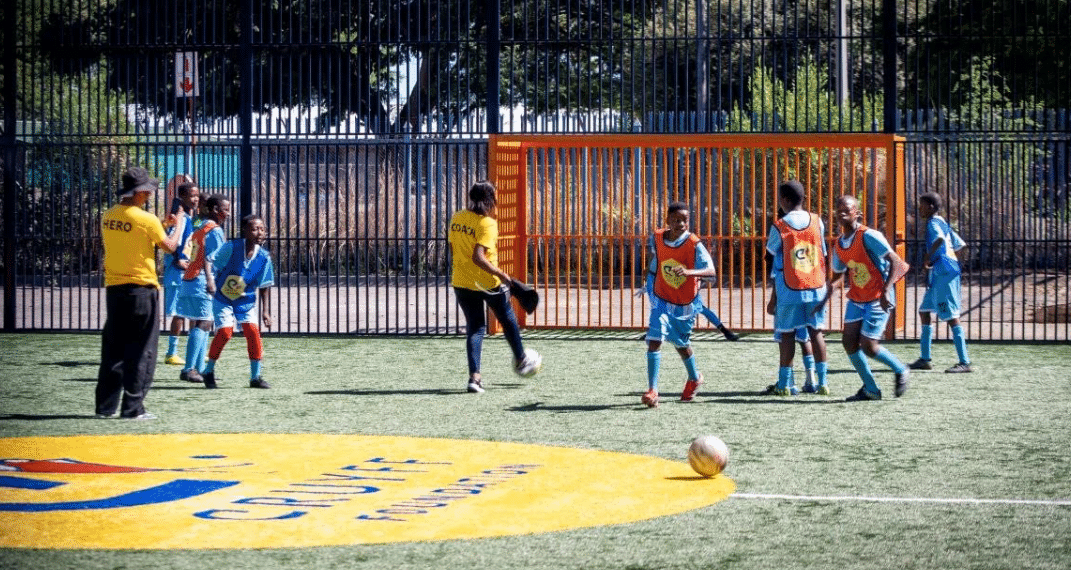
In Marikana, a football or netball court can offer more than a place to play. It can become a space where children build confidence, discover their abilities and learn lessons that extend far beyond the final whistle.
The newly launched Marikana Cruyff Court aims to do just that, bringing sport and recreation into a broader youth development programme designed to help young people prepare for their futures.
Officially launched on 20 October 2026 at the Marikana Youth Centre, the facility is the result of a partnership between Afrika Tikkun, the Johan Cruyff Foundation, Carglass/Belron Netherlands, Sibanye-Stillwater and Scania Southern Africa.
The court adds a dedicated space for physical activity to an existing programme that reaches more than 600 children and young people every year.
Building confidence beyond the classroom
For Afrika Tikkun, sport is part of a bigger picture. Its approach recognises that young people need more than academic support to thrive. They also need opportunities to develop life skills, form relationships and build a sense of belonging.
Agnes Sibanda, Head of Scale and Outreach at Afrika Tikkun, said the new facility strengthens the work already taking place at the centre.
“We believe sport and movement are a key part of children’s lives,” said Sibanda.
She explained that the court gives children another way to participate in structured activities while developing beyond their academic studies. Sport can help them discover their abilities, grow in confidence and learn to work with others.
At Marikana, these experiences form part of a wider support system that includes education, nutrition and social support.
The Marikana Youth Centre officially opened in July 2024. It brings together educational support, digital skills, personal development and social services to help young people prepare for adulthood.
More than a place to play
For more than 30 years, Afrika Tikkun has supported children through its “Cradle-to-Career” model, guiding them from the age of three through education, skills training and employment opportunities.
At the Marikana centre, children from Grade 1 to Grade 9 can access after-school support through the Ignite programme, including literacy and numeracy assistance.
The centre also provides a plated meal each day and access to an auxiliary social worker for children who need additional support.
Older learners can develop digital skills and take part in work readiness programmes. More than 70 digital workstations give them access to learning resources and opportunities that may otherwise be difficult to reach.
These services are particularly important for children from local feeder schools and surrounding rural and peri-rural communities, where distances between schools and families can make structured after-school activities harder to access.
The new court adds another dimension to this support. Planned activities include health and fitness sessions, alongside soccer and netball tournaments that will bring the wider community together.
Sport with a bigger purpose
The Johan Cruyff Foundation uses sport and play to encourage physical activity and support children’s development. Through its partnership with Afrika Tikkun, sport also becomes a way to teach teamwork, resilience and fair play.
Marikana is the fourth Cruyff Court at an Afrika Tikkun centre, following facilities in Diepsloot, Mfuleni and Orange Farm.
Rather than operating as a standalone sports project, the Marikana court forms part of an established youth development programme.
Sibanda said preparing children and teenagers for opportunities beyond school also means looking ahead to a future in which livelihoods may differ from those available today.
The court, she explained, is one part of that wider commitment.
A shared investment in the next generation
Marc Lubner, Executive Chairperson and Group CEO of Afrika Tikkun, said children deserve the space and opportunity to discover what they are capable of achieving.
He highlighted sport’s ability to inspire, unite people and help young people develop confidence, discipline, resilience and a sense of belonging.
“The Cruyff Court brings that opportunity into the heart of the Marikana Youth Centre, strengthening the work already being done to prepare children for the future,” said Lubner.
He added that meaningful investment in young people requires sustained commitment rather than a single intervention.
By bringing together organisations with different resources and expertise, the partnership connects sport with education, skills development and personal growth. The aim is to create an environment where young people can see possibilities for their future and receive support to pursue them.
Lubner also acknowledged the Johan Cruyff Foundation team and Carglass, headed by Bas Creemer, whom he described as a long-standing friend of Afrika Tikkun. He thanked Siyanda Siko of Sibanye-Stillwater for helping make the court possible on company property.
The real impact begins on the court
The launch brought together representatives from partner organisations, sponsors, community stakeholders and programme participants.
Niels Meijer, CEO of the Johan Cruyff Foundation and a former professional basketball player for the Dutch national team, spoke about sport’s ability to bring people together for good and give them a sense of purpose.
Johan Cruyff Foundation ambassador Aron Winter, who played for the Netherlands and several top European clubs, encouraged the men and women coaching and training at Afrika Tikkun to care for the young people as if they were their own. He also emphasised that having fun was the most important measure of success.
Ultimately, the court’s value will be measured by what happens there: the games played, the friendships formed, the skills learned and the children who gain the confidence to try something new.
For Marikana’s young people, the new facility is more than a sporting space. It is another opportunity to learn, connect and imagine a future beyond the limits of their immediate circumstances.
And as the court opens its doors to the community, its biggest victories may not be found on a scoreboard, but in the confidence and possibilities it helps young people build.