

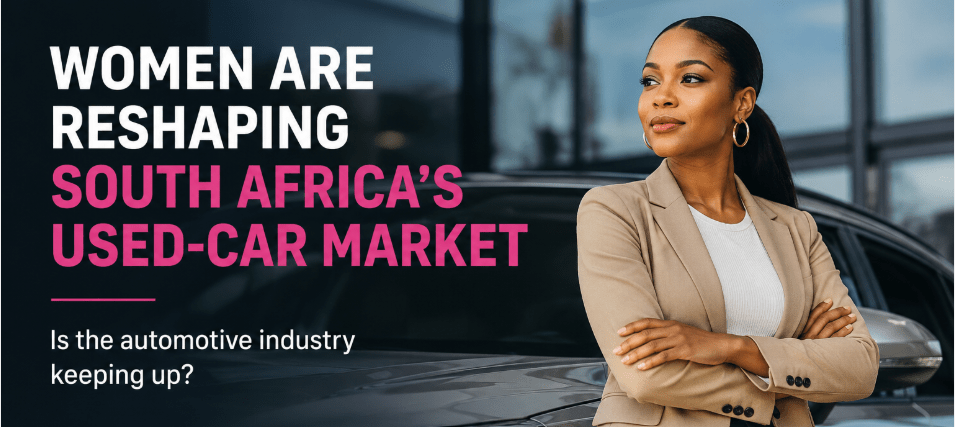
The South African used-car market is changing, and women are increasingly sitting in the driver’s seat of that transformation.
For years, the automotive industry has often operated around assumptions about who the traditional car buyer is. But those assumptions are becoming harder to defend as women’s influence over vehicle purchasing decisions continues to grow.
According to Lightstone Auto, women now account for 39% of all financed vehicle purchases in South Africa, up from 32% a decade ago. Over the same period, men’s share has declined from 68% to 61%.
The numbers point to more than a shift in who is buying cars. They highlight a changing expectation of how cars should be bought.
And according to Sam Ghisleni, Head of Marketing at Weelee, the automotive industry needs to pay attention.
Women aren’t a niche market
Women’s vehicle preferences are also evolving.
SUVs and crossovers are becoming increasingly popular among female buyers, while considerations such as safety, reliability, fuel efficiency and long-term value consistently outweigh performance or prestige.
Toyota remains the most financed brand among women, followed by Volkswagen, while Suzuki continues to gain momentum.
For Ghisleni, however, the most important shift may not be happening in the showroom. It is happening before customers even arrive.
“Women don’t want a different car-buying journey because they’re women – they want a better one because they’re customers.”
She says modern buyers are increasingly conducting their own research before visiting a dealership. They want transparency instead of negotiation, convenience instead of complexity and trust instead of pressure.
That expectation is not exclusive to women.
It could ultimately reshape the experience for everyone.
The old car-buying experience is under pressure
Buying a pre-owned vehicle can be a major financial decision.
Customers have to consider the vehicle’s condition, history, financing, insurance, running costs and long-term value. In an industry historically perceived as intimidating and transactional, particularly within the used-car market, uncertainty can make the process even more difficult.
Digital technology has changed part of that equation.
Consumers can research vehicles, compare options and access information before they ever walk into a showroom.
But technology has not removed one of the most important ingredients in the buying process: trust.
“The more digital the world becomes, the more human businesses need to be,” says Ghisleni.
She believes the role of marketing has therefore changed.
It is no longer simply about generating leads. It is also about reducing uncertainty and giving customers confidence when making one of the biggest financial decisions of their lives.
From selling cars to building confidence
Ghisleni’s approach is shaped by experience across FMCG, marketing agencies, property law and mobility.
At Weelee, she leads a data-driven marketing strategy that combines customer insights, digital experience and storytelling to simplify the vehicle-buying journey.
That philosophy extends into the company’s customer experience.
Weelee’s approach includes independently inspected and quality-checked vehicles, transparent condition reports, in-house finance and insurance solutions, and an online-to-showroom experience.
The objective is to remove some of the uncertainty traditionally associated with buying a used vehicle.
The idea is straightforward: the customer should have the information needed to make a confident decision.
What women want from a vehicle
The data suggests that female buyers are taking a pragmatic approach to their vehicle purchases.
Rather than focusing primarily on prestige or performance, safety, reliability, fuel efficiency and long-term value are important considerations.
Ghisleni believes this behaviour is frequently misunderstood.
“They’re not a niche market – they’re one of the fastest-growing customer segments.”
She argues that women often research more thoroughly, consider the total cost of ownership carefully and make pragmatic purchasing decisions.
For automotive businesses, understanding these behaviours could have consequences far beyond attracting more female customers.
It could encourage companies to improve the overall buying experience.
Mobility is about more than the car
The conversation also extends beyond the vehicle itself.
As South Africa marks Women’s Month, Ghisleni says the role of mobility in economic participation deserves greater attention.
A reliable vehicle can influence how people access employment, operate businesses, support families and build greater independence.
“A reliable vehicle is about far more than getting from A to B.”
That perspective places vehicle ownership within a much broader economic picture.
If buying a car becomes more transparent, accessible and straightforward, the impact can extend beyond the transaction itself.
The industry has a choice to make
South Africa’s automotive industry is facing a customer base that is increasingly informed, digitally connected and unwilling to accept unnecessary complexity.
Women now represent 39% of financed vehicle purchases, according to Lightstone Auto.
Their growing purchasing power is forcing an important question:
Is the automotive industry keeping up with the people actually buying the cars?
For brands, the answer may not simply be about developing different products or marketing specifically to women.
It may be about creating a better experience for everyone.
Clear information. Honest pricing. Reliable vehicle information. Digital convenience. Personalised support. And, above all, trust.
Because the future of automotive retail may not belong to the brands that sell the most aggressively.
It may belong to the brands that make customers feel most confident about buying.












![{"tiktok_developers_3p_anchor_params":"{"capability_extra_v2":{"portrait":[{"panel":"face-reshape"},{"panel":""}],"filter":[{"origin":"loki","resource_id":"7509778748628013569","effect_id":"2527224001"}]},"template_id":"7541764235387292981","client_key":"awgvo7gzpeas2ho6","capability_key":["filter","portrait"],"filter_id":["2527224001"]}","data":{"infoStickerId":"","activityName":"","appversion":"8.7.0","product":"hypic","pictureId":"0056B987-2C2E-4DB3-B740-00D1F27FBFCB","filterId":"7509778748628013569","playId":"","enter_from":"enter_launch","stickerId":"7541764235387292981","imageEffectId":"","os":"ios"},"source_type":"hypic"}](https://thevibeza.com/wp-content/uploads/2026/10/DF61D1A3-0F37-4DE5-9AE1-F2AF7CDF6022-copy-120x86.jpeg)
