
 January has a way of demanding reinvention. It’s the month of fresh starts, bold resolutions and renewed ambition — yet for many professionals, the pressure to do more can feel overwhelming. Learning, in particular, often gets pushed aside, perceived as another demand on already stretched time and energy.
But what if growth didn’t require burnout?
Enter the 5-Hour Rule — a deceptively simple principle with the power to quietly transform your career and mindset in 2026.
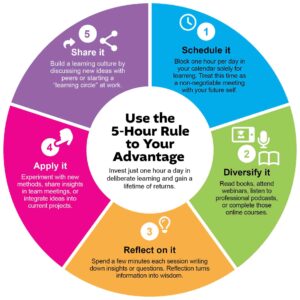
Popularised by author Michael Simmons, the 5-Hour Rule encourages individuals to dedicate just five hours a week — roughly one hour a day — to deliberate learning. Not multitasking. Not passive scrolling. But focused time spent reading, reflecting, experimenting, or practising a skill with intention.
The result is not pressure, but progress. Not overwhelm, but momentum.
A small habit with exponential returns
In a world engineered to hijack attention, the 5-Hour Rule is an act of quiet rebellion. Rather than surrendering your time to endless notifications and algorithms, it invites you to invest that energy in yourself — on your own terms.
This modest weekly commitment has profound effects. It helps professionals stay relevant in a rapidly changing economy, sharpen critical thinking, and rediscover the intrinsic joy of learning — a joy often lost amid deadlines and performance metrics.
Learning from the greats
The power of the 5-Hour Rule is not theoretical. Some of the world’s most accomplished leaders have long practised its principles.
Bill Gates is known to read around 50 books a year.
Oprah Winfrey credits her success to a lifelong commitment to reading and self-development.
Elon Musk, polarising though he may be, famously taught himself rocket science through focused study and application.
And Warren Buffett has said he spends up to 80% of his day reading and thinking.
Their schedules are relentless, yet their commitment to learning remains non-negotiable — a clear signal that growth is not about having more time, but about making better choices with the time you have.
Why learning at work matters more than ever
In today’s workplace, skills expire faster than ever before. Technology evolves, industries shift, and job roles are constantly being redefined. In this environment, learning agility has become one of the most valuable professional assets.
Research consistently shows that employees who engage in continuous learning are more adaptable, innovative and engaged. They solve problems more effectively, connect ideas across disciplines, and are better equipped to navigate uncertainty.
“Learning in the workplace is not just about keeping up — it’s about staying relevant,” says Michael Gullan, CEO of G&G Advocacy, an eLearning consultancy specialising in workforce development.
“Learning builds confidence, strengthens problem-solving skills, and encourages innovation by connecting ideas from different disciplines.”
How to apply the 5-Hour Rule at work
Implementing the 5-Hour Rule doesn’t require enrolling in expensive courses or chasing additional qualifications. At its core, the rule is about consistency, curiosity and intentionality.
Many organisations already offer continuous learning programmes designed to help employees upskill and reskill. Where these resources exist, they are often underutilised — not because they lack value, but because learning is not deliberately prioritised.
“If your place of work doesn’t provide access to online training and further development, look for relevant courses yourself,” Gullan advises.
“Even a small investment in deliberate learning can elevate your performance and open new opportunities in your role.”
The key is to treat learning as part of your job, not something extra.
Building a culture of learning
Now imagine the collective impact if every employee in an organisation committed just five hours a week to learning.
The results would be transformative: stronger collaboration, sharper thinking, increased innovation and a measurable competitive advantage. Learning cultures don’t emerge by chance — they are built through consistent individual habits that scale across teams.
As 2026 begins, the invitation is simple: replace fleeting resolutions with a sustainable commitment to growth.
The 5-Hour Rule isn’t about adding more to your schedule. It’s about investing intentionally in your future.
“The best professionals aren’t those who know the most — they’re the ones who never stop learning,” Gullan concludes.
“The smartest investment any professional can make is in their own development. The world is changing faster than ever, and staying curious is the only way to stay relevant.”