

KwaZulu-Natal has never lacked natural beauty. From rugged mountains and rolling hills to a dramatic coastline, rich Zulu heritage, historic battlefields and thriving wildlife reserves, the province has long possessed the ingredients for world-class tourism.
Yet for decades, one challenge remained: turning those natural assets into destination experiences compelling enough to make visitors stay longer.
That equation is beginning to change.
Following the announcement of a new development by Club Med on the province’s North Coast set to open later this year, a complementary private investment is emerging inland — one that could redefine the tourism landscape of the KwaZulu-Natal Midlands.
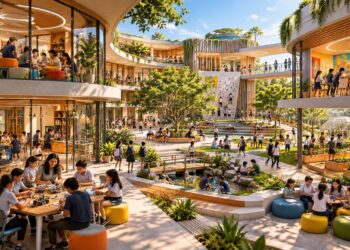
At the heart of this transformation is Brahman Hills, an award-winning sanctuary-style destination that has announced a multi-million Rand investment in the Serenity Garden. The ambitious project is set to become one of the most distinctive tourism developments in the region, anchored by what is planned to be the world’s largest labyrinth and a first-of-its-kind spa in Africa and the Indian Ocean Islands.
Turning a Scenic Pass-Through into a Destination
For many travellers, the Midlands has historically been a picturesque drive rather than a primary stop. Visitors pass through its misty valleys, charming farm stalls and art studios while travelling between coast and countryside.
But the vision behind Serenity Garden aims to change that narrative entirely.
“By creating a globally significant landmark, we expect to attract not only local holidaymakers but international travellers looking to discover something architecturally ambitious and experientially rare,” says Orrin Cottle, CEO of Brahman Hills.
The scale of the project is striking, yet its intention is the opposite of mass tourism.
According to Cottle, the development has been carefully designed as a sanctuary rather than a high-volume attraction — a place where guests can step away from the pace of modern life.
“Our intention is not to build a high-volume attraction. The Serenity Garden is designed as a sanctuary; a space for quiet reflection, where guests can reconnect with nature, art and themselves,” he explains.
A Vision Taking Shape by 2026
Scheduled to open toward the end of 2026, the Serenity Garden will stretch across 22 hectares, making it one of the most ambitious tourism projects in the KwaZulu-Natal Midlands.
The development will feature a series of carefully curated spaces designed to immerse visitors in nature, architecture and contemplative design. Among its key elements are:
-
The world’s largest labyrinth, designed as a symbolic and meditative journey
-
An underground orchid house showcasing rare botanical beauty
-
Curated olive groves that blend landscape design with agricultural heritage
-
A nine-metre waterfall forming a dramatic natural centrepiece
-
Expansive landscaped gardens designed for reflection and exploration
Each element has been intentionally planned not simply to impress, but to invite pause — creating an environment where nature, art and tranquillity intersect.
Jobs, Growth and a Stronger Midlands Economy
Beyond its architectural ambition, the project is already delivering tangible economic benefits.
Construction of the Serenity Garden, along with the expansion of the spa and renovations to the five-star Premium Signature Villas, has begun generating employment in the region. Once operational, the development will require a wide range of skilled and semi-skilled roles across garden management, visitor services, hospitality and maintenance.
But the real impact could extend far beyond the property itself.
Tourism experts have long emphasised that visitor length of stay is one of the strongest drivers of local economic growth. When travellers linger longer in a destination, they explore further — dining at restaurants, browsing galleries, visiting markets and booking outdoor adventures.
That ripple effect supports independent businesses and strengthens surrounding communities.
“When people stay longer, they explore more,” says Cottle. “It’s a win-win. The Midlands will win, independent businesses will win, and the province will win — but most importantly, lives will be shifted by this project.”
Reimagining KwaZulu-Natal’s Tourism Story
For decades, KwaZulu-Natal’s tourism narrative has centred on sun, sea and safari. While those pillars remain powerful attractions, developments like Serenity Garden represent a new chapter — one focused on experience-led travel.
This approach encourages visitors to move beyond the coastline and discover the depth of the province’s cultural and natural landscape.
The Midlands, with its rolling countryside and creative communities, is uniquely positioned to benefit from that shift.
Cottle believes the project reflects a broader confidence in the region’s future.
“We are building something that will outlive us. Something our children’s children will inherit with pride,” he says. “KwaZulu-Natal is rich in culture, history and natural beauty. It has often been undersold. We believe the province deserves infrastructure that matches its potential.”
A Foundation for Generations
Ultimately, the Serenity Garden is more than a tourism development. It represents a belief that carefully planned, long-term investments can elevate entire regions.
By combining architecture, nature, wellness and cultural storytelling, the project seeks to create a destination that invites visitors not only to see the Midlands — but to truly experience it.
If successful, it could help reshape the way travellers move through KwaZulu-Natal, encouraging them to slow down, stay longer and discover the province in ways they never have before.
And in doing so, the rolling hills of the Midlands may finally take their place as a destination in their own right.