
JOHANNESBURG, April 2026 — Ten years after Starbucks planted its first store on African soil, two parallel journeys finally converge: the global story of coffee expansion on the continent, and the deeply personal journey of South African barista Kabelo Jori. This month, those stories meet in Rwanda — a country where coffee is not just an export, but a symbol of rebuilding, resilience, and renewal.
What begins as a competition win quickly becomes something far more profound: a return to the roots of a cup he has served hundreds of times, without ever standing where it is grown.
Rwanda: Where Coffee Became a Language of Recovery
Rwanda is not an incidental stop on the global coffee map. It is a country where coffee has played a quiet but powerful role in national recovery following the 1994 genocide.
Since 2004, Starbucks has been sourcing coffee from Rwanda, building long-term relationships with local farmers and cooperatives. In 2009, the Kigali Farmer Support Centre was established — the first of its kind on the African continent — where agronomists work directly with smallholder farmers on soil health, yield improvement, and sustainable farming practices.
Today, nearly half a million Rwandan farmers are connected to the coffee industry. Behind every bag shipped to markets — including South Africa — sits more than two decades of agricultural partnership, knowledge-sharing, and quiet transformation.
A Competition That Became a Calling
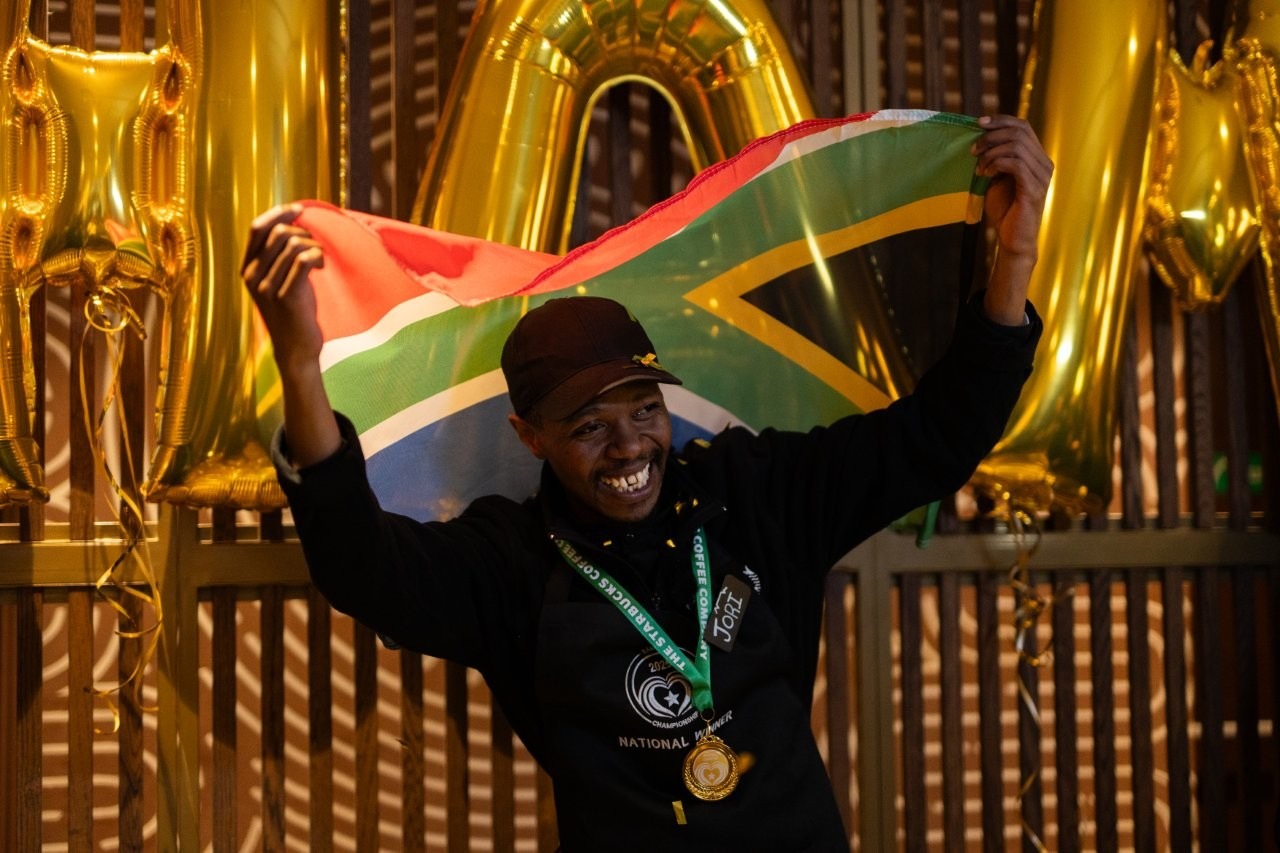
For Kabelo Jori, a South African barista, the opportunity to join the Starbucks Origin Experience trip to Rwanda came after outperforming 83 fellow partners. But the meaning of the moment shifted long before he boarded the plane.
He describes the moment he first heard he would be going to Rwanda:
“Honestly, it felt bigger than excitement. It was a mix of disbelief and responsibility. Rwanda wasn’t just a destination. It felt like being invited back to the beginning of something I’ve been part of for years without fully understanding. I was nervous, yes, but more than that, I felt chosen to carry a story.”
What started as a competition evolved into something deeper — representation.
“It stopped being a competition the moment I realised I wasn’t trying to win anymore. I was trying to represent. Represent my store, my partners and every cup I’ve ever served. That shift from proving something to standing for something, that’s when it became a calling.”
Redefining Mastery Behind the Bar
Within Starbucks culture, the purple apron represents mastery. But for Kabelo, Rwanda is reshaping what mastery truly means.
“Before, mastery felt like precision, recipes, technique, consistency. Now, mastery feels like connection. It’s understanding the hands behind the coffee, the soil, the story, and carrying that with intention every time I serve a cup.”
He has served Rwandan coffee to hundreds of guests in South Africa. Now, for the first time, he will stand where it is grown — where every bean begins its journey.
And when he returns, he says, something fundamental must change.
“I hope my hands slow down. Not in skill, but in awareness. I want every movement to carry meaning, knowing exactly where this coffee comes from and who made it possible. I don’t just want to make drinks. I want to honour them.”
The Silence That Says Everything
For Kabelo, coffee is not defined by taste alone. It is defined by presence — and the quiet moment that follows.
“A perfect cup feels like presence. Like everything else pauses for a second. It’s warmth, but also clarity. It’s that quiet moment where nothing needs to be added or changed. You feel it before you even think about it.”
He knows the exact moment it happens behind the bar.
“Yes. It’s that moment just after the first sip, when someone doesn’t speak. They just pause. You see it in their face. That silence is everything. That’s when I know the coffee has done something deeper than just taste good.”
A Message From the Source
When asked what Rwanda’s coffee might say to South Africa, his response is simple — but deliberate.
“Slow down and listen to me. Not just taste me, but understand me. There’s a story in every sip and it deserves your attention.”
Even technical perfection, he explains, is not always enough.
“I’ve redone a drink more times than I’d like to admit. Not because it was wrong on paper, but because it didn’t feel right. Sometimes you just know. It might look perfect, but if it doesn’t sit right with you, you start again.”
Coming Home Changed
As Kabelo prepares to travel to Rwanda through the Starbucks Origin Experience, the real question is not what he will see — but who will return.
“Someone more grounded. More aware. Less focused on being impressive and more focused on being intentional. The person coming back understands that coffee isn’t just a product. It’s people, its place and its purpose.”
Ten Years On: A Story Still Brewing
A decade after Starbucks entered Africa, the journey is no longer just about expansion. It is about connection — between farmer and barista, soil and cup, story and sip.
In Rwanda, coffee helped rebuild livelihoods. In Johannesburg, it is helping reshape perspective. And in between those two points stands one barista, carrying something far bigger than a drink — a story still being written.