

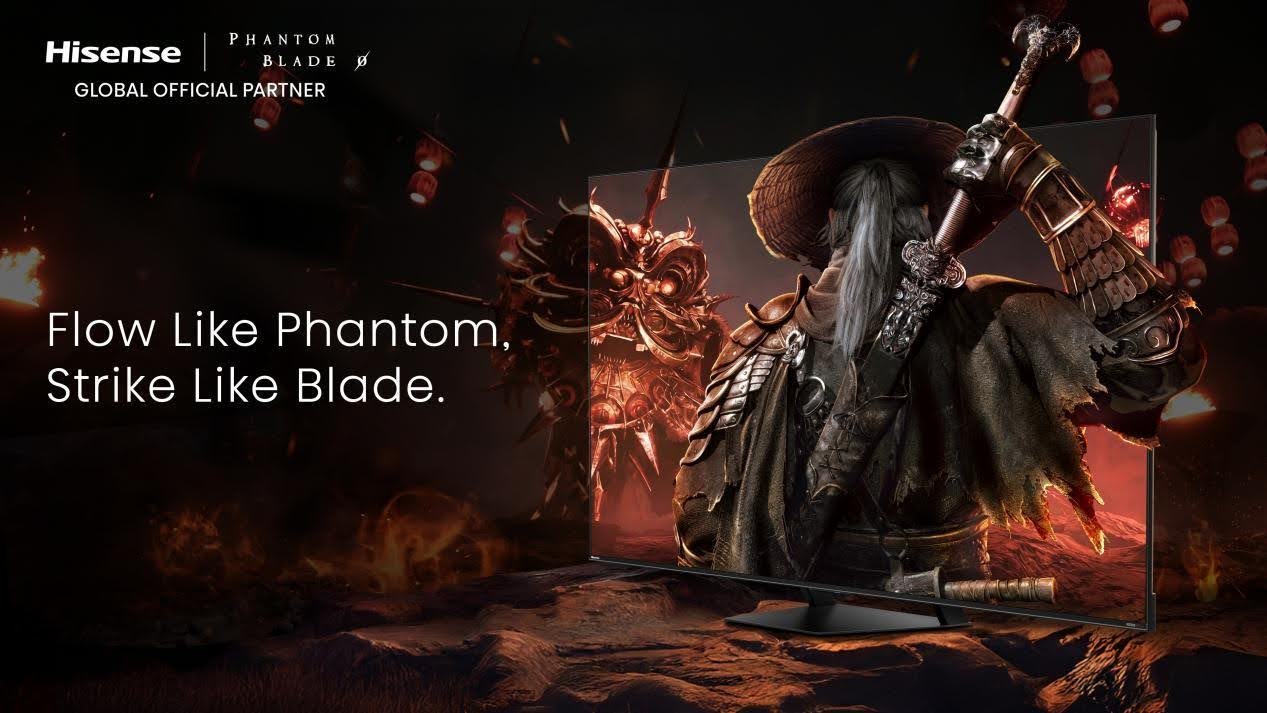
In a world where gaming is no longer just played but felt, the line between reality and digital immersion continues to blur. This week, that evolution takes a decisive leap forward as Hisense confirms its renewed global partnership with Phantom Blade Zero—a collaboration that places next-generation display technology at the very heart of modern gameplay.
And while the announcement will be brought to life thousands of kilometres away in Brazil, its impact is already echoing across South Africa’s rapidly expanding gaming landscape.
A Global Stage for a New Gaming Standard
The partnership will take centre stage at Gamescom LATAM 2026, the largest gaming event in Latin America, running from 30 April to 3 May at the iconic Distrito Anhembi in São Paulo.
Here, Hisense will move beyond traditional product showcases, demonstrating how advanced display technologies translate directly into real gameplay scenarios. The goal is clear: to show how visual precision, speed, and depth can transform how players experience a game—not as observers, but as participants inside it.
At the centre of this experience is Phantom Blade Zero, a visually rich, Wuxia-inspired action title developed by S-GAME. Known for its cinematic combat and atmospheric world-building, the game becomes a perfect testing ground for what next-generation displays can achieve.
Where Technology Meets Emotion
Gaming today is as much about emotional immersion as it is about performance. According to Hisense, that balance is exactly where this partnership thrives.
The brand’s display technology focuses on enhanced colour expression, deeper contrast, and fluid motion rendering—elements that, in a fast-paced action game, are not just aesthetic upgrades but functional necessities. Every movement, shadow, and strike in Phantom Blade Zero is designed to feel immediate, responsive, and alive.
As Paul Zhang, General Manager of Brand and Marketing at Hisense Global Commercial Center, explains, the aim is not simply to display a game—but to pull players into it fully, where every frame carries both precision and emotional weight.
Why This Matters for South African Gamers
While the showcase unfolds in Brazil, the implications for South Africa are tangible and immediate.
The local gaming industry has been on a steady rise, driven by faster internet access, the growth of esports, and a new generation of players demanding global-standard experiences. South African gamers are no longer content with basic setups—they are investing in performance, immersion, and competitive edge.
Hisense’s growing footprint in the country reflects this shift. With its latest ULED and Mini-LED TV ranges already available locally, the brand is positioning itself as a serious contender in the gaming hardware space. Features such as ultra-low latency, high refresh rates, and refined colour accuracy are no longer luxuries—they are becoming essential tools for both casual and competitive players.
This partnership signals a broader commitment: bringing world-class gaming experiences closer to home.
Beyond Screens: A Strategic Vision
For Hisense, this collaboration is not an isolated campaign—it’s part of a wider strategy to embed itself within global gaming culture.
Rooted in its “Innovate a Brighter Life” philosophy, the company continues to push a human-centric approach to technology. That means designing products not just for performance metrics, but for how people actually experience and interact with them.
From cinematic storytelling to competitive gameplay, the future of gaming is being shaped by how seamlessly technology disappears into the experience itself. And through partnerships like this, Hisense is positioning its displays as the invisible force behind that transformation.
The Future Is Already Loading
As Phantom Blade Zero prepares to captivate global audiences, one thing is clear: the next generation of gaming will not be defined by hardware alone, but by how deeply it connects players to the worlds they enter.
For South African gamers, that future is no longer distant. It’s arriving—frame by frame, pixel by pixel—on screens designed to do more than show the game.
They bring it to life.