
A stretch of Bree Street long known for its restaurants, creative culture and relentless urban energy is becoming something else entirely: a blueprint for the future of South African cities.
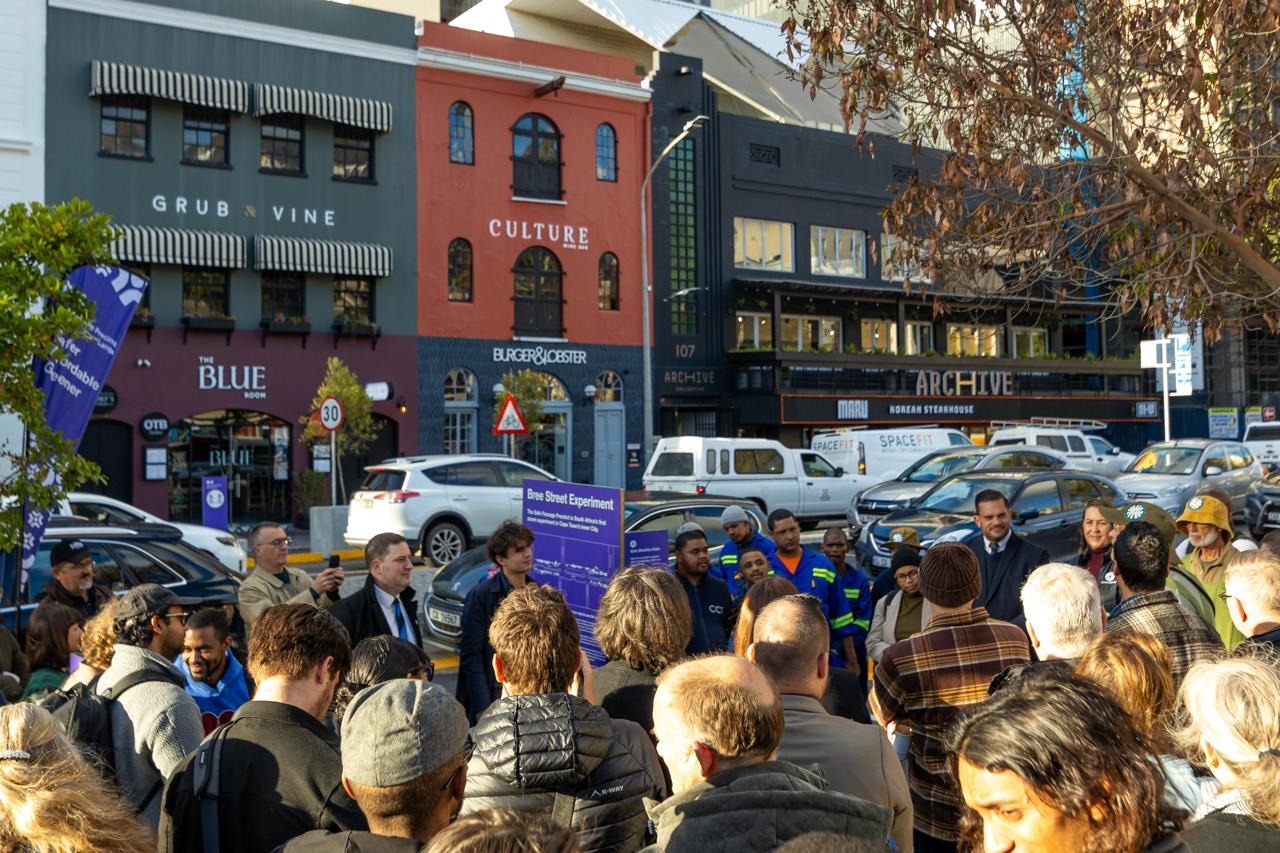
On 7 May 2026, Geordin Hill-Lewis officially opened the Safe Passage Precinct, marking the launch of South Africa’s first inner-city street experiment — a bold six-month urban pilot designed to test how public streets can function when people, rather than vehicles, become the priority.
The initiative transforms part of Bree Street in Cape Town’s CBD into a living, data-driven mobility experiment focused on safety, accessibility, sustainability and economic activation.
And for many urban planners, mobility experts and city developers, it may signal the beginning of a radically different approach to how South African cities are designed.
A street redesigned around people
Led by Young Urbanists NPC in partnership with SDI Development Trust, and supported by the City of Cape Town, Adreach Group, the Mission for Inner City Cape Town and various local and international partners, the project seeks to answer a deceptively simple question:
What happens when streets are designed for humans first?
The pilot temporarily narrows the section of Bree Street between Wale and Shortmarket Streets into a single mixed-traffic lane in each direction, reclaiming road space for pedestrians, cyclists, delivery riders and public interaction.
Using fully reversible infrastructure, including:
- Temporary kerbs
- Bollards
- Removable seating
- Urban greenery and planters
- Dedicated loading bays
- Protected motorcycle parking
the experiment creates a flexible urban environment capable of evolving based on real-world public use and measurable data.
A living experiment in safer cities
Unlike permanent infrastructure projects that often commit cities to expensive long-term decisions before outcomes are fully understood, the Safe Passage Precinct operates as a live pilot.
The idea is not simply aesthetic improvement.
It is evidence-based urban testing.
According to Roland Postma, the project is designed to measure how streets perform when road space is redistributed more equitably.
“This is a live pilot to measure safety, movement, business activity, and how people use the street on a daily basis,” he explains.
“By temporarily reallocating road space with temporary delineator kerbs, bollards, removable seating, landscaping, and defined loading bays, we can improve pedestrian safety, calm traffic, and support local economic activity while maintaining access for through traffic.”
Cape Town’s broader urban vision
The experiment directly supports the City of Cape Town’s broader CBD Mobility and Access Plan, which identified Bree Street as a “Special Activity Street” because of its exceptionally high pedestrian activity and concentration of restaurants, retail spaces and creative businesses.
For years, however, much of the street’s design still prioritised vehicle movement over human experience.
The Safe Passage Precinct aims to reverse that imbalance.
Mayor Geordin Hill-Lewis described the project as a major step toward more liveable urban spaces.
“Today’s launch of the Safe Passage Precinct as a street experiment is an exciting step forward in making our streets more friendly for their actual users — people and pedestrians, not just cars,” he said.
He also linked the initiative to the growing popularity of Bree Street’s seasonal car-free Sundays, which have increasingly transformed the area into a public gathering space for families and communities.
What visitors experience on Bree Street now
For pedestrians arriving on Bree Street today, the changes are immediately visible.
Traffic moves more slowly and deliberately at a pedestrian-conscious 30km/h. Seating areas invite people to stop rather than rush through. Greenery softens the urban landscape. Dedicated mobility hubs provide safer infrastructure for delivery drivers and riders.
Meanwhile, formal commercial loading bays reduce illegal parking and congestion — helping balance pedestrian needs with the realities of commercial activity.
Rather than restricting urban life, the redesign attempts to harmonise it.
From Bree Street to national impact
Importantly, the Bree Street experiment is only the beginning.
The initiative forms the first phase of the broader Safe Passage Programme, which aims to connect Cape Town’s townships, informal settlements and economic hubs through safer, greener and more inclusive transport corridors.
Phase Two is expected to extend the route along Albert Road toward Langa.
The long-term ambition stretches far beyond Cape Town itself.
Insights gathered from the project are intended to inform future urban interventions across:
- Woodstock
- Salt River
- Langa
- Dunoon
- and potentially cities across South Africa
The rise of “Brand Urbanism”
An especially distinctive element of the initiative is the role played by Adreach Group, which has positioned itself as the exclusive media partner for the project.
The company describes its involvement through the concept of “Brand Urbanism” — the idea that brands can actively contribute to shaping public urban environments while simultaneously gaining meaningful visibility.
Art installations, cycle lane infrastructure, street activations and even the project’s zero-emission Safe Passage Mellow Van feature commissioned work from local artists integrated into the urban landscape itself.
According to Ryan Hancock, the initiative demonstrates how commercial partnerships can support genuine civic improvement.
“This initiative connects brands directly with Bree Street, delivering exceptional visibility while supporting a meaningful community project that is improving lives and public spaces.”
Why this matters now
The significance of the Safe Passage Precinct reaches beyond Cape Town.
Across South Africa, cities continue grappling with traffic congestion, unsafe pedestrian environments, fragmented transport systems and spatial inequality inherited from decades of urban separation.
Projects like this challenge older assumptions about what streets are for.
They suggest that roads are not merely corridors for cars — but public spaces capable of creating safety, economic activity, environmental resilience and social connection.
And perhaps most importantly, the experiment reframes urban development as something collaborative.
Not simply government-led.
Not purely private-sector driven.
But collectively shaped by communities, planners, businesses and citizens themselves.
The Safe Passage Precinct may begin on one street in Cape Town.
But its implications could stretch across the country.