Why Addiction Must Become Part of the Student Success Conversation.
Every June, South Africa reflects on the promise of its youth.
Youth Month is a celebration of resilience, ambition and possibility. It is a time to acknowledge the progress made in expanding educational opportunities while also confronting the realities that continue to stand between young people and the futures they deserve.
For decades, significant investments have been made to improve access to education, increase participation in higher learning and create pathways to employment and economic inclusion. These efforts have been driven by a shared understanding that the country’s long-term prosperity depends on the success of its youth.
Yet despite these investments, a troubling question remains: Are South Africa’s students truly succeeding once they gain access to higher education?
A growing body of evidence suggests that the answer is far more complicated than graduation statistics alone can reveal.
Beyond Access: The Challenge of Student Success
Higher education has long been viewed as one of the most powerful tools for social mobility.
For many young South Africans, earning a qualification represents more than academic achievement. It symbolises financial independence, career opportunities, family upliftment and a chance to break cycles of poverty and inequality.
However, gaining admission to a university or college is only the beginning of the journey.
According to the Council on Higher Education’s most recent cohort data, 38% of students who began three-year degree programmes at South African public and private institutions in 2016 had not graduated within five years.
The statistic highlights a reality that many institutions, policymakers and social investors are grappling with: access alone does not guarantee success.
Students continue to face a complex web of social, economic, institutional and personal challenges that can derail even the most promising academic journeys.
Poverty, unemployment, inequality, housing instability, mental health struggles and financial pressure remain deeply entrenched obstacles for many young people attempting to navigate higher education.
These challenges influence not only academic performance but also how students cope with stress, uncertainty and the pressures of building a future in an increasingly demanding world.
Looking Beyond Traditional Measures
In 2025, Tshikululu Social Investments published Beyond Access: Reimagining Student Success as a Systemic Imperative, a paper exploring the broader factors shaping student outcomes in South Africa.
The publication examined how academic, social, financial, institutional and environmental realities intersect to influence educational success.
Its central question was both simple and profound:
In an environment marked by multiple overlapping pressures, can students truly seize the opportunities that higher education promises?
The findings underscored the importance of viewing student success as a systemic challenge rather than a purely academic one.
While significant resources have been invested in academic support, financial aid, accommodation, mental health services and student development programmes, there remains a need to better understand how these various factors interact and influence one another.
This broader perspective forms the foundation of Tshikululu’s latest research initiative.
The Issue Few Are Talking About
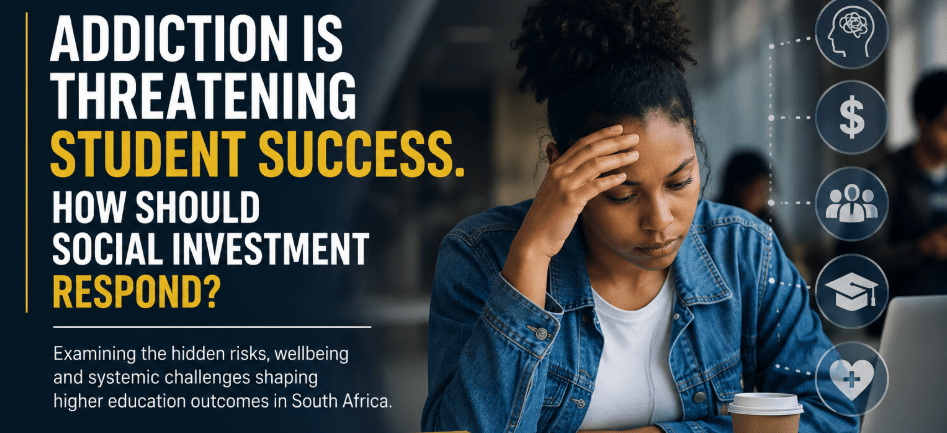
The second paper in Tshikululu’s Rethinking Student Success series introduces a topic often overlooked in discussions about higher education outcomes: addiction.
Developed in partnership with Thrive Student Living, Addiction, Wellbeing and Hidden Risks in Higher Education argues that addiction should no longer be viewed solely as a health, behavioural or disciplinary concern.
Instead, it should be recognised as a critical factor influencing student success.
Substance abuse, gambling, digital dependency and other compulsive behaviours are frequently treated as isolated problems.
However, the paper suggests these behaviours often serve as indicators of deeper challenges affecting students’ wellbeing, academic engagement, retention and long-term educational outcomes.
By examining addiction through this broader lens, institutions and investors gain valuable insight into the pressures students experience long before those struggles become visible through poor academic performance or dropout rates.
Addiction as a Warning Signal
One of the paper’s key arguments is that addiction often reveals underlying realities that may otherwise remain hidden.
Stress.
Loneliness.
Financial hardship.
Mental health challenges.
Social isolation.
A lack of belonging.
Uncertainty about the future.
These factors can contribute to unhealthy coping mechanisms that gradually undermine student wellbeing and academic success.
Rather than viewing addiction purely as a behavioural issue, the research positions it as a signal that points to broader systemic vulnerabilities.
In this context, addiction becomes one of the few visible indicators that multiple hidden pressures may be converging in a student’s life.
It provides institutions with an opportunity to identify and address challenges before they escalate into academic failure or permanent disengagement from higher education.
Why Social Investment Must Evolve
For social investors, funders and policymakers, the implications are significant.
The challenge is not simply to fund addiction treatment programmes or behavioural interventions.
It is to understand and address the underlying conditions that contribute to addiction in the first place.
This requires a more integrated approach to student support.
Academic performance cannot be separated from mental health.
Financial wellbeing cannot be isolated from emotional resilience.
Housing security cannot be disconnected from educational outcomes.
Each element influences the others.
According to Tshikululu, strengthening student success requires recognising these interconnected realities and designing interventions that respond to the full student experience.
When support systems are fragmented, students often fall through the cracks.
When support systems work together, students are more likely to convert educational opportunities into meaningful success.
The Invisible Influences Shaping Outcomes
The conversation around student success often focuses on measurable outcomes such as graduation rates, pass rates and employment statistics.
While these metrics remain important, they do not always reveal the invisible factors shaping those results.
The pressures students face are often deeply personal, complex and difficult to quantify.
Yet their impact can be profound.
As South Africa reflects on the future of its youth, there is growing value in shifting attention toward the realities that exist beneath the surface.
Understanding these hidden influences may prove essential to improving outcomes in a meaningful and sustainable way.
A New Perspective on Student Success
The upcoming paper, Rethinking Student Success: Addiction, Wellbeing and Hidden Risks in Higher Education, challenges institutions, investors and policymakers to rethink how they define and support student success.
Its message is clear.
If South Africa is serious about empowering young people through education, it must look beyond access alone.
Opportunity matters.
But opportunity without the support needed to navigate life’s hidden challenges can only go so far.
The future of student success may depend less on the opportunities we create and more on how effectively we help young people overcome the invisible barriers standing in their way.
The publication will be available on the Tshikululu Social Investments website later this month.