
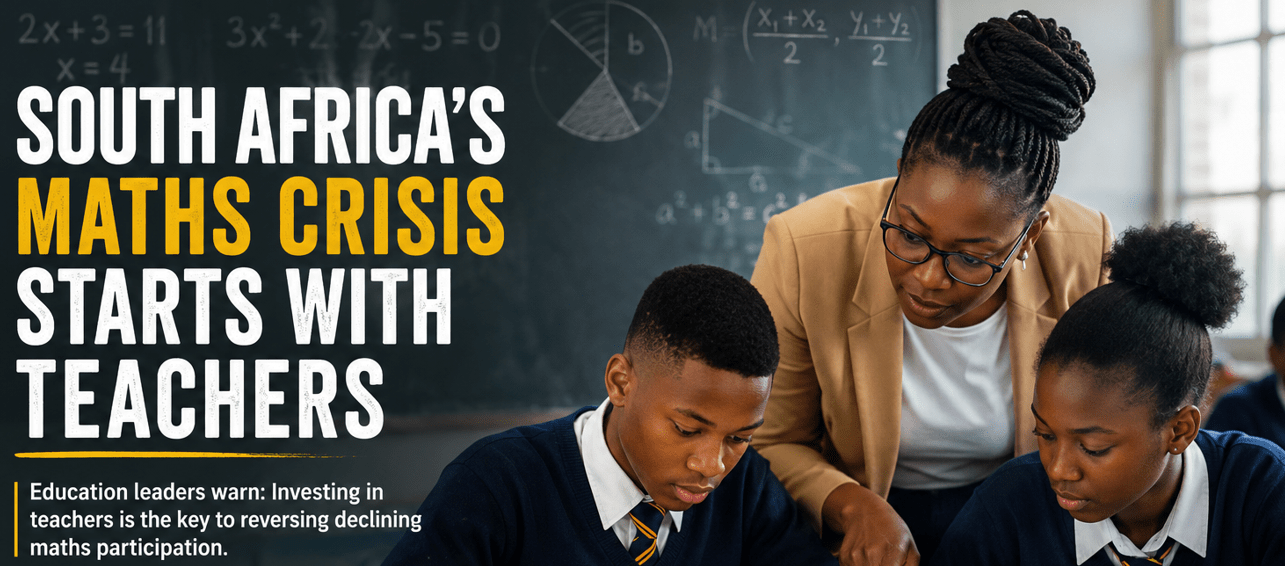
South Africa’s declining mathematics participation has become one of the country’s most pressing education challenges, raising concerns about the future workforce, economic competitiveness and the nation’s ability to thrive in an increasingly data-driven world.
While debates around curriculum reform and technology continue, education leaders believe the real solution lies elsewhere: building a stronger teaching profession.
That was the central message emerging from the latest Education Conversations webinar, hosted by Kagiso Trust in partnership with the University of Johannesburg Faculty of Education, where education specialists, school leaders and industry experts agreed that meaningful improvement begins with teacher professionalisation.
Why Teacher Development Matters More Than Ever
Only one in three matric candidates wrote mathematics in 2025, highlighting a worrying decline in learner participation that experts say threatens South Africa’s future skills pipeline and long-term economic growth.
According to the webinar panellists, South Africa cannot become a mathematically capable nation without first developing confident, highly skilled mathematics teachers.
One of the challenges, they noted, is that many educators enter the profession by circumstance rather than passion, often choosing teaching for job security despite lacking confidence in mathematics themselves. This creates a cycle where teachers struggle to inspire learners or build lasting confidence in the subject.
Nicolas Mmako, who leads Investec’s Corporate Social Investments in mathematics and science education, believes this challenge starts within the education system itself.
“When teachers have been produced by a system which failed to help them realise their ultimate potential, they cannot be expected to unleash the maximum potential of a learner.”
Mentorship Is the Missing Ingredient
Teacher development, panellists agreed, should extend far beyond occasional workshops.
Instead, they advocated for continuous professional development through:
- Intensive mentorship
- Collaborative lesson planning
- Ongoing classroom support
- Shared problem-solving strategies
- Professional learning communities
Samson Hove, a mathematics mentor at Kagiso Trust, said sustained mentorship enables teachers to continuously improve both their confidence and classroom practice.
Trudy Shongwe, a Head of Department at a Johannesburg school, added that collaborative planning between teachers helps tackle difficult mathematical concepts while creating consistency in assessments across different grades.
There Are No Quick Fixes
While technology, digital learning platforms and curriculum improvements all have an important role to play, speakers stressed that none of these initiatives can replace confident, well-supported teachers.
Mmako cautioned against expecting immediate results.
“We have to be in it for the long haul. This is a whole system challenge that requires very intentional, long-term collaboration—not a microwave approach.”
The discussion highlighted successful examples already making a difference across South Africa, including mentorship programmes, innovative digital learning platforms and private-public partnerships.
The challenge now is scaling these proven interventions nationally.
Changing How Learners Think About Mathematics
Beyond improving teaching quality, the panel also called for a complete shift in how mathematics is perceived.
Educational content creator Mlungisi Nkosi, whose mathematics lessons reach hundreds of thousands of learners online, challenged the belief that maths is simply “a difficult subject.”
Instead, he described mathematics as a tool for building resilience through what he called productive struggle.
“Mathematics does not only open doors to opportunity. Through productive struggle, it builds the discipline and resilience needed to solve problems whose answers do not yet exist.”
Rather than fearing mistakes, learners should be encouraged to see challenges as opportunities to grow, experiment and develop problem-solving skills that extend well beyond the classroom.
Making Mathematics Relevant
Panellists also argued that mathematics teaching needs to become more closely connected to learners’ everyday experiences.
Ernest Phahlamohlaka, who teaches Grade 11 and Grade 12 mathematics in Limpopo, believes abstract teaching methods often discourage learners.
Instead, real-world examples can demonstrate how mathematics influences careers, technology, business and daily life, helping reduce the stigma that surrounds the subject.
Why Mathematics Matters in an AI Economy
As artificial intelligence reshapes industries around the world, mathematics is becoming increasingly valuable rather than less important.
The webinar warned that countries failing to build mathematically literate workforces risk falling behind in an economy driven by data, automation and technological innovation.
Mmako emphasised that AI strengthens—not weakens—the case for mathematics education.
Without mathematical understanding, future workers risk becoming passive users of technology rather than active innovators capable of questioning, directing and improving AI systems.
Seven Priorities for Reversing the Mathematics Decline
The panel identified seven practical interventions needed to improve mathematics participation nationwide:
- Make teacher development a national strategic priority with dedicated funding.
- Change the national narrative around mathematics from fear to resilience.
- Build school cultures that actively value mathematics.
- Create safe learning environments where mistakes become opportunities for growth.
- Begin interventions as early as Grades 8 and 9.
- Strengthen partnerships between schools, universities and industry.
- Empower parents to encourage mathematics, regardless of their own educational background.
A National Responsibility
The webinar concluded that improving mathematics education cannot rest solely on schools.
Government, universities, business, civil society and families all have a role to play in building confidence, strengthening teaching and creating opportunities for learners.
Kagiso Trust Head of Education, Sizakele Mphatsoe, believes mathematics deserves national priority status.
“We need to embed the culture that is required for us to succeed in growing not only the subject but also the economy of the country. That is why we should look at the subject as a national priority.”
As South Africa prepares future generations for careers increasingly shaped by science, technology, engineering, artificial intelligence and innovation, investing in teachers today may prove to be one of the country’s most important long-term investments.