
By the time a child reaches Grade 4, the ability to understand a story, interpret a question and communicate an idea should be firmly established.
For too many South African children, however, those foundations remain fragile.
The numbers tell a troubling story.
The Progress in International Reading Literacy Study (PIRLS) found that 81% of South African Grade 4 learners could not read for meaning in any language in 2021. The figure was already deeply concerning in 2016, when 78% of learners faced the same challenge.
The deterioration makes one thing clear: South Africa’s reading crisis cannot be treated as a problem that suddenly appears in Grade 4.
The foundations are laid much earlier.
Literacy starts long before school
A child’s journey towards literacy begins in the earliest years of life.
It starts through conversation, stories, songs and play. It grows through vocabulary, listening and the ability to respond.
These seemingly simple experiences help children connect sounds with words, follow instructions, express their thoughts and eventually understand what they read.
That is why early childhood development is so important.
Theresa Michael, CEO of Afrika Tikkun Bambanani, believes literacy should be viewed as a foundation for learning across the entire curriculum.
“Literacy levels amongst young South Africans are troubling. There is a clear need to focus on each and every child’s reading ability.”
Michael also stresses that literacy cannot be reduced to English or the language classroom.
A child must be able to read for meaning in every subject.
That includes history.
It includes mathematics.
It includes science.
If a learner cannot understand a written question, for example, solving the problem becomes difficult even when the learner understands the mathematical concept itself.
Reading for meaning therefore affects much more than reading lessons. It influences how children engage with knowledge across the curriculum and how confidently they communicate.
Building stronger foundations before Grade 4
Afrika Tikkun Bambanani is working to strengthen these early foundations through its programmes at Early Childhood Development (ECD) centres, particularly in communities where practitioners and children have historically had limited access to quality teaching materials, training, books and developmental support.
Its approach uses a structured, play-based curriculum.
Practitioners receive daily and weekly guidance, educational resources, training, mentoring and tools to assess children’s development.
The objective is not to push formal reading onto very young children.
Instead, the focus is on creating language-rich classrooms where children can listen, speak, question, describe, sequence, imagine and make meaning.
Those skills may look simple.
They are anything but.
They form part of the foundation children need when they eventually encounter more complex texts, instructions and ideas at school.
When a library becomes a doorway
One of the initiatives supporting this work is Afrika Tikkun Bambanani’s Little Libraries programme.
For children growing up in under-resourced communities, access to age-appropriate books can be limited. Some may have few books at home or in their ECD centres.
The Little Libraries initiative aims to address that gap by introducing libraries into Bambanani’s outreach centres and creating welcoming spaces where children can encounter books, stories and new ideas.
But the initiative is about more than putting books on shelves.
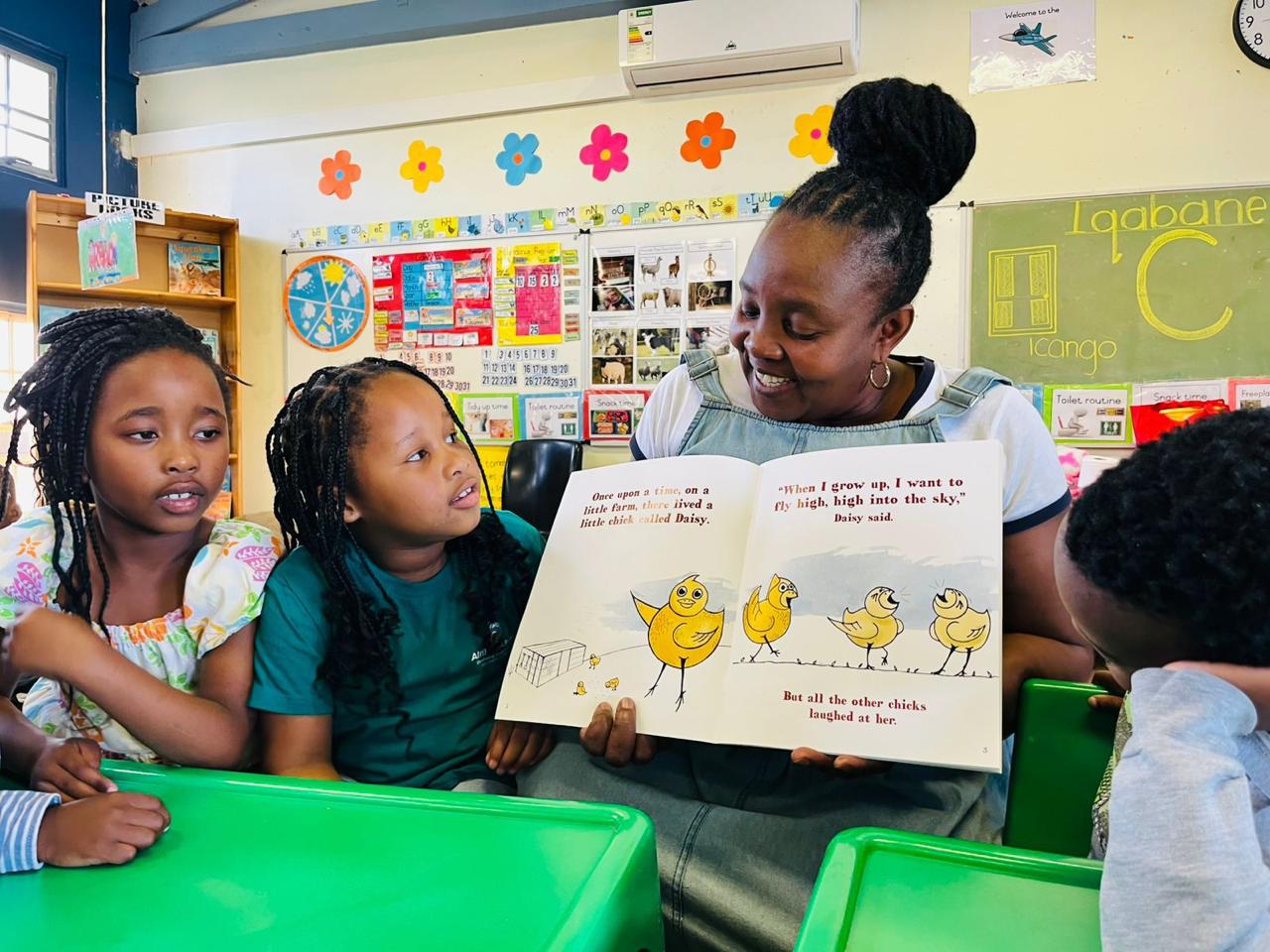
A book creates an opportunity for a practitioner to read aloud, discuss characters, explore events and introduce new vocabulary.
Children can be encouraged to predict what happens next.
They can explore pictures.
They can ask questions.
They can listen.
And, through repeated exposure to stories, they begin to understand how spoken and written language connect.
This can help nurture the curiosity and imagination that support later reading comprehension.
For a child who does not regularly encounter books at home, simply having the opportunity to choose a story, explore its pictures and listen to someone read can make books feel familiar and enjoyable.
The wider aim is to give children in Bambanani’s outreach centres access to the same world of stories, knowledge and imagination available to their more privileged peers.
Literacy goes digital too
The literacy offering extends beyond physical books.
The BambaLearn application includes audio and visual storybooks, as well as activities focused on literacy, letter recognition, problem-solving and active listening.
This gives children opportunities to engage with stories while developing early literacy skills through both traditional books and accessible digital learning.
The combination reflects a broader approach to early learning: children can encounter language through different formats while practitioners continue to guide their development.
Finding challenges before they become barriers
Assessment is another important part of the programme.
Children are assessed throughout the year against age-appropriate developmental milestones. Screening tools can also help practitioners identify children who may require additional support.
Teacher development is monitored too.
That matters because meaningful improvement in children’s learning depends on practitioners who are confident, trained and supported.
The scale of the work is substantial.
According to Afrika Tikkun Bambanani, its programmes have reached 755 centres, 5,189 practitioners and teachers, and 65,830 children.
Its Assessment Centre currently tracks the progression of approximately 3,200 learners.
The purpose is to help educators identify difficulties early rather than allowing children to move through the education system without the support they need.
The numbers behind school readiness
There are also encouraging signs.
In reporting on its partnership with Afrika Tikkun Bambanani, Capitec highlighted a 99.2% school-readiness rate.
The figure represents children entering formal schooling with stronger developmental foundations and a better chance of engaging meaningfully with classroom learning.
Behind such statistics, however, are educators working directly with children every day.
At Tiny Tots Daycare Centre in Kensington, principal Nasimah says the Afrika Tikkun Bambanani curriculum helps educators support children in reaching developmental milestones and developing skills for the future.
Gabrielle, who teaches the centre’s four-to-five-year-old group, also describes the difference the programme has made to her teaching.
Training and mentoring are complemented by printed manuals, workbooks, themed posters and assessment tools.
Together, these resources help her understand where individual children are in their development and identify areas where additional support may be needed.
The power of an informed practitioner
This is where early intervention becomes more than a collection of books or educational materials.
When a practitioner can recognise why a child is struggling, choose an appropriate story or activity, adapt the teaching approach and monitor progress, the classroom becomes more responsive.
A challenge can be identified earlier.
A child who might otherwise fall behind can receive additional support.
And a learner who may previously have remained quiet can be given more opportunities to participate.
The goal is not simply to prepare children to read words.
It is to help prepare them to understand.
A national crisis needs an early response
South Africa’s literacy crisis will not be solved by one programme or a once-off campaign.
It requires sustained investment in the adults who guide children during their earliest and most formative years.
It requires access to books.
It requires meaningful conversations.
It requires stories.
And it requires an understanding that literacy is much more than pronouncing words on a page.
Literacy means being able to understand, connect ideas, ask questions and communicate.
That is why the Grade 4 statistic should not only make us look at Grade 4.
It should make us look much earlier.
The story starts before the textbook
If South Africa wants children to read for meaning in Grade 4, the work must begin well before Grade 4.
It begins when a young child is invited into a story.
It begins when a child is encouraged to speak.
It begins when someone listens carefully to what that child has to say.
And it begins when a practitioner has the knowledge, training and resources to respond.
The reading crisis may become visible in the classroom.
But its foundations are built much earlier.
By investing in those early moments and placing books within children’s reach, South Africa can do more than help children learn to read.
It can help them understand the world around them.
And, ultimately, give them greater confidence to find their place within it.