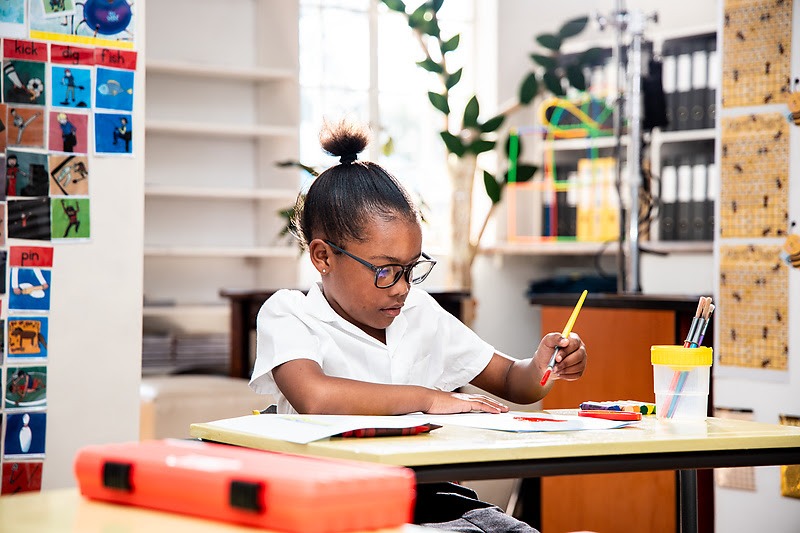
Imagine sitting in a classroom, looking towards the board, and struggling to see what the teacher has written. You cannot read the words in your textbook clearly. You lose track of the lesson. Your teacher may think you are distracted, but the real problem is that you cannot see properly.
For thousands of South African children, this could be a barrier to learning that goes unnoticed.
As South Africa marks Eye Care Awareness Month, a new policy brief is raising concern about the country’s approach to children’s eye health. Published by Change Ideas and Hold My Hand, the brief estimates that 1.3 million South African learners have eye-health problems, with at least 130,000 needing spectacles now.
Yet fewer than three in every 100 learners are screened for vision problems each year.
The brief, titled Seeing to Learn: Scaling Eye Health and Vision Screening for Young Children, calls for a coordinated national approach to identify vision problems early and ensure children receive the care they need.
Its message is clear: identifying a problem is only the beginning. Children must also receive the treatment and spectacles that can help them participate fully in the classroom.
When Poor Vision Becomes a Barrier to Learning
Vision problems can be difficult to identify in young children.
A child who cannot see the board or read a textbook clearly may not realise that their vision differs from that of their classmates. Instead, adults may interpret their behaviour as a lack of concentration or interest.
This can affect a child’s classroom experience before anyone recognises the underlying problem.
The policy brief describes vision difficulties as one of the most common, yet overlooked, barriers to learning in South Africa.
The scale of the challenge is significant. At current screening rates, reaching every learner even once would take decades.
This falls far short of the Integrated School Health Policy (ISHP), which requires children to receive screening three times during their school careers.
Even when a child is screened and referred for care, another challenge remains: ensuring that the referral leads to treatment.
A 2011 study in KwaZulu-Natal, published by Mahraj and colleagues in African Vision and Eye Health, found that 81% of children who needed spectacles never received them.
The finding highlights a critical gap between identifying a vision problem and ensuring that a child receives the support they need.
A System That Needs to Work Together
South Africa’s challenge is not simply a lack of screening. Access to eye-care professionals also plays a significant role.
According to the policy brief, 96% of South Africa’s optometrists work in the private sector. Many are concentrated in Gauteng and the Western Cape, leaving rural and lower-income communities with limited access to diagnostic services.
For families in these areas, getting a child assessed and treated can be difficult.
Hold My Hand’s Strategy Lead, Dr Noxolo Gqada, believes the country needs stronger coordination between existing services and organisations.
“This isn’t a policy failure. It’s a coordination failure,” says Dr Gqada.
She argues that South Africa already has policy frameworks, service delivery platforms and cross-sector partnerships in many areas. The missing link is bringing these elements together into a system that consistently reaches children.
That means connecting schools, healthcare services, government departments, non-profit organisations and private eye-care providers.
Without that coordination, children may be screened but never receive the care they need.
Why Grade R Could Change the Picture
The policy brief identifies Grade R as a crucial opportunity to strengthen early detection.
With Grade R now compulsory, it offers a point at which South Africa can reach almost every child as they enter the formal education system.
The brief recommends making vision and hearing screening a standard part of Grade R entry.
Early screening could help identify children who need further assessment before undetected difficulties have more time to affect their learning.
However, screening cannot rely on optometrists alone. The brief proposes a task-sharing model in which trained, designated screeners conduct routine checks in schools and Early Childhood Development (ECD) centres.
Optometrists could then focus their specialist skills on diagnosis and treatment.
This approach would help make better use of limited professional capacity while extending screening into communities that currently have less access to services.
Dr Gqada emphasises the importance of reaching children early.
“Grade R is not the only point to screen children, but it is the one moment South Africa can reach almost every child at the same time, before poor vision has a chance to hold them back,” she says.
“The task now is to make sure every child gets it, not just a few.”
The Cost of Making Screening Work
Expanding screening requires investment. However, the policy brief argues that screening itself is only one part of the overall cost.
Costing work commissioned for the brief estimates that the full pathway, including screening, diagnosis, intervention and follow-up, would cost approximately R235 per child.
Screening alone accounts for R62.
The remaining investment must support the next steps in the process. These include confirming a diagnosis, providing appropriate intervention and ensuring children receive the spectacles or treatment they need.
This distinction matters because a screening programme cannot deliver its full benefit if children are identified but left without care.
The proposal therefore focuses on funding the entire pathway, rather than treating screening as a standalone activity.
It also calls for a whole-of-society approach that brings public and private partners together.
What the Policy Brief Wants Government to Do
The brief calls for coordinated action by the Departments of Health and Basic Education.
Its recommendations include:
- Establishing clear joint governance for screening at national, provincial and district levels.
- Making vision and hearing screening a standard part of Grade R entry.
- Formally supporting non-governmental organisations already delivering screening services.
- Recognising and supporting designated vision screeners within a coordinated system.
- Bringing private eye-care providers into structured partnerships.
- Funding diagnosis, treatment, spectacles and follow-up alongside screening.
These measures aim to connect existing resources and strengthen the pathway from early detection to effective care.
The brief argues that South Africa does not need to start from scratch. Instead, the country can learn from programmes already operating in communities and build on what works.
A South African Programme Shows What Is Possible
There are examples of community-based initiatives already making a difference.
The Small Projects Foundation, which works in rural Eastern Cape, has screened close to 60,000 learners and dispensed more than 5,000 pairs of spectacles.
According to the policy brief, the programme combines school-based and mobile screening with trained community eye ambassadors and private optometrists who support local initiatives.
Its experience demonstrates how partnerships can help bring services closer to children who might otherwise struggle to access them.
Mita Pema-Keshaw, project manager at the Small Projects Foundation, says some learners have been overlooked when teachers interpreted their behaviour as a lack of focus or as classroom disruption.
She also highlights shortages in the wider care pathway in Buffalo City.
Pema-Keshaw reports that staff shortages at the two hospitals there have contributed to a four-year backlog for cataract surgeries. She also says there has been no qualified surgeon available for strabismic repair for the past three years.
Her comments underline a key issue: identifying a problem is not enough if the health system cannot provide the necessary treatment.
For children, the consequences can extend beyond the screening room and into their daily school experience.
Building a National Community for Eye Health
Alongside its policy recommendations, the initiative is encouraging greater collaboration across the eye-health sector.
An Eye Health and Vision Screening Community of Practice has been established as an open network for stakeholders involved in children’s eye care.
The network aims to strengthen early detection and intervention through shared learning, coordinated action and continuous improvement.
Healthcare professionals, educators, non-profit organisations and others working in eye health and vision are invited to participate.
The goal is to bring people together to develop solutions that improve access to services for children and families across South Africa.
Interested stakeholders can sign up for the Eye Health and Vision Screening Community of Practice.
The Next Step: Making Sure No Child Is Left Behind
The policy brief presents a challenge that extends beyond eye tests. South Africa needs a system that connects early identification with accessible, appropriate care.
The estimated 1.3 million learners with eye-health problems represent children whose needs may otherwise go unnoticed. At least 130,000 need spectacles now, according to the brief.
A coordinated approach could help identify these children earlier and improve their access to treatment.
Grade R provides an important opportunity to begin. Partnerships between government, schools, non-profit organisations and private eye-care providers could help turn that opportunity into a practical national response.
The question is no longer only whether children can be screened. It is whether the country can ensure that screening leads to care.
Because every child deserves the opportunity to see the board, read the page and take part in learning without an undetected vision problem standing in the way.
Read the full policy brief, Seeing to Learn: Scaling Eye Health and Vision Screening for Young Children, at Hold My Hand’s policy briefs page.
About Hold My Hand
Hold My Hand is a national communications and social mobilisation campaign supporting the National Strategy to Accelerate Action for Children (NSAAC). Its purpose is to help ensure that the rights and well-being of South Africa’s children and teenagers are prioritised.
The Hold My Hand Accelerator for Children and Teens has also been established to fast-track selected priority strategies within the NSAAC.