
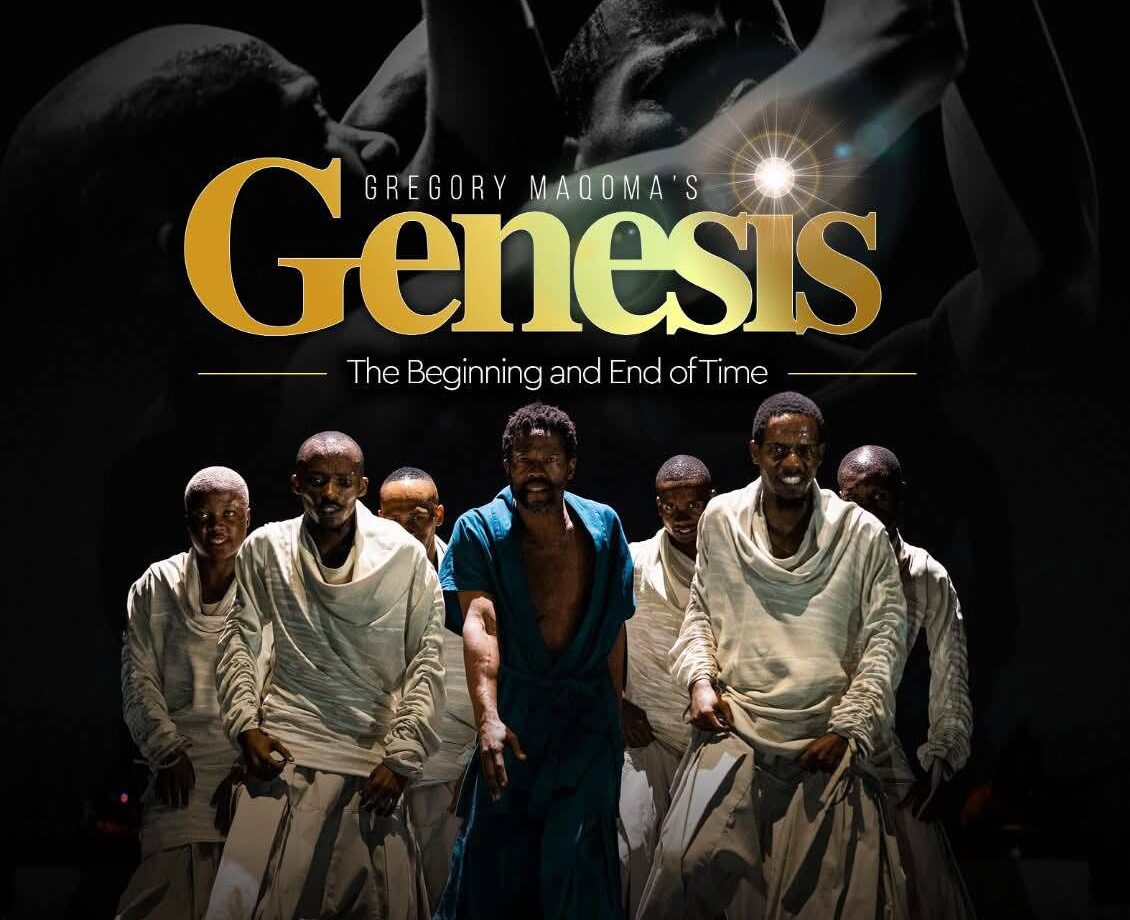
Opening with a visceral surge of sound, movement, and poetic intensity, the production grips the audience in a way that feels almost physical. There is no gentle easing in. Instead, under the masterful direction of Gregory Maqoma, the stage becomes a living, breathing force — urgent, layered, and impossible to ignore.
Presented at Joburg Theatre from 19 to 22 March 2026, this powerful dance opera stands as one of the most thought-provoking and emotionally resonant productions to grace the South African stage this year.
A Return That Redefines Beginning Again
Following the widely discussed Exit/Exist, many believed Maqoma was stepping away. Instead, Genesis reveals something far more profound — a return, not to the past, but to origin.
“Beginning again does not mean starting over unchanged,” Maqoma reflects. And this philosophy pulses through every second of the production.
This is not a story told in straight lines. It unfolds in cycles — birth, knowledge, fracture, exile, confrontation, and return — mirroring the rhythms of history and the human condition itself.
Where Time Folds and Memory Speaks
What makes Genesis so arresting is its refusal to treat time as linear. Instead, it bends, folds, and echoes — drawing from:
-
Colonial histories and their enduring shadows
-
The philosophical fire of Frantz Fanon, Aimé Césaire, and Steve Biko
-
The lived realities of displacement, resistance, and identity
Through this lens, the production becomes more than performance — it becomes witness.
The stage transforms into a site of mourning, defiance, and ultimately, renewal.
A Multidisciplinary Masterpiece
Blending dance, live music, and spoken word into a seamless whole, Genesis operates as a fully realised dance opera — a hybrid form that feels both ancient and urgently contemporary.
The creative collaboration is nothing short of extraordinary:
-
Librettist Karthika Naïr crafts language that feels like incantation rather than instruction
-
Musical direction by Nhlanhla Mahlangu anchors the work in deeply resonant soundscapes
-
Movement analysis by Shanell Winlock-Pailman ensures every gesture carries meaning
On stage, an ensemble of musicians, dancers, and vocalists deliver a performance that is both technically precise and emotionally raw — where every note, step, and silence feels intentional.
The Body as Archive, Protest and Prayer
Perhaps the most striking element of Genesis is how it uses the human body.
Here, the body is not just a tool of expression — it becomes:
-
An archive of memory and inherited trauma
-
A protest against erasure and injustice
-
A prayer for healing and transformation
Through high-octane choreography and deeply symbolic staging, the performers move between ruin and renewal, embodying the tension between past and possibility.
A Story You Don’t Just Watch — You Feel
There are no traditional characters here, only archetypes: a shepherd, a tempter, seekers, witnesses. This abstraction allows the audience to step into the work themselves.
You are not told what to think.
You are invited to feel, to reflect, to confront.
The poetic language, layered visuals, and haunting soundscape create an experience that lingers long after the final note fades.
A Standing Ovation for a Work That Matters
Co-produced by institutions including Baxter Theatre Centre and supported by the National Arts Council of South Africa, Genesis is a testament to the power of collaboration and creative courage.
From its preview at KunstFest Weimar to its premiere at the Baxter Theatre in Cape Town (18–22 February 2026), and now its impactful run in Johannesburg, the production continues to resonate across audiences and borders.
🎭 Final Reflection
Genesis: The Beginning And End Of Time is not just a performance — it is an experience of reckoning and renewal.
It asks difficult questions:
-
What do we inherit?
-
What do we carry?
-
And how do we begin again?
And in doing so, it offers something rare — not answers, but possibility.
In a world where history often repeats itself, Maqoma reminds us that transformation is still within reach.
All we have to do… is begin again.