
South Africa’s new-energy vehicle (NEV) market is no longer a niche story.
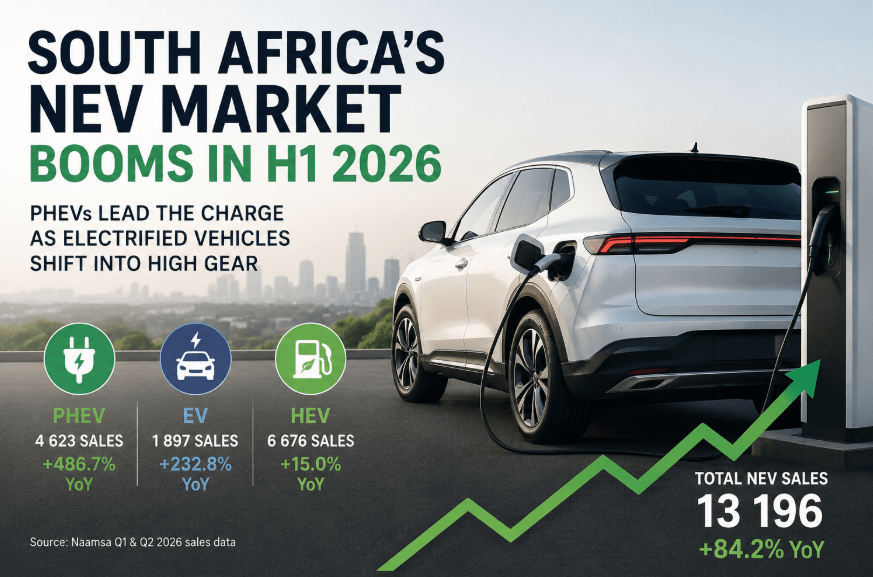
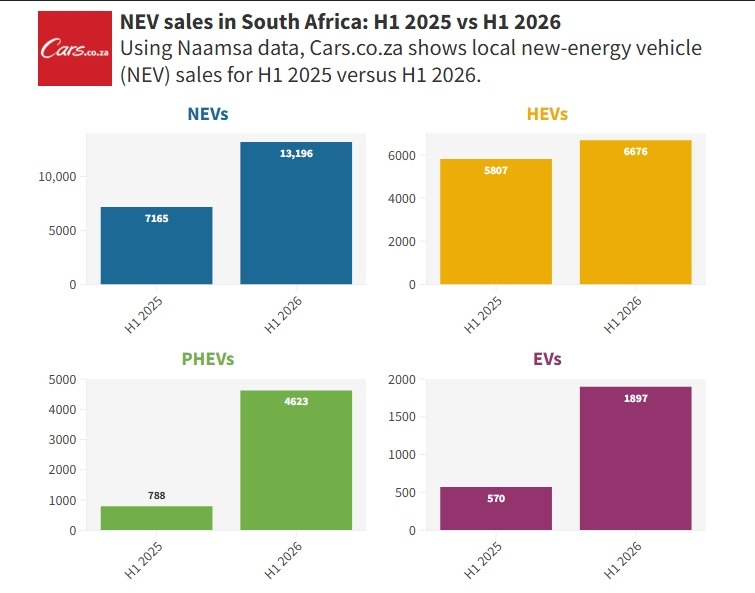
The numbers from the first half of 2026 suggest that electrified mobility is gaining serious momentum, with 13,196 NEVs sold between January and June — an 84.2% increase compared with the same period last year.
More importantly, the market is changing shape.
While traditional hybrids remain the largest part of the NEV market, plug-in hybrid electric vehicles (PHEVs) have delivered the most dramatic growth, with sales jumping by an extraordinary 486.7% year on year.
And that surge could signal a major shift in how South Africans approach the move towards electrified driving.
 PHEVs are stealing the spotlight
According to Naamsa Q1 and Q2 2026 sales data, South Africans bought 4,623 PHEVs in the first half of 2026.
That represents growth of 486.7% compared with the same period in 2025.
PHEVs now account for 35% of all NEV sales in the reporting period.
The growth comes from a relatively low base, but the pace is difficult to ignore.
Alan Quinn, Chief Product and Innovation Officer, believes the appeal lies in the flexibility that plug-in hybrids offer South African motorists.
“The fact that PHEV sales have surged by 486.7% tells us that people prefer plug-in hybrids because they can use electric power for their everyday journeys and, at the same time, depend on a combustion engine for longer trips,” says Quinn.
He adds that this flexibility supports demand while South Africa continues to build its charging infrastructure.
That combination could be particularly important in a market where charging availability remains part of the wider conversation around EV adoption.
NEVs are gaining ground across the market
PHEVs may be grabbing the headlines, but they are not the only electrified vehicles experiencing significant growth.
Fully electric vehicles also recorded a substantial increase.
EV sales climbed 232.8% year on year to 1,897 units during the first six months of 2026.
That gives fully electric vehicles a 14.4% share of total NEV sales for the period.
Traditional hybrid electric vehicles (HEVs), meanwhile, remain the biggest contributor to the NEV market.
HEV sales increased by 15% to 6,676 units.
But their dominance is beginning to change.
HEVs accounted for 81% of the NEV market last year. In the first half of 2026, that share had fallen to 50.6%.
The reason is not necessarily a collapse in demand for hybrids.
Instead, the faster growth of PHEVs and EVs is expanding the market around them.
The bigger picture is even more significant
Across all new vehicles sold in South Africa during the first half of 2026, NEVs accounted for 4.2% of the market.
The total new-vehicle market stood at 315,303 units, with NEVs contributing 13,196 of those sales.
Put another way, electrified vehicles now represent approximately one in every 17 new light vehicles sold.
For Quinn, that figure shows how quickly the market is evolving.
“The fact that NEVs now account for one in every 17 new cars sold shows that we have moved beyond the early-adopter phase and are now entering the mainstream,” he says.
That is perhaps one of the most important signals in the latest figures.
Electric mobility is no longer being driven solely by a small group of early adopters.
The market is broadening.
More brands are changing the equation
The growth is also being supported by a wider selection of vehicles entering the South African market.
Naamsa says the latest NEV sales performance was strongly supported by new entrants beginning to report new-vehicle sales data, alongside a broader range of products in the segment.
One notable development is the arrival of BYD in the industry’s reporting data.
The Chinese automotive brand began reporting its sales to the industry in March 2026 and has averaged 740 units per month since then.
That additional volume is contributing to the wider momentum behind NEVs.
It also points to an increasingly competitive market, with consumers gaining access to more electrified options.
South Africans have more electric choices
The expansion is not only visible in sales figures.
The range of available vehicles is growing too.
More than 50 different battery electric vehicle models recorded sales during the first five months of 2026.
That means consumers considering an electric vehicle are no longer looking at a market defined by only a handful of choices.
The growing variety of products, combined with increasing sales, suggests that electrification is becoming a more visible part of South Africa’s automotive landscape.
Why the PHEV surge matters
The extraordinary PHEV growth tells an interesting story about the transition to electric mobility.
A fully electric vehicle depends entirely on its battery and charging infrastructure.
A conventional hybrid does not plug in, but combines an internal combustion engine with electric assistance.
A PHEV sits somewhere between the two.
It allows drivers to use electric power for everyday journeys while retaining a combustion engine for longer trips.
According to Quinn, that flexibility is helping drive demand as South Africa continues expanding its charging network.
The result is a market where consumers do not necessarily have to choose between electric driving and the familiarity of a combustion engine.
South Africa’s electric transition is gathering momentum
The first half of 2026 has produced a clear message.
South Africa’s NEV market is growing, but perhaps more importantly, the composition of that market is changing rapidly.
HEVs remain the largest segment at 6,676 units.
But PHEVs have surged to 4,623 units, while EVs have reached 1,897.
Together, the three technologies brought total NEV sales to 13,196 units, up 84.2% year on year.
The figures do not mean South Africa has completed its transition to electric mobility.
But they do show that the market is moving.
With more manufacturers entering the space, more models becoming available and consumers increasingly exploring electrified options, the country’s NEV story is becoming harder to dismiss as a niche trend.
And if the first six months of 2026 are any indication, South Africa’s electric vehicle market may only be getting started.