
Some stories are told through words. Others live in the body, move through music and reach into the parts of ourselves that are difficult to explain. For acclaimed South African choreographer and performer Vincent Sekwati Koko Mantsoe, dance offers a way to explore all of these worlds.
Now, Mantsoe is returning to the University of Johannesburg (UJ) as its 2026 Artist in Residence for dance, bringing decades of creative practice into a new work that explores dreams, identity, spirituality and ancestral connections.
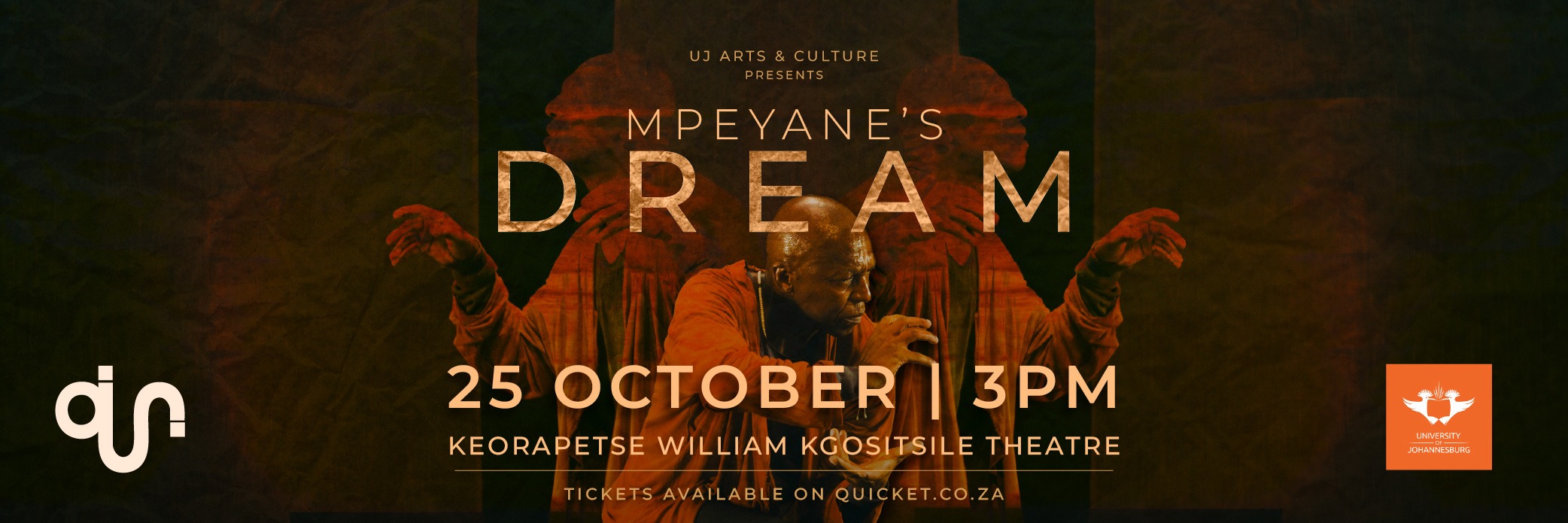
Audiences will have one opportunity to experience the first rendition of his residency creation, Mpeyane’s Dream/Ipupo, on 25 October 2026 at 15:00 at the UJ Arts Centre’s Keorapetse William Kgositsile Theatre.
The return follows Mantsoe’s premiere of Desert Poems at the UJ Arts Centre in April 2025.
A dream that reaches back to the beginning
Mpeyane’s Dream/Ipupo revisits more than three decades of Mantsoe’s creative practice. Rather than simply revisiting earlier work, the production reshapes elements of his artistic journey for both the stage and the lecture room.
At its centre is a character struggling to understand who he was. Through dreams, he begins a journey towards his ancestors, his spirits and his own path.
For Mantsoe, the work is still evolving.
“This is a development process. There is nothing concrete yet,” says Mantsoe. “I am trying to shape it like a dream, to tap into different ideas and see how they come out physically and emotionally.”
That openness is central to the residency. It gives him the space to refine, revisit and retune elements of his earlier work, allowing new ideas to emerge instead of simply repeating what has come before.
When movement, music and spirituality meet
Mantsoe is taking on more than choreography for this production. He is also composing the music and designing the set, bringing different creative elements together as the work develops.
The music draws on isiXhosa sounds and connects the character’s dream journey to the spiritual world. For Mantsoe, this connection is deeply personal.
“The music links to the spirituality, because this is who I am and where I come from,” he says. “I come from a family of Sangomas. Without that, I would just be creating for the sake of creating.”
His words point to the roots of a practice shaped by personal history and cultural experience. In this work, spirituality is not simply a theme. It forms part of the foundation from which the movement and music emerge.
Taking dance beyond the stage
The residency also has an academic purpose.
Mantsoe wants Mpeyane’s Dream/Ipupo to serve as a case study of his artistic development, giving students an opportunity to interpret his creative process and learn from it. The work extends his long-running exploration of teaching approaches derived from sangoma ritual practice.
This places the production at the intersection of performance and higher education. It offers a way to consider how movement is developed, how artistic knowledge is shared and how cultural practices can inform creative learning.
Yet bringing these traditions into a contemporary performance setting requires care.
“These are sacred movements that I am using on stage and in rehearsal,” he says. “I have to treat them with respect, understanding where they come from and what the implications are.”
For Mantsoe, that responsibility is inseparable from the work itself. The movements carry meaning beyond their physical form, and their use calls for an understanding of their origins and significance.
A performance designed to leave an impression
Mantsoe is not approaching this creation as light entertainment. He wants the experience to reach audiences on a deeper level and leave them with something to reflect on long after the performance ends.
“My work is not light. I want to penetrate and go deeper into the core,” he says. “The ancestors are talking to me in different ways, and I portray that without guilt and without reservation. It goes beyond entertainment. People have to be moved by something higher than themselves.”
It is an ambition that brings together the central threads of the residency: memory, identity, ancestry, spirituality and the evolving language of dance.
With Mpeyane’s Dream/Ipupo, Mantsoe is returning to the beginning of his journey while continuing to reshape the artistic practice he has developed over more than three decades.
For audiences, the performance offers a rare opportunity to encounter that process as it takes form on stage.
Meet Vincent Sekwati Koko Mantsoe
Born in Soweto in 1971, Vincent Sekwati Koko Mantsoe is a South African choreographer, dancer and teacher. He grew up in a family of sangomas and played drums at healing ceremonies alongside his grandmother, aunt and mother.
His dance journey began through self-directed learning, drawing inspiration from youth clubs, music videos and street dancing. In 1990, he won a scholarship to Moving Into Dance Mophatong, the pioneering multiracial dance company founded by Sylvia Glasser.
Mantsoe later served as the company’s associate artistic director from 1997 to 2001 before establishing his own company.
His distinctive Afro-fusion style brings together traditional African dance, contemporary and ballet technique, and Asian martial arts. His solo works include Gula, Mpheyane, NTU and Skwatta.
He has also created work for international companies, including Dance Theatre of Harlem, Skånes Dansteater in Sweden and ACE Dance and Music in the United Kingdom.
His achievements include first prize at the Rencontres chorégraphiques de Bagnolet in 1996 and 1998, as well as the Prix du Peuple in Montreal in 1999.
Event details: Mpeyane’s Dream/Ipupo
- Date: Sunday, 25 October 2026
- Time: 15:00
- Venue: Keorapetse William Kgositsile Theatre, UJ Arts Centre
- Tickets: R150
- Bookings: Available via Quicket
With one performance scheduled, Mpeyane’s Dream/Ipupo invites audiences into an evolving artistic world where movement becomes a way to explore identity, ancestry and the deeper forces that shape human experience.