For more than seven decades, Gucci and New York City have shared a relationship rooted in ambition, reinvention and style.
That relationship began in 1953 when Gucci opened its first store outside of Italy on Fifth Avenue — a move that helped transform the House from an Italian luxury label into a global cultural force.
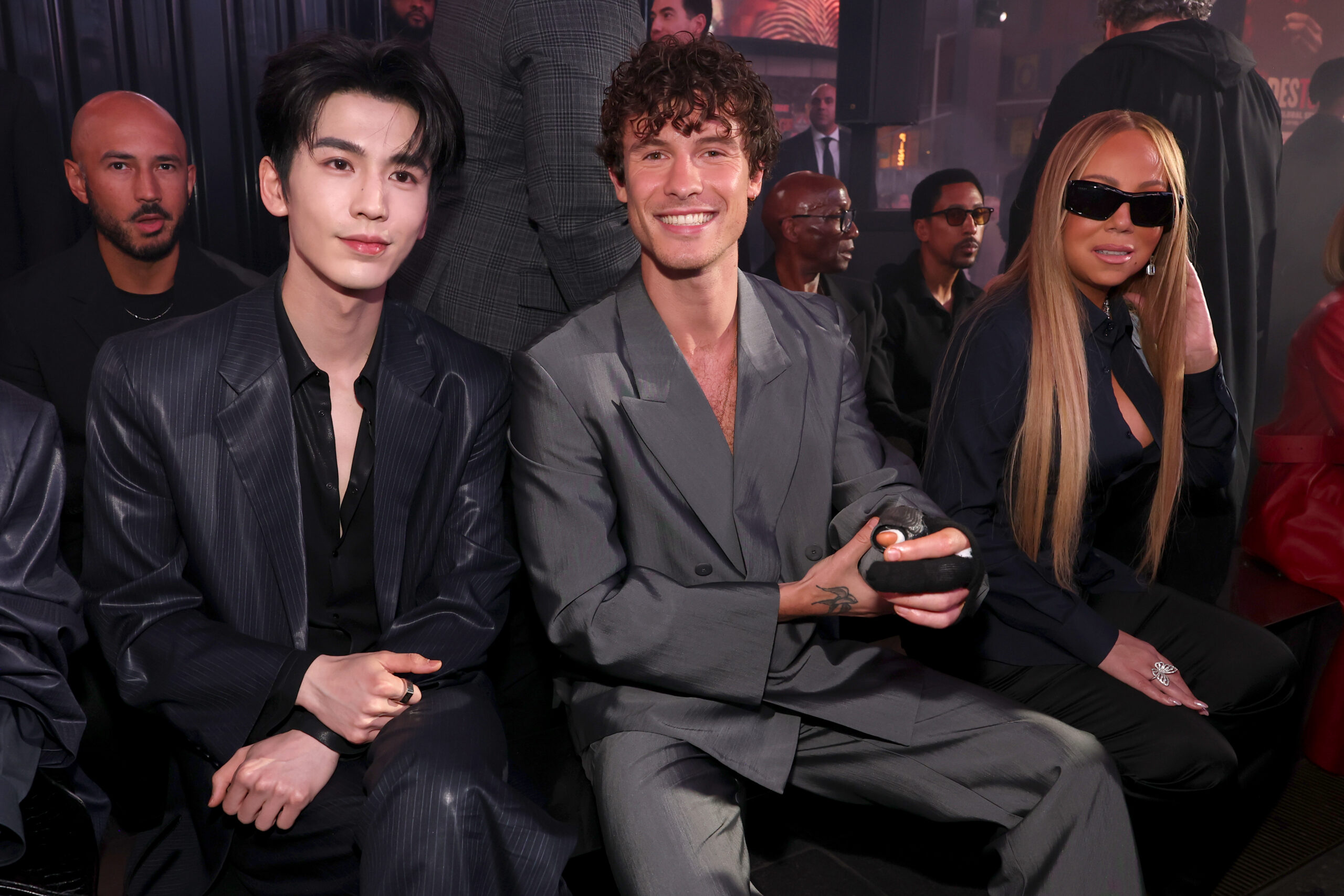
Now, under the artistic direction of Demna, Gucci has returned to the city that helped shape its international identity with GucciCore — a cinematic, city-sized fashion statement staged in the middle of Times Square.
But GucciCore is not simply another runway collection.
It is a manifesto about identity, permanence and modern luxury.
It is Gucci distilled to its essence.
A Homecoming in the Middle of Times Square
For Demna, bringing GucciCore to New York carried emotional and historical significance.
“Gucci’s love story with this city began more than seven decades ago on Fifth Avenue, so bringing this show to New York feels like a homecoming for the brand,” he explains.
That idea of “homecoming” shaped every aspect of the presentation.
In one of fashion’s boldest staging decisions in recent memory, Gucci transformed Times Square itself into the set. The district’s towering digital billboards and oversized screens became living extensions of the collection — immersing the city directly into the spectacle.
“I wanted to do the impossible and place Gucci at the centre of this metropolis by staging a show in the middle of Times Square, using its screens and billboards as the set itself,” says Demna.
The result blurred the line between fashion presentation, urban installation and cinematic performance art.
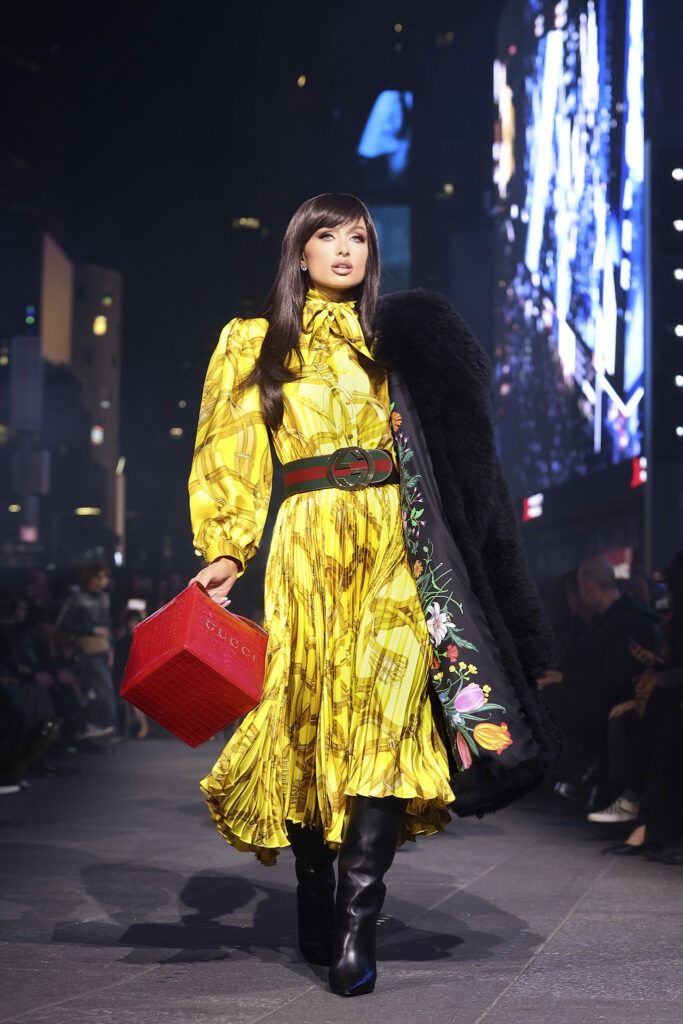 GucciCore: Building the Foundations of a Permanent Wardrobe
At the heart of GucciCore lies Demna’s evolving “character studies” approach — a creative philosophy previously explored through La Famiglia, Generation Gucci and Primavera.
GucciCore becomes the fourth act in that narrative universe, uniting those visual languages into what Demna describes as “one single, cohesive vision.”
This time, however, the focus shifts away from fleeting seasonal fashion and toward permanence.
Demna’s ambition was to create what he calls a “core wardrobe” — a permanent collection built around staple pieces that form the foundation of Gucci’s stylistic identity.
The collection includes timeless essentials elevated through Gucci craftsmanship and attitude: the perfect peacoat, the classic trench coat, sharply tailored business suits, essential shirting and the ultimate pencil skirt.
These foundational pieces are layered with unmistakable elements of Italian glamour and elegance, creating a wardrobe that feels both luxurious and deeply wearable.
Unlike trend-driven collections designed around rapid reinvention, GucciCore positions itself as an evolving permanent offering — one that will continue developing over time as the foundation of Demna’s long-term Gucci vision.
The Streets of New York Become the Runway
Perhaps the most defining element of GucciCore is its relationship with real people.
Rather than constructing fantasy personas detached from everyday life, Demna wanted the collection worn by the kinds of individuals one might genuinely encounter walking through New York’s neighbourhoods.
“To do something that felt real to New York, I wanted to show this collection on the kind of people you might pass on the street,” he explains.
The collection reflects the visual diversity of the city itself.
Stockbrokers in pinstripes stand beside downtown skaters in relaxed denim and soft tailoring. Socialites move through the collection alongside business executives, creatives and sharply dressed urban characters whose personal styling choices intersect “like the streets of the city.”
This plurality of style becomes central to GucciCore’s identity.
The collection does not attempt to define one type of Gucci person.
Instead, it embraces individuality as the core language of modern luxury.
Reinventing Gucci Signatures for a New Era
While grounded in practicality, GucciCore remains unmistakably luxurious.
Signature House codes are reinterpreted through Demna’s sharp, architectural lens.
The iconic Web stripe is transformed into a bandeau top, while the equestrian-inspired Horsebit appears as stirrup detailing on angular boots and metallic-tipped stilettos.
Elsewhere, haute couture craftsmanship merges with urban utility.
Croc-scale sequins, feather embroideries and beaded fringe elevate menswear pieces, while oversized sling totes and richly textured leather handbags arrive in deep jewel-toned finishes.
Technical outerwear lined with shearling and goat hair balances functionality with extravagance — a recurring tension throughout the collection.
The message is clear: luxury no longer exists separately from everyday life.
It lives within it.
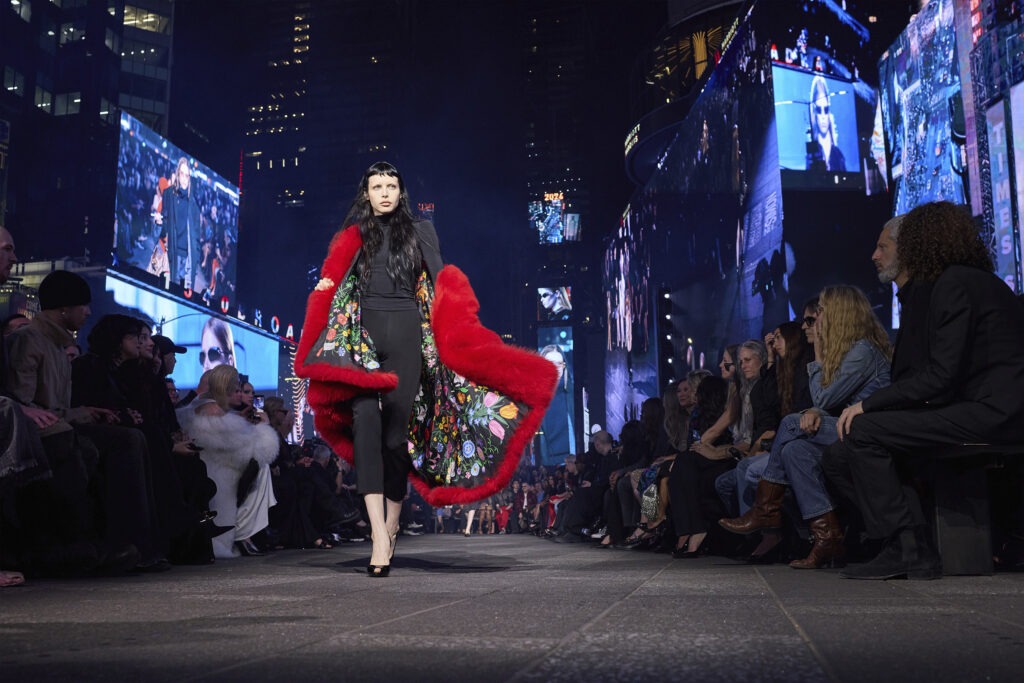 More Than Fashion — A New Gucci Language
Before the show began, Times Square’s massive screens displayed a surreal montage blending found footage with fictional Gucci advertisements for imagined lifestyle extensions including “Gucci Gym,” “Gucci Automobili,” “Gucci Viaggio,” “Gucci Pets” and “Palazzo Gucci.”
The sequence reinforced GucciCore’s broader thematic idea: Gucci as a complete visual language rather than merely a clothing brand.
It positioned the House as an ethos — one capable of shaping aesthetics, lifestyle and cultural identity simultaneously.
And through GucciCore, Demna continues pushing Gucci toward a future where luxury is not defined solely by exclusivity, but by emotional resonance, individuality and permanence.
More than 70 years after Gucci first arrived in New York, GucciCore transforms that historic relationship into something modern, cinematic and deeply human.
Not simply a collection.
A foundation.
A wardrobe.
A city.
A language.