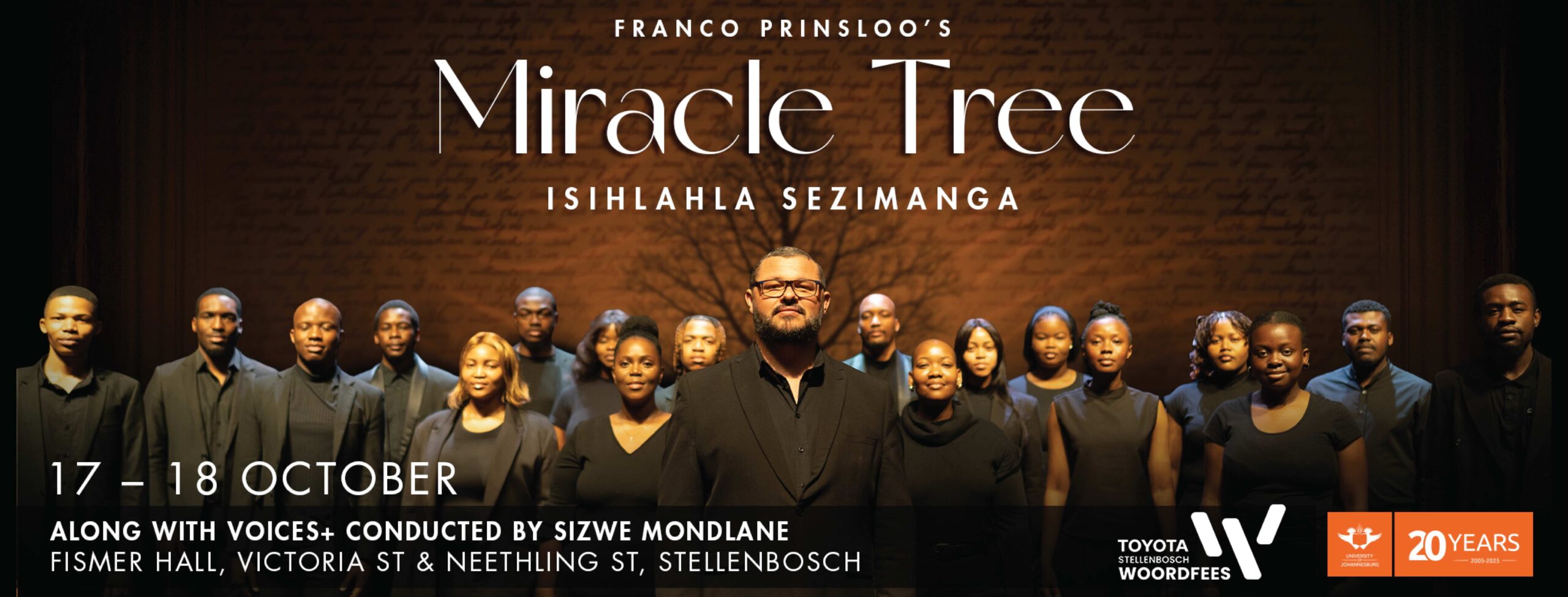

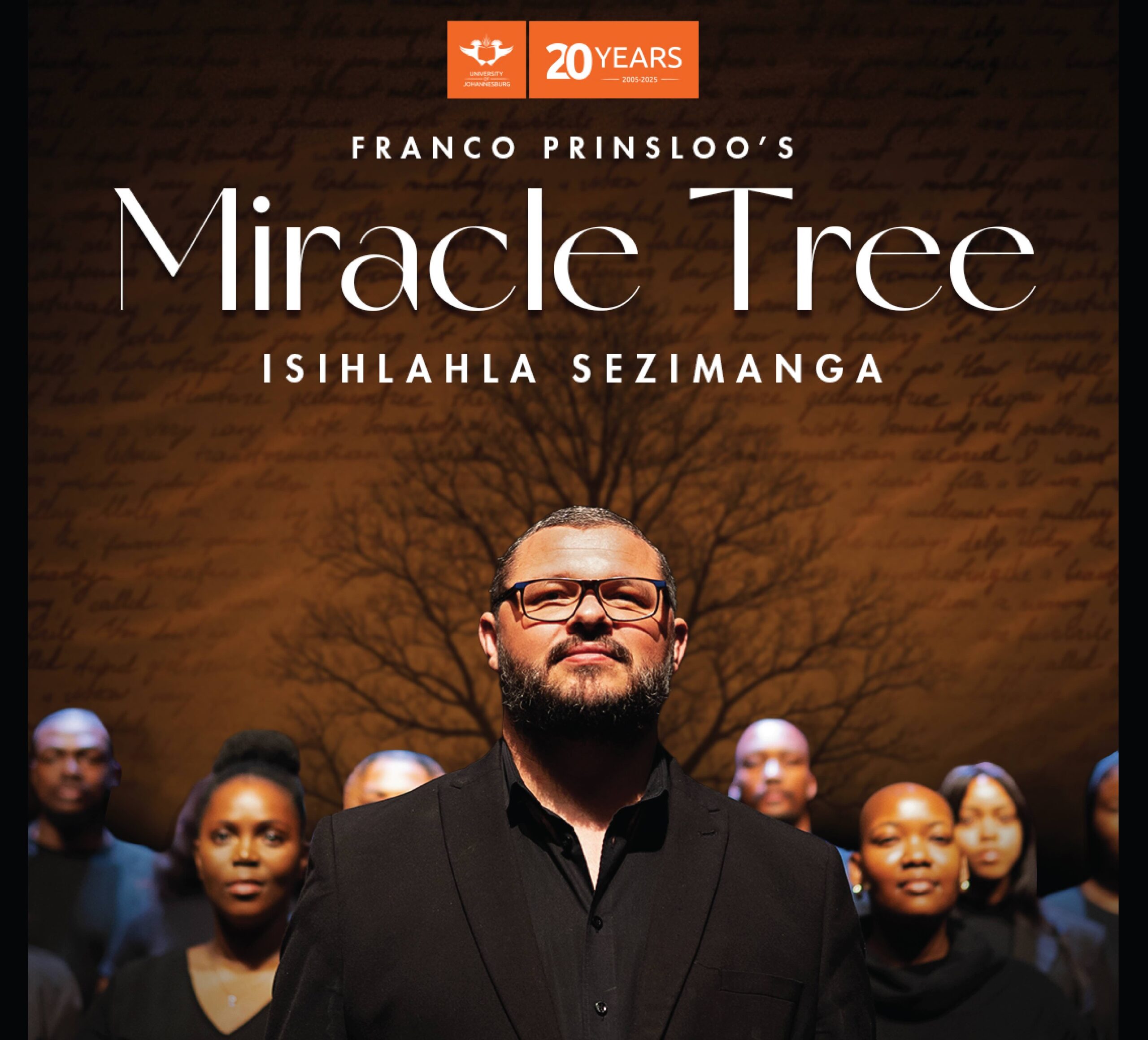
Miracle Tree: Ishilaha Sezimanga can be seen as a blueprint of what Prinsloo has always dreamed of achieving with his work. In an interview, he tells how language and music fascinated him since childhood. He grew up with music. His beloved grandmother was an organist at a local parish, and his father shared his own love for classical music with his son from an early age. Music nestled deep into his soul, making it a perfectly logical career choice.
In high school, thanks to a teacher who introduced him to the work of Breyten Breytenbach, Prinsloo fell in love with the magic of poetry, something that to this day plays a big part in his work.
Prinsloo is known for his unique, multilingual approach to choral music, and he brings this to life when composing for choirs he is involved with as conductor or composer, and also when composing commissioned works. “Choirs have the wonderful ability to bring people together regardless of culture, country, geographical origin or language,” he explains. “Especially the singers, because everyone is working towards the same end goal: to create beautiful harmony.” It inspires him to know that – as a composer – he can do even more to make singers feel at home in a choir. And so, he began to create unique, truly South African multilingual choral works.
“Through my work, I want to further illuminate the idea of collaboration and a common goal. I want the people on that stage to feel that their language is also represented, that it also counts,” Prinsloo explains. An added bonus of a multilingual production is that the singers can get to know each other – and learn about each other’s culture – through the music they perform. “The Setswana singer can help the Afrikaans singer with things like meaning and pronunciation, and vice versa. And so, a composition can become a blueprint for how people in a multilingual country like South Africa can interact with each other and work together to create harmony.”
Through his own Vox Chamber Choir and various commissioned works – he has over 800 compositions to his credit – Prinsloo has been able to hone this dream. As artist-in-residence at the University of Johannesburg, he has the opportunity this year to expand it even more by developing innovative artistic projects that focus on South Africa’s cultural and linguistic diversity.
He is using his residency to focus on how multilingual choral works can enrich choirs and help individuals to connect through their shared passion for music. “But I also want to explore what role it can play with audiences – how it can enrich, educate and expose people to the different poetic traditions of the languages of our country.”
The multilingual production Miracle Tree: Ishilaha Sezimanga not only reflects Prinsloo’s commitment to exploring the deep connections between language, music and identity, but is a lovely musical celebration of being human, of living in a country with a melting pot of languages and people from different cultural backgrounds.
Prinsloo’s musical brand is closely linked to his love of poetry. “Poetry fascinates me – it’s such a beautiful way of using language. And I use music to interpret poetry,” he explains. “Other people read it, while I sound it out, so to speak, to understand it better. That’s my process.”
Turning poems into songs is important to him for another reason. “People often find poetry inaccessible, or you might think poetry is not something you like, but when you can sing it or listen to it, you experience it on a deeper level and in a different way. Then you interact with the poetry, and it starts meaning something to you.”
The music in Miracle Tree – like all of Prinsloo’s compositions – touches your soul because of the language, and musically it has an almost sacred sound. The kind of sound that belongs in a cathedral. This makes sense when he explains that his major musical influences are the music of the Middle Ages and the subsequent Renaissance era. Gregorian chant, the sacred songs in Latin from the earliest era of the Roman Catholic church tradition, is another major inspiration.
Miracle Tree is a production in which you can hear a lot of local talent. Voices+, an ensemble of UJ Choir members, conducted by Sizwe Mondlane, takes you on a musical journey through South Africa. Heritage and hope are neatly tied together through harmony. The poetic inspiration behind it all is a poem by isiZulu poet Bongekile Mbanjwa called Ishishilha Sezimanga (Miracle Tree). The symbolism of the poem stayed with him long after he read it: how a small tree is planted, and can die or flourish, depending on what people decide to do with it. “If you nurture it, it can provide shade for an entire community. And that’s also how I see language,” Prinsloo explains.
Mbanjwa’s poem is not used in its original form in the production but forms the subtext of the production. Prinsloo’s music – which includes songs in isiZulu, Afrikaans, translations from /Xam, as well as songs in Tshivenda, seTswana and seSotho – is interwoven with poetry specially created in response to it by poet and artist Vus’umuzi Phakathi.
In addition to Phakathi’s connecting text, you can also hear a poem that Prinsloo wrote in collaboration with the poet Ingrid Hlatshwayo and then set to music (Luister na die nag) and a setting of Hlatshwayo’s Phula! Phula! The Afrikaans poet Philip de Vos’s almost playful verse Hoekom is die hemel blou? and I’ll be going soon can also be heard as songs. Antjie Krog’s translations from /Xam (Slaapliedjie, Wat die sterre sê and Lied van die korhaan) are interspersed with, among others, !Nanni’s Prayer to the young moon (translated by Jack Cope) and Bonisile Xumalo’s Zwelombe (translated into Tshivenda by Hulisani Belesi).
Text speaks to text in this production, and just how strikingly this can be done – even within different variations of one language – is illustrated by Namagowab lied van die lier, a new song specially created to celebrate Afrikaans100. Prinsloo says he wanted something that celebrated the diverse richness and evolving nature of the Afrikaans language. He then asked three poets – Veronique Jephtas, Alwyn Roux and Lynthia Julius – to each write a part of the song in his or her distinctive variety of Afrikaans. Julius’ Northern Cape or Orange River Afrikaans, Jephtas’s Afrikaaps or Cape Afrikaans, and Roux’s standard Afrikaans came together in a surprising way, providing a lyrical celebration of a growing and dynamic poetic language.
René Bohnen’s poem Walvisnota was also an important source of inspiration. It tells more about the treasures that lie locked up in a language. “It’s not always understandable to whomever hears it, but it’s there nonetheless,” he explains. “She puts it strikingly in the first lines: a dictionary is like a whale song/ there are corals hiding in the sound of the troglodyte/ It’s mystical like wild oysters that offer jewels.”
Miracle Tree leaves one deeply impressed by language. The power of language, but also the realisation that language must be preserved, something Prinsloo feels strongly about. “Language is living heritage. When you create something new in language, it must be preserved, used, things must be done with it,” he explains.
Although Afrikaans is his native language, all the languages of South Africa are important to him. “They all carry parts of our history – the stories, the nuances of our country. In fact, the different languages are our country’s greatest, most important heritage. And –just like the miracle tree that Mbanjwa writes about in her poem – the languages of the country belong to all of us. We as South Africans must interact in and through and with our languages. We must water them and help them grow so that they can provide shade for everyone in the country.”
The production also showcases the talent of select musicians such as Eugene Joubert, Magdalena de Vries, and Motshwane Pege, directed by award-winning theatre maker, Jade Bowers.
Miracle Tree forms part of the University of Johannesburg’s twentieth anniversary celebrations, celebrating two decades of excellence in higher education and community engagement. This performance highlights UJ’s ongoing commitment to creative expression, cultural preservation, and linguistic diversity.
*UJ Arts & Culture proudly presents Miracle Tree | Ishithala Sezimanga at the Toyota SU Woordfees in Stellenbosch. There are performances on 17 and 18 October.