A simple question can be uncomfortable.
“Have you had your PSA checked?”
Or perhaps:
“Have you noticed anything unusual?”
For some men, those questions may feel awkward. For their partners, mothers, sisters or daughters, they can feel necessary.
That is the message behind the latest focus of the Hollard Daredevil Run: men’s health is often a family conversation.
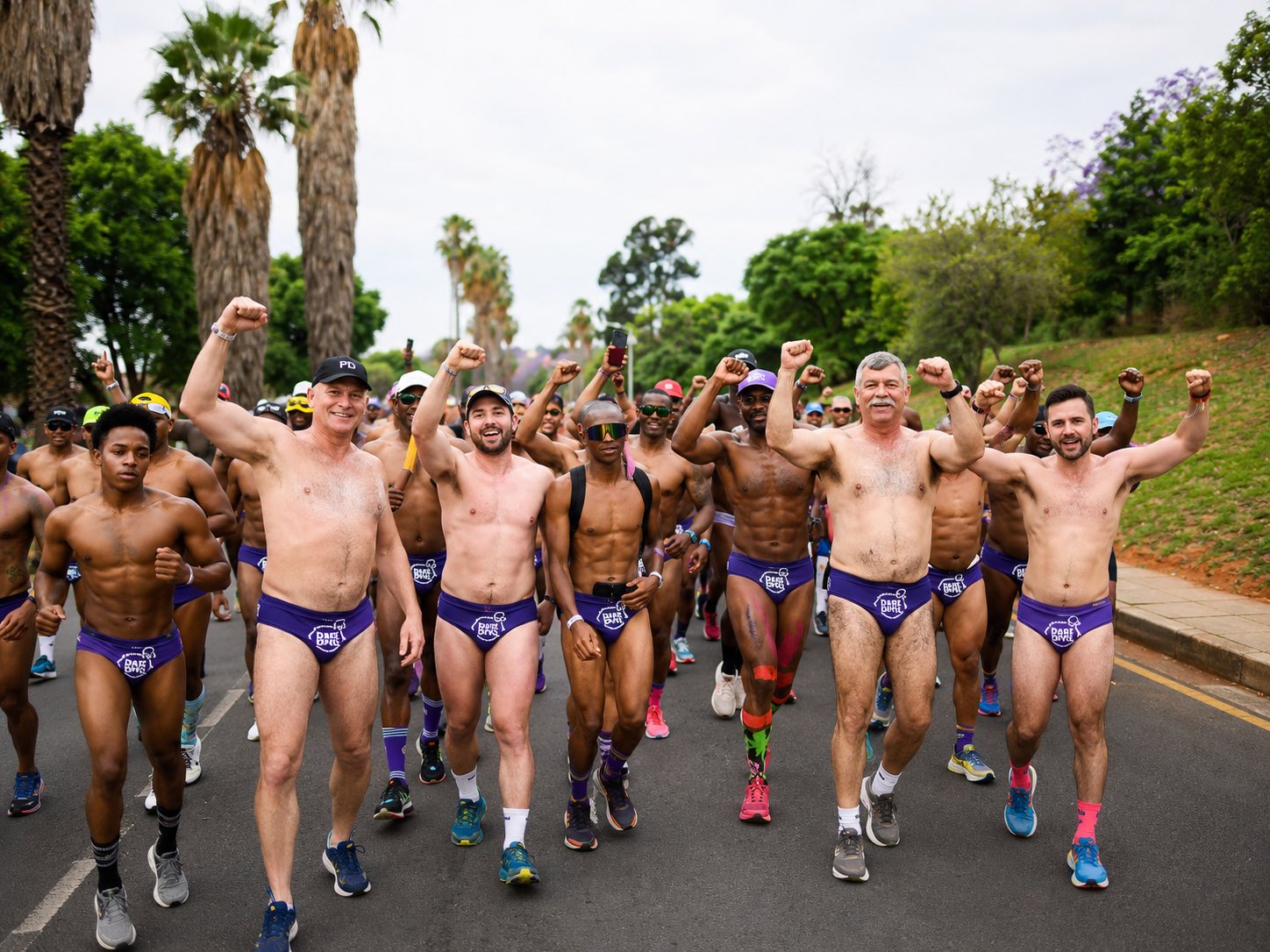
Now in its 17th year, the initiative continues to use one of South Africa’s most eye-catching spectacles — thousands of men running in purple speedos — to get people talking about prostate and testicular cancer and the importance of early detection.
But this year, the conversation extends beyond the men wearing the speedos.
It also recognises the women who often encourage the men in their lives to take their health seriously.
When asking becomes an act of care
A man’s health decisions ultimately belong to him. Yet the people closest to him can influence whether he seeks medical attention, gets screened or pays attention to something that does not feel right.
The Hollard Daredevil Run is putting that influence into the spotlight.
The campaign encourages women across South Africa to use their voices with purpose by encouraging partners, family members, friends and colleagues to learn about prostate and testicular cancers, register for the Daredevil Run and take screening seriously.
Adél Kriel, Head of Experiential Marketing at Hollard South Africa, knows the importance of these conversations personally.
As a wife and mother of two adult sons, she says caring for her family means sharing information and creating an environment where conversations about men’s health become easier.
“We can’t make their health decisions for them, but we can start conversations, ask questions and encourage them to take action,” says Kriel.
For her, that is part of what makes the Daredevil Run so powerful.
“One purple speedo can start a conversation that reaches far beyond the man wearing it,” she says.
Why the family conversation matters
A diagnosis of prostate or testicular cancer does not affect only the person diagnosed.
It can affect an entire family emotionally, practically and financially.
That makes early detection an issue that reaches far beyond the doctor’s office.
Research cited by the campaign has also highlighted the influence of partners. One study involving men with a family history of prostate cancer found that men whose partners were highly involved in their screening decisions were more than three times as likely to have undergone PSA testing compared with single men.
That finding adds weight to a simple idea: sometimes, encouragement from someone close can make the difference between putting a health check off and actually doing it.
Prostate cancer: knowing the risk matters
The statistics make the conversation even more important.
According to the information supplied by the campaign, one in four black men and one in eight white men in South Africa will develop prostate cancer during their lifetime.
Black African men also face a 60% greater risk.
Prostate cancer is described as South Africa’s top invasive cancer, making awareness and early detection particularly important.
The campaign points to PSA testing as an important screening tool.
The Prostate Cancer Foundation of South Africa advises men at higher risk — including black African men and those with a first-degree family history of prostate or breast cancer — to have an annual PSA test from age 40.
For other men, the supplied guidance recommends yearly PSA screening from age 45.
These are conversations that families can start before a doctor’s appointment.
Sometimes, it begins with simply asking whether someone has had their PSA checked.
Testicular cancer can affect younger men
Testicular cancer presents a different challenge.
Although it is less common overall, the campaign notes that it is the most frequently diagnosed cancer among young men aged 15 to 49.
Approximately one in every 250 males develops the disease during their lifetime.
Early detection is associated with excellent treatment outcomes.
The Cancer Association of South Africa encourages men and boys in this age group to check their testicles monthly for changes and to seek medical advice promptly if they notice a lump, swelling or anything unusual.
For mothers in particular, these conversations can start early.
Teaching sons what to look for and encouraging them to understand what is normal for their bodies can help make awareness part of everyday health rather than something discussed only when there is a problem.
The conversation that became a lifesaver
Marc Curlewis knows exactly how important that message can be.
When Marc felt a lump in his testicles while showering, he knew he could not ignore it.
He was approaching 30.
Long before that moment, however, his mother Olivia had already made testicular health part of the conversation.
A nurse who worked with the Cancer Association of South Africa, Olivia had repeatedly reminded Marc and his brother to check their testicles for lumps.
At the time, those reminders may have felt embarrassing or annoying.
But they gave Marc something crucial: awareness of the warning signs.
His cancer was diagnosed early, before it had spread to his lymph nodes. He underwent surgery and two rounds of chemotherapy.
Today, he is cancer-free.
Marc has since become an advocate for organisations including CANSA and encourages men to take regular screening and awareness seriously.
A conversation that could once have felt awkward ultimately helped him recognise that something was wrong.
The power of the purple speedo
This is where the Hollard Daredevil Run’s unusual visual identity becomes more than a spectacle.
Thousands of men taking to the streets in purple speedos creates an instant conversation starter.
People notice.
People ask questions.
People talk.
And those conversations can travel from the streets into homes, workplaces, friendships and families.
Over its 17 years, the Daredevil Run has helped build a community where men can stand together, challenge stigma and make conversations about men’s health more normal.
The campaign’s message now deliberately reaches the people around those men too.
Because lasting behavioural change is rarely achieved in isolation.
Men need support too
Women have long relied on networks of friends, family and communities during difficult moments in life.
The Daredevil Run argues that men need those spaces too.
A community where men can talk about health without shame can help challenge the stigma that often surrounds medical conversations.
The purple speedo becomes a symbol of that openness.
Every run, shared story and conversation has the potential to make men’s health a little less uncomfortable to discuss.
And the women who encourage those discussions have a role to play.
The message goes beyond race day
The Hollard Daredevil Run is ultimately about much more than one event.
It is about what happens before and after the run.
It is the partner asking a question.
The mother reminding her son.
The sister sharing information.
The friend encouraging another friend to get checked.
The colleague starting a conversation.
These moments may seem small, but they can have enormous consequences.
That is why the campaign is calling on South Africans to bring men’s health into everyday conversations — at home, at work, in schools, among friends and throughout communities.
A purple speedo may get attention.
But the conversation is what can make the difference.
Encourage the men in your life to learn about prostate and testicular cancer, understand their risk and seek appropriate medical advice.
Because sometimes, the question you are almost too uncomfortable to ask is the one someone desperately needs to hear.