

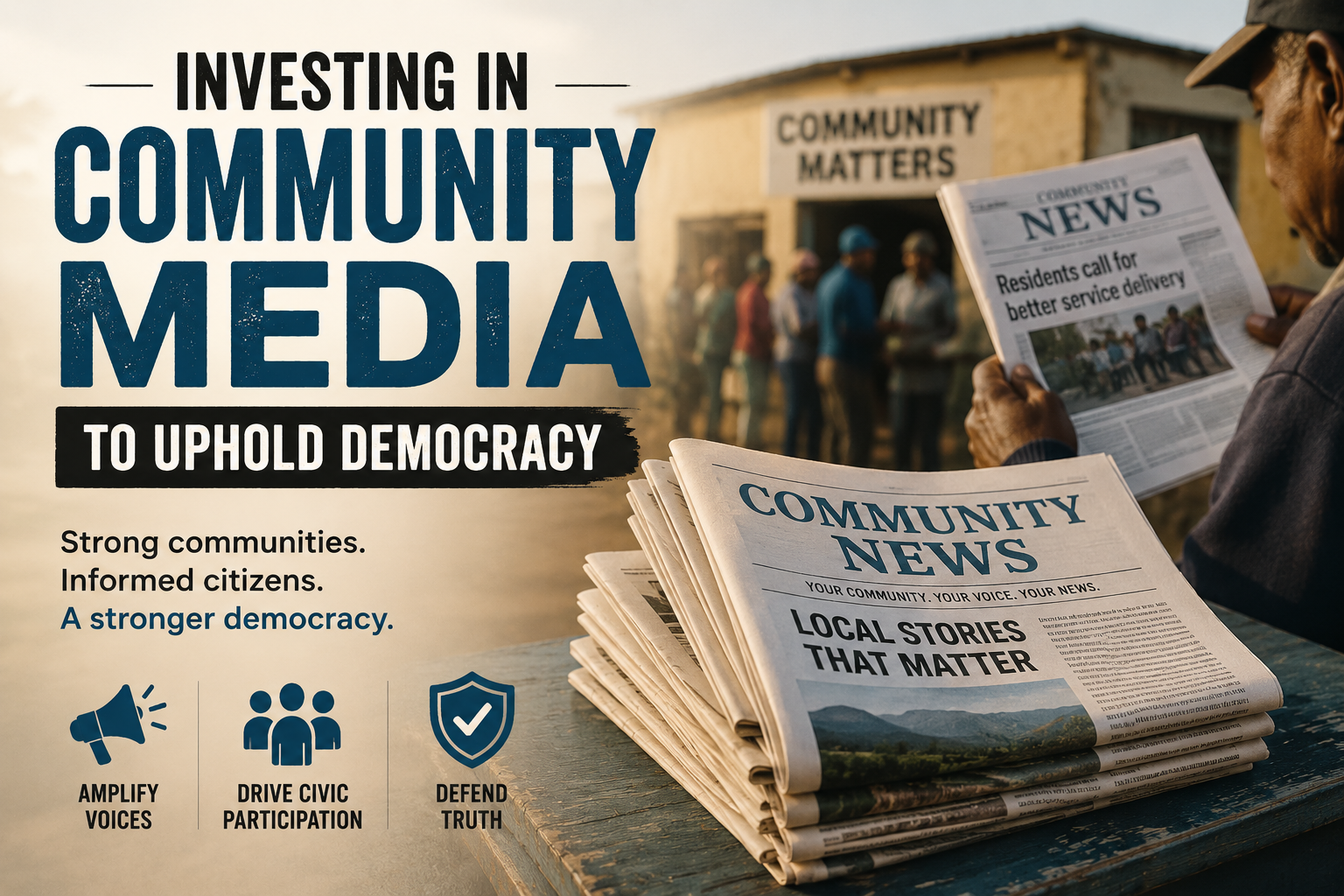
In an era where misinformation spreads faster than facts and independent journalism faces mounting financial pressure, South Africa’s community newspapers remain among the country’s most important democratic safeguards. They are the storytellers of overlooked communities, the watchdogs of local governance, and often the only trusted source of information for thousands of citizens navigating daily realities far removed from the national spotlight.
Now, as global press freedom continues to decline, there is growing recognition that protecting democracy requires more than defending journalists in principle — it requires investing in the sustainability of the platforms that keep communities informed.
According to UNESCO, global press freedom has steadily deteriorated since 2012. Yet South Africa continues to rank relatively strongly, placing 27th out of 180 countries in the World Press Freedom Index. While this reflects the country’s enduring commitment to media independence, the threat facing community media is becoming increasingly financial rather than political.
At the centre of this conversation is the urgent need for strategic social investment.
Cebisa Zondo, SI Analyst: Fund Management & Specialist Services at Tshikululu Social Investments, believes the future of community media depends on recognising its role not only as a communications platform, but as critical democratic infrastructure.
“Community media plays an important role in fostering democratic participation at a grassroots level,” says Zondo. “Strategic social investment has the power and the responsibility to protect it.”
The Financial Crisis Facing Community Media
For decades, community newspapers have documented the realities that mainstream media often overlooks. They cover municipal failures, celebrate local achievements, preserve community history, and create platforms where ordinary citizens can engage in public discourse.
Yet despite their value, many independent publications are struggling to survive.
Traditionally, these newspapers have relied heavily on advertising revenue from small local businesses. But in a constrained economic climate, many of those businesses no longer have consistent advertising budgets. At the same time, the rise of social media marketing has diverted advertising spend toward cheaper, more targeted digital platforms, leaving community publishers with shrinking revenue streams.
The result is a sector under severe pressure.
A report by the Media Development & Diversity Agency found that only 7% of respondents within the community and small commercial media sector believed their organisations were financially sustainable. Among the biggest challenges identified were declining funding support from government, donor agencies and the private sector, low revenue diversification, and limited access to non-financial support such as technical skills and digital training.
Compounding the issue is the increasing concentration of ownership within the print media industry, where commercial interests can often overshadow smaller independent voices.
More Than Newspapers — Guardians of Local Truth
The importance of community media extends far beyond headlines.
Independent newspapers preserve community heritage through archives that date back to the 1880s. They document the social, political and cultural evolution of communities over generations, serving as historical records that would otherwise disappear.
They are also increasingly vital in the fight against misinformation.
At a time when social media platforms are flooded with disinformation, community newspapers remain trusted sources of verified local news. They communicate in languages communities understand and report on issues that directly affect people’s lives — from municipal service delivery failures to healthcare access, local crime and educational challenges.
Without them, entire communities risk losing both representation and accountability.
The Cost of Going Digital
While many community publishers are attempting to digitise their operations to diversify income and reach wider audiences, the transition is expensive.
Digital transformation requires investment in equipment, cybersecurity, platform development, staff training and technical infrastructure — costs that many small publications simply cannot absorb on their own.
Importantly, digitisation is not a complete replacement for print.
In many South African communities, internet access and digital connectivity remain inconsistent or unaffordable. Print publications continue to play a critical accessibility role, particularly in rural and underserved areas.
That means sustainable support cannot focus solely on digital migration. It must also strengthen the broader operational resilience of community publishers.
Why Social Investment Matters
Despite media’s role in sustaining democracy, funding for journalism remains alarmingly limited globally.
Between 2016 and 2022, less than 1% of international donor aid was directed toward media and information initiatives. In South Africa, research by Trialogue found that only 17% of surveyed companies allocated corporate social investment funding toward social justice and advocacy, and of that amount, only 6% supported press freedom initiatives.
This creates a significant gap — one that organisations such as Tshikululu Social Investments are beginning to address through targeted programmes designed to strengthen independent journalism.
Since 2025, Tshikululu has managed the Digital News Transformation Fund (DNTF), established in partnership with the Association of Independent Publishers and funded by Google.
The initiative provides project-based funding to support the sustainability and digital transformation of independent South African news publishers.
In its first phase alone, the fund approved and distributed R10.5 million to 21 independent publishers across the country. Beyond funding, the programme also offers training in digital journalism and broader digital skills development.
The initiative is already being recognised as a practical model for how social investors can support public-interest journalism while strengthening democratic participation.
Democracy Depends on Local Voices
Community newspapers do more than report the news — they create informed citizens, amplify community concerns and strengthen civic participation.
They also support the very social development goals many investors are trying to achieve.
When communities are informed, they are better able to advocate for improved service delivery, hold institutions accountable and protect the resources invested into their development.
As Zondo argues, community media forms part of the infrastructure through which social investment itself becomes sustainable.
“If we are serious about systems-level change, it is in the interest of social investors and their beneficiaries to keep the lights on for community newspapers and support their growth.”
That support may take many forms: funding digital transformation, supporting skills development, financing operational infrastructure, or even helping newspapers own their means of production to reduce long-term costs.
What matters is recognising that independent community media is not peripheral to democracy — it is foundational to it.
As South Africa reflects on the meaning of World Press Freedom Day, one truth becomes increasingly clear: protecting democracy is not only about defending freedom of expression. It is about ensuring the institutions that carry local voices into the public sphere are able to survive, evolve and continue serving the communities that depend on them.